English


Camouflage
Camouflage is the use of coloration or patterns to conceal or disguise by blending in with the surrounding…
Reads at Grades 6–8 Listens at Grades 4–8
Print & create
Answer keys·No prep·Free with an account
28 worksheets · answer keys · full story · quiz · Ages 10-12 · CEFR B2
Plus adds 164,000+ more stories in 27 languages, audio for every one, and printables for all of them.
Just want Camouflage?

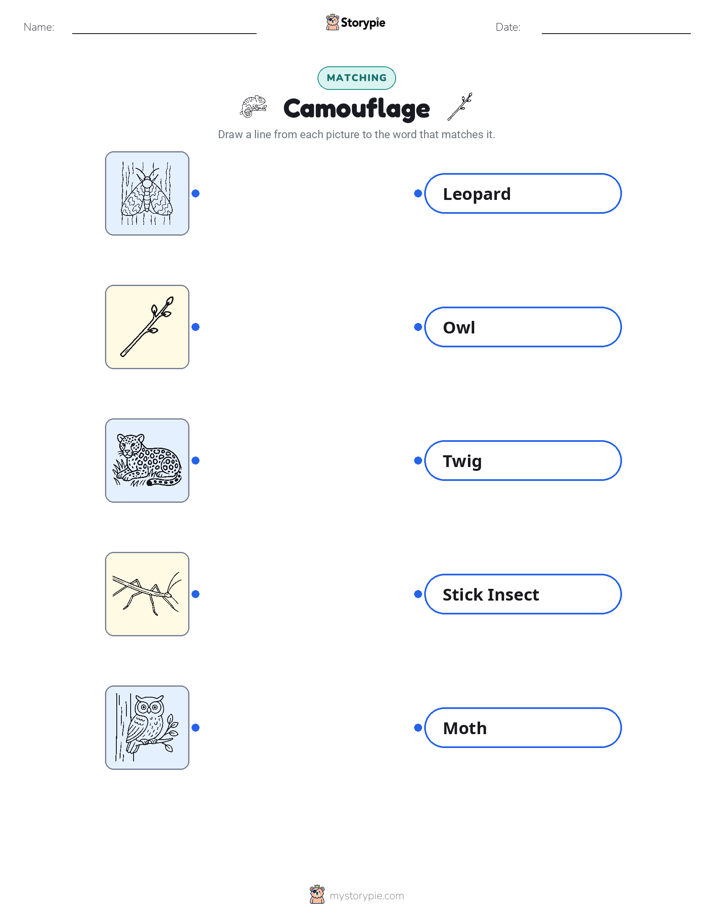
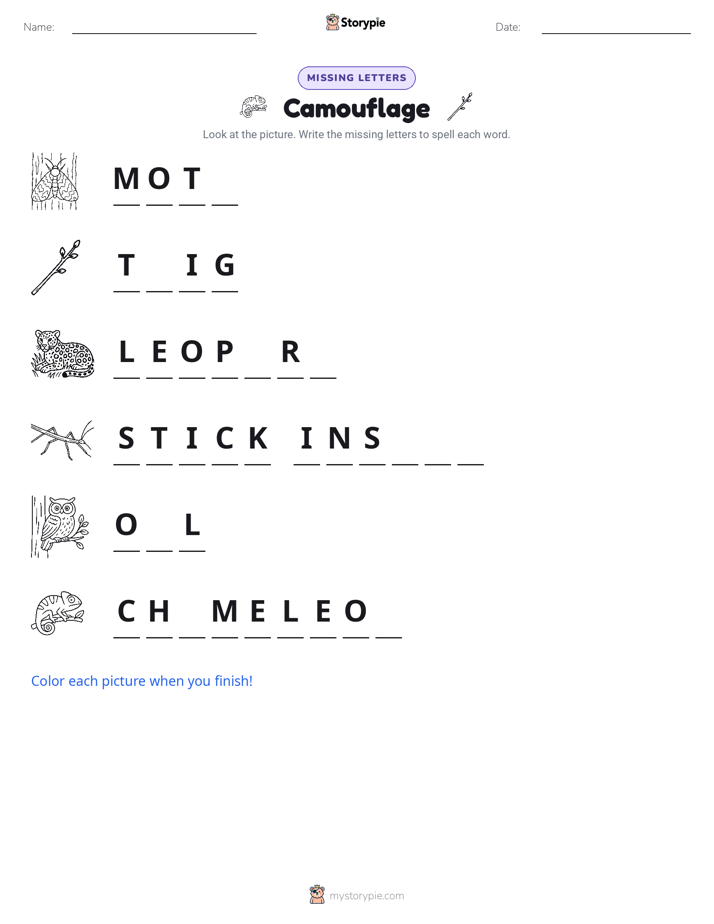
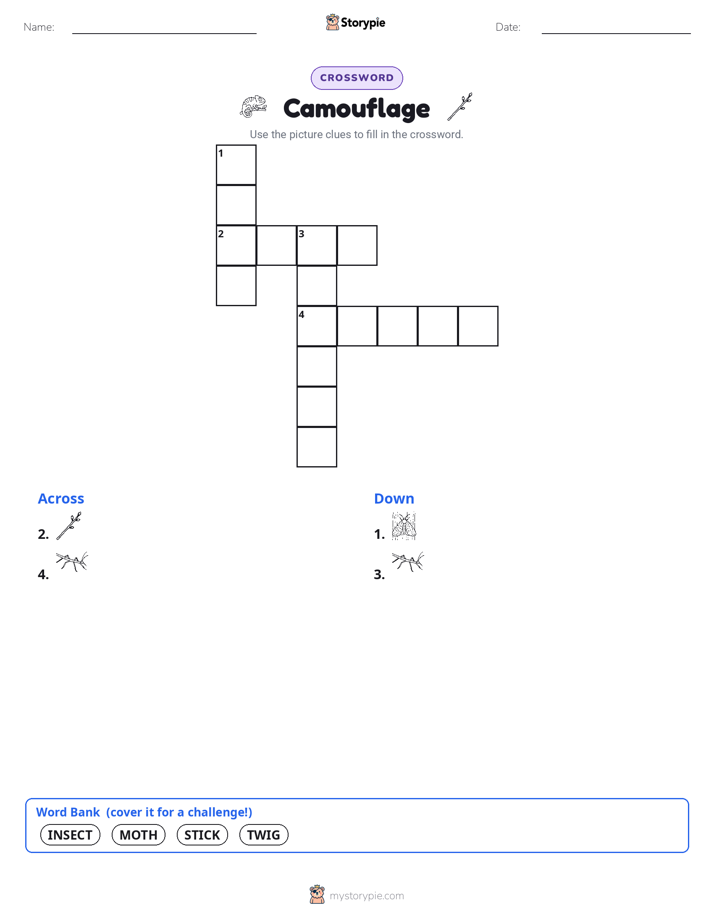
I am the whisper of a secret, the thrill in a game of hide-and-seek. Have you ever seen a moth disappear against the bark of a tree, or a stick insect look so much like a twig that you almost touched it by accident? Have you watched a leopard’s spots make it vanish into the sun-dappled grass of the savanna? That’s me at work. I am the magic trick that nature has been performing for millions of years, a silent and ancient art. I paint animals in the colors of their homes, helping them stay safe from predators or sneak up on their dinner. Before people even had a word for me, I was there, in the silent, feathered edges of an owl’s wing that muffle its flight and the slow, color-changing creep of a chameleon on a branch. I am the art of not being seen, the science of blending in. I am Camouflage.
For thousands of years, humans watched me and learned. Ancient hunters covered themselves in mud and leaves to get closer to their prey, borrowing my tricks to feed their families. But for a long time, when people formed large armies, they did the exact opposite. They dressed their soldiers in the brightest, boldest colors you can imagine—brilliant reds that shouted across the battlefield, royal blues, and shining whites. It was easy to spot a regiment from far away, a magnificent and terrifying sight. But in the 19th century, everything began to change. New inventions, like rifles that could shoot accurately from a great distance, made being a bright, obvious target incredibly dangerous. Soldiers desperately needed my help to survive. The British Army, fighting in India in the mid-19th century, was one of the first to officially borrow my ideas on a large scale. They stopped wearing their traditional red coats and started dyeing their white uniforms with tea, mud, or curry powder, creating a dusty, light-brown color they called 'khaki.' By the time of the Second Boer War, which started in 1899, these practical, earth-toned uniforms were saving countless lives by helping soldiers blend in with the dry South African landscape. It was a simple idea, borrowed from the dusty ground itself, but it changed military strategy forever.
The Art of Not Being Seen
I am the whisper of a secret, the thrill in a game of hide-and-seek. Have you ever seen a moth disappear against the bark of a tree, or a stick insect look so much like a twig that you almost touched it by accident? Have you watched a leopard’s spots make it vanish into the sun-dappled grass of the savanna? That’s me at work. I am the magic trick that nature has been performing for millions of years, a silent and ancient art. I paint animals in the colors of their homes, helping them stay safe from predators or sneak up on their dinner. Before people even had a word for me, I was there, in the silent, feathered edges of an owl’s wing that muffle its flight and the slow, color-changing creep of a chameleon on a branch. I am the art of not being seen, the science of blending in. I am Camouflage.
For thousands of years, humans watched me and learned. Ancient hunters covered themselves in mud and leaves to get closer to their prey, borrowing my tricks to feed their families. But for a long time, when people formed large armies, they did the exact opposite. They dressed their soldiers in the brightest, boldest colors you can imagine—brilliant reds that shouted across the battlefield, royal blues, and shining whites. It was easy to spot a regiment from far away, a magnificent and terrifying sight. But in the 19th century, everything began to change. New inventions, like rifles that could shoot accurately from a great distance, made being a bright, obvious target incredibly dangerous. Soldiers desperately needed my help to survive. The British Army, fighting in India in the mid-19th century, was one of the first to officially borrow my ideas on a large scale. They stopped wearing their traditional red coats and started dyeing their white uniforms with tea, mud, or curry powder, creating a dusty, light-brown color they called 'khaki.' By the time of the Second Boer War, which started in 1899, these practical, earth-toned uniforms were saving countless lives by helping soldiers blend in with the dry South African landscape. It was a simple idea, borrowed from the dusty ground itself, but it changed military strategy forever.
My big debut on the world stage, however, happened during World War I. This was a new kind of war, and a single color wasn't enough to hide giant cannons, supply trucks, and massive ships from enemy observers in airplanes. So, in 1915, the French army did something brilliant: they hired artists. Painters, stage designers, and sculptors formed a special unit called the 'Section de Camouflage.' Led by artists like Lucien-Victor Guirand de Scévola, they used the wild, blocky ideas from a new art style called Cubism to break up the familiar shapes of military equipment. They painted jagged, confusing patterns of contrasting colors that tricked the eye and made a cannon look like a meaningless jumble of shadows and light from a distance. My most mind-bending trick was developed for ships. A British marine artist named Norman Wilkinson realized you couldn't actually hide a giant ship in the middle of the empty ocean. So instead of trying, around 1917 he invented 'Dazzle' camouflage. He covered Allied ships in bold, zebra-like stripes and clashing geometric shapes. The goal wasn't to hide the ship, but to confuse enemy submarine commanders about its size, speed, and which direction it was heading, making it nearly impossible to aim a torpedo accurately. I wasn't just hiding things anymore; I was an illusionist, playing tricks on the human mind.
After the world wars, I became a standard and essential part of every soldier's uniform. Military designers created special patterns for every possible environment—dappled greens and browns for the jungle, muted tans and grays for the desert, and stark whites for the snow. My evolution continued right into the digital age. In 2002, the United States Marine Corps introduced a pixelated pattern called MARPAT. It used tiny squares of color, like the pixels on a computer screen, to mimic the textures of nature even more effectively at both close and long ranges. But my story didn't end on the battlefield. I escaped the world of soldiers and found my way into your world. You can find my patterns on skateboards, backpacks, jackets, and even on the runways of high fashion. I became a way for people to express themselves, a symbol of both toughness and style. From an ancient survival trick used by insects to a life-saving tool for soldiers, and now a pattern on your favorite hoodie, I am proof that the most brilliant ideas often come from paying close attention to the world around you. I remind you that sometimes, the most powerful thing you can do is blend in, observe, and appreciate the hidden beauty all around you.
Wow facts
About
Camouflage is the use of coloration or patterns to conceal or disguise by blending in with the surrounding environment, a technique used by both animals in nature and humans, especially in military contexts.
Take a Quiz
Question 1 of 5
What was the primary problem Norman Wilkinson was trying to solve with 'Dazzle' camouflage for ships during World War I?
Explore next






Want to do even more?
Go beyond exploring. Unlock tools that turn every story into real learning.

Storypie Plus for families
Full stories, quizzes, and printables. Nights and car rides, sorted.
- Unlimited audio stories
- Create Mode: your child stars in the story
- Offline downloads
- Printable worksheets & coloring pages

Why Storypie for Schools
Students engaged. Prep in seconds. Evenings back to you.
- Worksheets & Quizzes
- Classroom Management
- Formative Assessment
- Custom Curriculum & Lesson Plans
- 27 Languages

Why Storypie for Homeschool
Curriculum done. They'll ask for more. Hours back in your day.
- Worksheet Generator
- First-Person Audio Stories
- Built-in Comprehension Quizzes
- Custom Curriculum & Lesson Plans
- Print & Go Activities