English

Chess
Chess is a two-player strategy board game played on a checkered board with 64 squares arranged in an 8x8 grid.
Reads at Grades 6–8 Listens at Grades 4–8
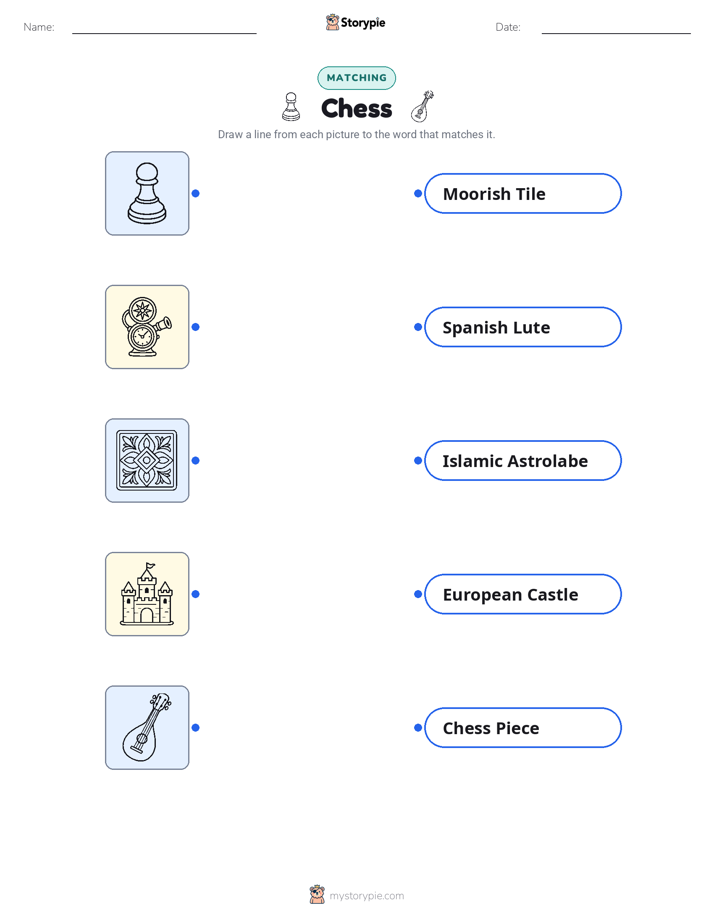
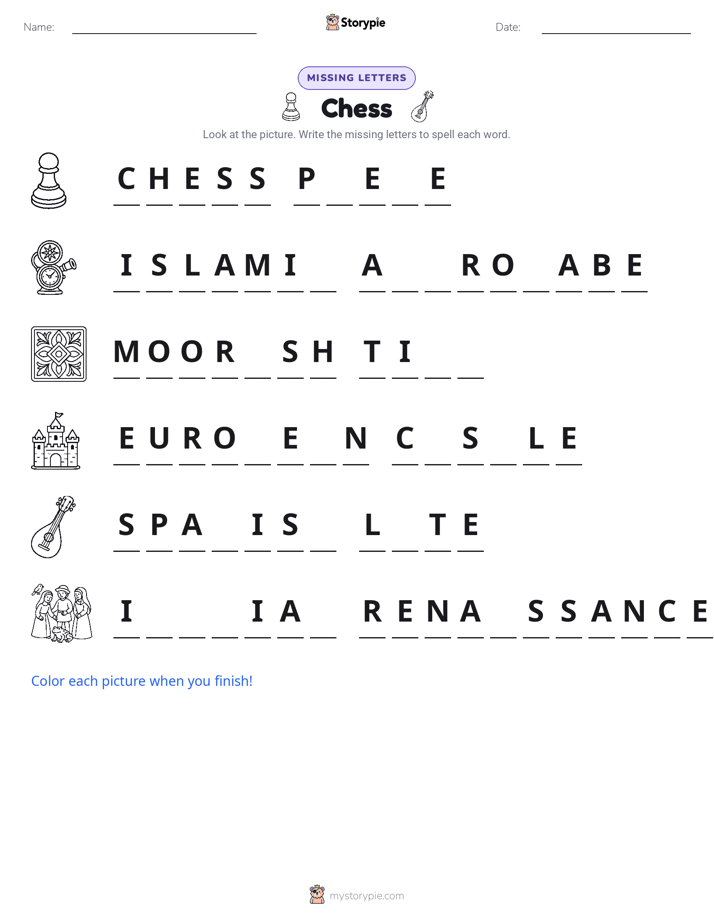
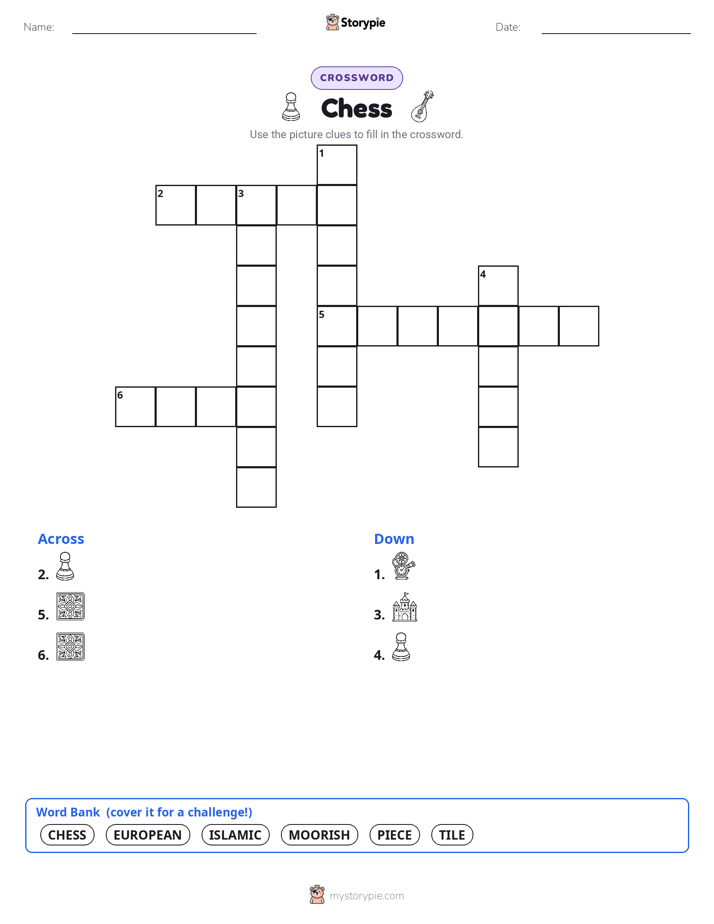
Print & create
Answer keys·No prep·Free with an account
28 worksheets · answer keys · full story · quiz · Ages 10-12 · CEFR B2
Plus adds 244,000+ more stories in 27 languages, audio for every one, and printables for all of them.
Just want Chess?
Imagine the cool, smooth feel of carved wood in your hand. Picture a silent battlefield of sixty-four black and white squares, where two minds are locked in a tense duel. On this field, kings and queens command loyal armies of knights, bishops, and pawns. Each piece moves with a purpose, a silent promise of the battle to come. The steady pawns advance like a wall of soldiers, the bishops slice across the board on diagonals, the rooks charge in straight lines, and the knights surprise their foes with a clever L-shaped leap. I am a puzzle of infinite possibilities, a story of attack and defense, and a contest of pure logic. I am a whole world contained within a simple box, a kingdom waiting for its rulers to make their first move. I am Chess.
My story begins long ago, in a land of vibrant colors, fragrant spices, and powerful empires. I was born in the Gupta Empire of India, sometime around the 6th century. I wasn’t called Chess back then. My first name was Chaturanga, a Sanskrit word that perfectly described my purpose: 'four divisions of the military.' Imagine an ancient Indian army preparing for battle. You would see the brave infantry soldiers marching forward, the swift cavalry on their horses, the mighty elephants trampling everything in their path, and the fast-moving chariots racing across the field. I was a reflection of that army. My pawns were the infantry, my knights were the cavalry, my bishops represented the elephants, and my rooks were the chariots. At the center of the army stood the Raja, the king. The game was a training ground for generals and nobles. They could practice tactics, test strategies, and learn the art of war without a single drop of blood being shed. The objective was simple and direct: to capture the enemy's Raja. There was no elegant 'checkmate,' just the decisive conclusion of a well-fought battle on my board.
The Kingdom in a Box
Imagine the cool, smooth feel of carved wood in your hand. Picture a silent battlefield of sixty-four black and white squares, where two minds are locked in a tense duel. On this field, kings and queens command loyal armies of knights, bishops, and pawns. Each piece moves with a purpose, a silent promise of the battle to come. The steady pawns advance like a wall of soldiers, the bishops slice across the board on diagonals, the rooks charge in straight lines, and the knights surprise their foes with a clever L-shaped leap. I am a puzzle of infinite possibilities, a story of attack and defense, and a contest of pure logic. I am a whole world contained within a simple box, a kingdom waiting for its rulers to make their first move. I am Chess.
My story begins long ago, in a land of vibrant colors, fragrant spices, and powerful empires. I was born in the Gupta Empire of India, sometime around the 6th century. I wasn’t called Chess back then. My first name was Chaturanga, a Sanskrit word that perfectly described my purpose: 'four divisions of the military.' Imagine an ancient Indian army preparing for battle. You would see the brave infantry soldiers marching forward, the swift cavalry on their horses, the mighty elephants trampling everything in their path, and the fast-moving chariots racing across the field. I was a reflection of that army. My pawns were the infantry, my knights were the cavalry, my bishops represented the elephants, and my rooks were the chariots. At the center of the army stood the Raja, the king. The game was a training ground for generals and nobles. They could practice tactics, test strategies, and learn the art of war without a single drop of blood being shed. The objective was simple and direct: to capture the enemy's Raja. There was no elegant 'checkmate,' just the decisive conclusion of a well-fought battle on my board.
I did not stay in India forever. I have always been a traveler, an adventurer. My journey began as I moved with merchants and scholars along the famous Silk Road, a network of trade routes that connected the East and West. By the 7th century, I had arrived in Persia, a powerful empire to the west of India. The Persians were fascinated by me. They adopted me as their own, but they also gave me a new identity. They called me Shatranj. My pieces changed their names to fit this new culture. The Raja became the Shah, which is the Persian word for king. It’s from this word, 'Shah,' that your modern words 'check' and 'checkmate' eventually came. 'Shah Mat' in Persian means 'the king is helpless.' From Persia, my influence spread like wildfire. I traveled throughout the vast Islamic world, carried by traders and conquerors. Around the 9th century, I crossed the Mediterranean Sea into Spain with the Moors. From Spain, it was only a matter of time before I reached the rest of Europe. By the 10th century, I was a cherished pastime in the grand, cold castles of European knights and royalty. They saw in me the same challenges of strategy and honor that they faced on the battlefield. I had become a truly global citizen.
My time in Europe brought about my most significant transformation. For centuries, I was a slow, methodical game. But around the 15th century, innovators in Spain and Italy decided to make me more dynamic. They looked at my board and saw potential for more excitement. The biggest change involved the Queen. Originally, she was one of the weakest pieces, only able to move one square diagonally. But in this new version, she was granted incredible powers, allowing her to move any number of squares in any direction—horizontally, vertically, or diagonally. She became the formidable force you know today. My pawns also received a boost; they were given the ability to move two squares forward on their very first move, allowing for quicker development and more aggressive openings. These rule changes made me faster, more thrilling, and more complex. I began to look much more like the game played today. As my popularity grew, so did the desire for organized competition. The first major international chess tournament was held in London in 1851. The competition was fierce, and it set the stage for a new era. On January 11th, 1886, a brilliant player named Wilhelm Steinitz became the very first official World Chess Champion, cementing my status as a serious, competitive sport.
Today, my story continues on millions of boards and screens all over the world. I connect people who don't speak the same language, bridging cultures and generations with a shared love for strategy. I am not just a game for humans anymore. I have become a benchmark for artificial intelligence. One of my most famous modern moments came on May 11th, 1997, when the IBM supercomputer Deep Blue defeated the reigning world champion, Garry Kasparov, in a historic match. It was a moment that showed just how complex I am, a challenge even for the most powerful electronic minds. But my true purpose is not about winning or losing. I am a teacher. I teach patience, requiring you to think before you act. I teach foresight, encouraging you to see the consequences of your decisions several moves ahead. I teach critical thinking and problem-solving with every puzzle I present. Most importantly, I show that every action matters and that even the smallest piece, a humble pawn, can cross the board and become a powerful queen. My sixty-four squares are a world of endless possibility, and I am proud to be a timeless challenge that helps every mind grow stronger.
Wow facts
About
Chess is a two-player strategy board game played on a checkered board with 64 squares arranged in an 8x8 grid. It is one of the world's most popular games, played by millions of people worldwide.
Take a Quiz
Question 1 of 5
In your own words, summarize the journey of Chess from its origin to its modern form.
Explore next



Want to do even more?
Go beyond exploring. Unlock tools that turn every story into real learning.

Storypie Plus for families
Full stories, quizzes, and printables. Nights and car rides, sorted.
- Unlimited audio stories
- Create Mode: your child stars in the story
- Offline downloads
- Printable worksheets & coloring pages

Why Storypie for Schools
Students engaged. Prep in seconds. Evenings back to you.
- Worksheets & Quizzes
- Classroom Management
- Formative Assessment
- Custom Curriculum & Lesson Plans
- 27 Languages

Why Storypie for Homeschool
Curriculum done. They'll ask for more. Hours back in your day.
- Worksheet Generator
- First-Person Audio Stories
- Built-in Comprehension Quizzes
- Custom Curriculum & Lesson Plans
- Print & Go Activities