English


Coal
A combustible black or brownish-black sedimentary rock, a fossil fuel formed from ancient plant matter…
Reads at Grades 6–8 Listens at Grades 4–8
Print & create
Answer keys·No prep·Free with an account
28 worksheets · answer keys · full story · quiz · Ages 10-12 · CEFR B2
Plus adds 244,000+ more stories in 27 languages, audio for every one, and printables for all of them.
Just want Coal?
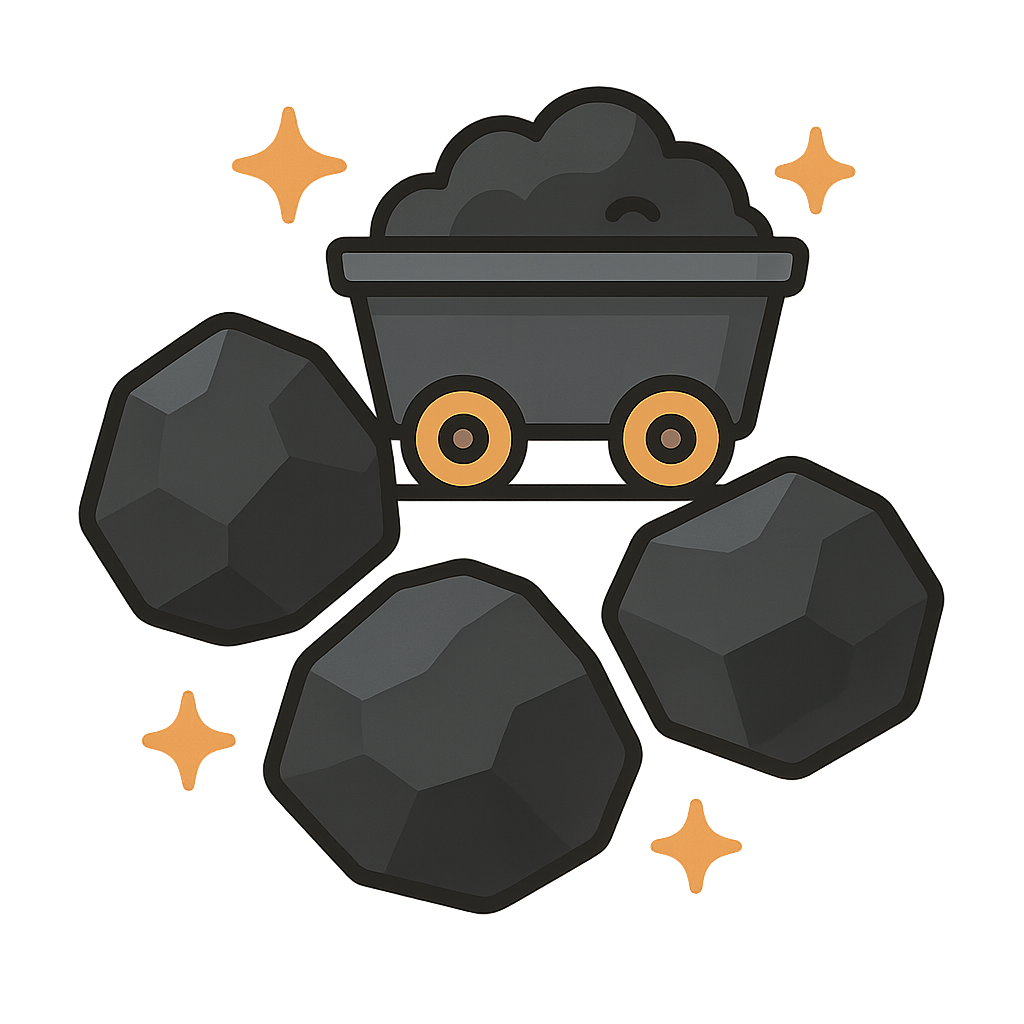
Imagine a world long before the first human voice echoed through the trees. I was there, sleeping deep within the Earth. My story began hundreds of millions of years ago, during a time you call the Carboniferous Period. The air was thick and warm, and the land was covered in vast, swampy forests. Giant ferns unfurled towards the sky, and towering trees, unlike any you see today, drank in the sunlight. For ages, I was that sunlight, captured and stored in every leaf and branch. When these ancient plants died, they sank into the murky water of the swamps. They didn't rot away completely. Instead, they were buried under layers of mud, sand, and rock. As millions of years passed, the weight of the world pressed down on them. The Earth's own heat baked them. This immense pressure and intense heat worked a slow, powerful magic, transforming the buried forests. All that captured sunlight, all that ancient life, was squeezed and cooked until it became something new—a hard, shiny, black rock, humming with dormant energy. I am that rock. I am Coal.
For millennia, I slept in my dark seams, a hidden treasure of warmth and light. My first real interactions with humanity were small sparks in the vastness of time. Archaeologists have found evidence that people in what is now China were digging me up and using me for fuel as far back as 4000 BCE. They must have marveled at this strange black stone that could burn. Much later, when the Roman Empire stretched its mighty arms across the globe, its soldiers found me in Britain during the 2nd century CE. They didn't have a name for me, so they called me a 'burning stone.' They used me to heat the water for their famous baths and to keep their villas warm against the damp island chill. Still, my true potential remained a secret. Over a thousand years later, in the 13th century, a Venetian traveler named Marco Polo journeyed across Asia. He wrote with astonishment about the people of China, who didn't chop down trees for fire. Instead, he saw them dig up 'black stones… which burn like logs.' To him, it was a strange and wonderful novelty. For most of history, I was just that—a curiosity, a peculiar rock that burned hotter and longer than wood. I was useful, yes, but humanity hadn't yet found the key to unlock the true giant sleeping within me. I waited patiently.
The Story of Coal
Imagine a world long before the first human voice echoed through the trees. I was there, sleeping deep within the Earth. My story began hundreds of millions of years ago, during a time you call the Carboniferous Period. The air was thick and warm, and the land was covered in vast, swampy forests. Giant ferns unfurled towards the sky, and towering trees, unlike any you see today, drank in the sunlight. For ages, I was that sunlight, captured and stored in every leaf and branch. When these ancient plants died, they sank into the murky water of the swamps. They didn't rot away completely. Instead, they were buried under layers of mud, sand, and rock. As millions of years passed, the weight of the world pressed down on them. The Earth's own heat baked them. This immense pressure and intense heat worked a slow, powerful magic, transforming the buried forests. All that captured sunlight, all that ancient life, was squeezed and cooked until it became something new—a hard, shiny, black rock, humming with dormant energy. I am that rock. I am Coal.
For millennia, I slept in my dark seams, a hidden treasure of warmth and light. My first real interactions with humanity were small sparks in the vastness of time. Archaeologists have found evidence that people in what is now China were digging me up and using me for fuel as far back as 4000 BCE. They must have marveled at this strange black stone that could burn. Much later, when the Roman Empire stretched its mighty arms across the globe, its soldiers found me in Britain during the 2nd century CE. They didn't have a name for me, so they called me a 'burning stone.' They used me to heat the water for their famous baths and to keep their villas warm against the damp island chill. Still, my true potential remained a secret. Over a thousand years later, in the 13th century, a Venetian traveler named Marco Polo journeyed across Asia. He wrote with astonishment about the people of China, who didn't chop down trees for fire. Instead, he saw them dig up 'black stones… which burn like logs.' To him, it was a strange and wonderful novelty. For most of history, I was just that—a curiosity, a peculiar rock that burned hotter and longer than wood. I was useful, yes, but humanity hadn't yet found the key to unlock the true giant sleeping within me. I waited patiently.
My moment finally arrived in the 1700s, an era of incredible change. In Britain, where people had once relied on vast forests for fuel, the trees were becoming scarce. People needed a new source of energy to heat their homes and power their workshops. They turned to me. The real breakthrough came in 1709. An iron-maker named Abraham Darby I figured out how to purify me by baking me in an oven to remove impurities. This new form, called coke, burned incredibly hot and clean. Using coke, he could smelt iron ore far more efficiently than with charcoal from wood. Suddenly, iron became cheaper and stronger, ready to build the bones of a new world. But I needed a partner to truly unleash my power. I found it in an invention that hissed and rattled and breathed out clouds of vapor: the steam engine. While early versions existed, it was James Watt's improved design in 1781 that changed everything. His engine was a hungry beast, and I was the perfect food. Together, we were an unstoppable force. We powered pumps that sucked water out of deep mines, allowing miners to dig up even more of me. We turned the giant wheels of looms in textile factories, weaving cloth faster than hundreds of hands ever could. We became the heart of the locomotive, pulling trains full of goods and people across continents on newly laid iron rails. We fueled the mighty steamships that conquered the oceans, connecting the world like never before. I wasn't just a burning stone anymore. I was the engine of progress, the fuel of the Industrial Revolution.
A powerful legacy and a new chapter. My influence grew even stronger in the 20th century. I found a new purpose: generating electricity. In massive power plants, my heat boiled water into steam, which spun turbines that created the electrical current that lit up the world. I powered the lights in your homes, the machines in your hospitals, and the computers in your schools. I helped build the modern society you know today. But powering such monumental change came at a cost. The smoke from my fires filled the air in industrial cities, and scientists later discovered that the gases released when I burn contribute to the warming of the planet, what you now call climate change. This became part of my story, too—a difficult but important lesson for humanity. The journey of discovery is never simple. The very progress I fueled, the scientific advancements and technological innovations, has now given humans the knowledge to look for new, cleaner ways to power their world. I am proud of the world I helped build, a world of invention and connection. Now, I see humanity reaching for the sun again, this time directly with solar panels, and harnessing the wind and the atom. My time as the world's main source of energy is coming to an end. I am passing the torch, and I am excited to see what amazing future you will build with it.
Wow facts
About
A combustible black or brownish-black sedimentary rock, a fossil fuel formed from ancient plant matter, which was the primary energy source for the Industrial Revolution.
Take a Quiz
Question 1 of 5
Which statement best summarizes the main idea of the story?
Explore next






Want to do even more?
Go beyond exploring. Unlock tools that turn every story into real learning.

Storypie Plus for families
Full stories, quizzes, and printables. Nights and car rides, sorted.
- Unlimited audio stories
- Create Mode: your child stars in the story
- Offline downloads
- Printable worksheets & coloring pages

Why Storypie for Schools
Students engaged. Prep in seconds. Evenings back to you.
- Worksheets & Quizzes
- Classroom Management
- Formative Assessment
- Custom Curriculum & Lesson Plans
- 27 Languages

Why Storypie for Homeschool
Curriculum done. They'll ask for more. Hours back in your day.
- Worksheet Generator
- First-Person Audio Stories
- Built-in Comprehension Quizzes
- Custom Curriculum & Lesson Plans
- Print & Go Activities