English

Computational Thinking (Breaking Big Problems into Small Ones)
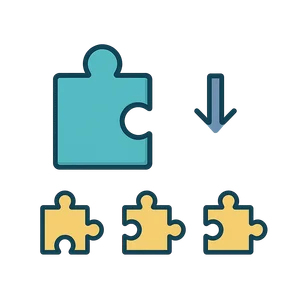
Computational thinking is a problem-solving process that involves breaking down a complex problem into…
Reads at Grades 6–8 Listens at Grades 4–8
Print & create
Answer keys·No prep·Free with an account
28 worksheets · answer keys · full story · quiz · Ages 10-12 · CEFR B2
Plus adds 244,000+ more stories in 27 languages, audio for every one, and printables for all of them.
Just want Computational Thinking (Breaking Big Problems into Small Ones)?

Have you ever stood at the door of your room, staring at a mountain of clothes, books, and toys, and felt completely overwhelmed. Or maybe you’ve been given a massive school project, a ten-page report on a topic you barely understand, and your mind just goes blank. The challenge feels so gigantic, so impossible, that you don’t even know where to begin. In those moments of chaos, a quiet little voice might whisper an idea in your head. It doesn’t shout. It just suggests, 'Let’s break it down.' That voice is me. I help you see the patterns in the mess. When you start sorting your laundry, you’re not just making piles; you’re recognizing patterns—whites with whites, colors with colors. When you follow a recipe to bake cookies, you’re not just mixing ingredients; you’re executing a precise, step-by-step plan. I am the logic that tells you to add the flour before the chocolate chips. When you plan your weekend, deciding to do homework first, then go to the park, and finally see a movie, you are breaking a big block of time into smaller, manageable tasks. I am there in all those moments, helping you transform a huge, scary problem into a series of simple, achievable steps. I’m your built-in toolkit for making sense of the world. I am Computational Thinking.
My story, however, didn’t begin with computers. I am much older than the glowing screens you know. I’ve been a quiet partner to humanity for centuries, helping the greatest minds organize their thoughts. My journey can be traced back to ancient Greece, around 300 BCE. A brilliant mathematician named Euclid was wrestling with complex number puzzles. To find the greatest common divisor of two numbers, he didn't just guess; he created a step-by-step process, a repeatable method that would work every single time. That methodical process was one of my core ideas: the algorithm. I was there, helping him create order from numerical chaos. Centuries later, in the 9th century, a remarkable Persian scholar named al-Khwarizmi gave my methods a new voice. He wrote extensively about systematic processes for solving mathematical problems, particularly in algebra. His work was so influential and his methods so clear that his own name, al-Khwarizmi, eventually morphed into the very word we use today: 'algorithm.' He showed the world how a structured approach could solve incredibly complex equations. Fast forward a thousand years to the mid-20th century. Suddenly, humans built enormous machines—the first computers. These giant metal brains needed instructions, and they couldn’t understand vague ideas. They needed me. Early computer scientists used my principles of decomposition, pattern recognition, and algorithms to write the first programs, telling the machines exactly what to do, one logical step at a time. Then, a visionary named Seymour Papert saw that I wasn't just for scientists. In his 1980 book, 'Mindstorms,' he argued that I was a powerful tool for everyone, especially for kids learning to program and think. He imagined a world where children could use logic and step-by-step thinking to build, create, and solve their own problems. Finally, in 2006, a computer scientist named Jeannette Wing gave me the name you know me by today. She declared that 'Computational Thinking' was a fundamental skill for everybody in the 21st century, just as important as reading, writing, and arithmetic. She helped everyone see that I was not just about computers; I was about a powerful way of solving problems.
The Problem-Solving Superpower
Have you ever stood at the door of your room, staring at a mountain of clothes, books, and toys, and felt completely overwhelmed. Or maybe you’ve been given a massive school project, a ten-page report on a topic you barely understand, and your mind just goes blank. The challenge feels so gigantic, so impossible, that you don’t even know where to begin. In those moments of chaos, a quiet little voice might whisper an idea in your head. It doesn’t shout. It just suggests, 'Let’s break it down.' That voice is me. I help you see the patterns in the mess. When you start sorting your laundry, you’re not just making piles; you’re recognizing patterns—whites with whites, colors with colors. When you follow a recipe to bake cookies, you’re not just mixing ingredients; you’re executing a precise, step-by-step plan. I am the logic that tells you to add the flour before the chocolate chips. When you plan your weekend, deciding to do homework first, then go to the park, and finally see a movie, you are breaking a big block of time into smaller, manageable tasks. I am there in all those moments, helping you transform a huge, scary problem into a series of simple, achievable steps. I’m your built-in toolkit for making sense of the world. I am Computational Thinking.
My story, however, didn’t begin with computers. I am much older than the glowing screens you know. I’ve been a quiet partner to humanity for centuries, helping the greatest minds organize their thoughts. My journey can be traced back to ancient Greece, around 300 BCE. A brilliant mathematician named Euclid was wrestling with complex number puzzles. To find the greatest common divisor of two numbers, he didn't just guess; he created a step-by-step process, a repeatable method that would work every single time. That methodical process was one of my core ideas: the algorithm. I was there, helping him create order from numerical chaos. Centuries later, in the 9th century, a remarkable Persian scholar named al-Khwarizmi gave my methods a new voice. He wrote extensively about systematic processes for solving mathematical problems, particularly in algebra. His work was so influential and his methods so clear that his own name, al-Khwarizmi, eventually morphed into the very word we use today: 'algorithm.' He showed the world how a structured approach could solve incredibly complex equations. Fast forward a thousand years to the mid-20th century. Suddenly, humans built enormous machines—the first computers. These giant metal brains needed instructions, and they couldn’t understand vague ideas. They needed me. Early computer scientists used my principles of decomposition, pattern recognition, and algorithms to write the first programs, telling the machines exactly what to do, one logical step at a time. Then, a visionary named Seymour Papert saw that I wasn't just for scientists. In his 1980 book, 'Mindstorms,' he argued that I was a powerful tool for everyone, especially for kids learning to program and think. He imagined a world where children could use logic and step-by-step thinking to build, create, and solve their own problems. Finally, in 2006, a computer scientist named Jeannette Wing gave me the name you know me by today. She declared that 'Computational Thinking' was a fundamental skill for everybody in the 21st century, just as important as reading, writing, and arithmetic. She helped everyone see that I was not just about computers; I was about a powerful way of solving problems.
Now, I am everywhere, working behind the scenes in your daily life. I am the secret code that makes your favorite video games challenging but fair, designing levels and character behaviors through logical rules. I am the engine inside smartphone apps that maps the fastest route to your friend's house by analyzing traffic patterns. Scientists use me to sift through enormous sets of data to understand climate change, discover new medicines, or map the stars. But you don’t need to be a coder or a scientist to be my partner. When you create an outline for an essay, you are decomposing a big idea into smaller paragraphs. When you and your friends try to figure out why your group project isn’t working, you are 'debugging' the problem by testing different parts of your plan. Every time you organize a complex task into a checklist, you are using my power to create order and clarity. I am not a subject you learn in one class; I am a way of seeing the world. I am your partner in turning chaos into order and big challenges into small, solvable steps. So next time you face a puzzle that seems too big to handle, a project that feels overwhelming, or a mess that looks unconquerable, remember me. Take a deep breath, find the first small step, and let's figure it out together.
Wow facts
About
Computational thinking is a problem-solving process that involves breaking down a complex problem into smaller, more manageable parts. It is a fundamental skill in computer science but is also applicable to a wide range of real-world challenges.
Take a Quiz
Question 1 of 5
What is the main idea of this story?
Explore next






Want to do even more?
Go beyond exploring. Unlock tools that turn every story into real learning.

Storypie Plus for families
Full stories, quizzes, and printables. Nights and car rides, sorted.
- Unlimited audio stories
- Create Mode: your child stars in the story
- Offline downloads
- Printable worksheets & coloring pages

Why Storypie for Schools
Students engaged. Prep in seconds. Evenings back to you.
- Worksheets & Quizzes
- Classroom Management
- Formative Assessment
- Custom Curriculum & Lesson Plans
- 27 Languages

Why Storypie for Homeschool
Curriculum done. They'll ask for more. Hours back in your day.
- Worksheet Generator
- First-Person Audio Stories
- Built-in Comprehension Quizzes
- Custom Curriculum & Lesson Plans
- Print & Go Activities