English

Computational Thinking (Breaking Big Problems into Small Ones)
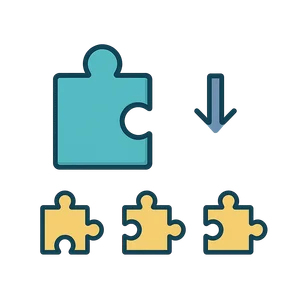
Computational thinking is a problem-solving process that involves breaking down a complex problem into…
Reads at Grades K-2 Listens at K–3
Print & create
Answer keys·No prep·Free with an account
28 worksheets · answer keys · full story · quiz · Ages 6-8 · CEFR A2
Plus adds 244,000+ more stories in 27 languages, audio for every one, and printables for all of them.
Just want Computational Thinking (Breaking Big Problems into Small Ones)?

Have you ever looked at your room when it’s super messy and felt a little stuck, not knowing where to start? Or maybe you wanted to build the biggest, most amazing castle out of blocks, but all the pieces were just a giant, jumbled pile. It can feel like a huge challenge. But what if a helpful little whisper in your mind said, 'Don't worry. Let's do this one tiny piece at a time.' First, let’s pick up all the red blocks. Then, let’s find all the square ones. Suddenly, the giant challenge doesn't seem so big anymore. It becomes a fun to-do list, like a game you can win step-by-step. That helpful whisper is me. I am Computational Thinking, and I’m here to help you solve anything.
I’m not new, even though my name sounds a bit like 'computer.' I have been helping people solve problems for a very, very long time, even before computers were in every house. A brilliant woman named Ada Lovelace was one of the first people to really understand me. Way back in the 1840s, she imagined a special machine that could follow instructions. She wrote down a list of simple, tiny steps for the machine to do a math problem. This list was like the first-ever computer program. She showed everyone that even a machine could solve big problems if you just gave it a good plan. Much later, in 1980, a kind man named Seymour Papert wrote a book called 'Mindstorms.' He knew I could be a superpower for kids. He helped create a little turtle on a computer screen that kids could teach. To draw a square, you had to tell the turtle to go forward, then turn right, then go forward, then turn right. He realized that when you learn how to teach a computer to solve a problem step-by-step, you get much better at solving problems yourself.
Your Secret Problem-Solving Superpower
Have you ever looked at your room when it’s super messy and felt a little stuck, not knowing where to start? Or maybe you wanted to build the biggest, most amazing castle out of blocks, but all the pieces were just a giant, jumbled pile. It can feel like a huge challenge. But what if a helpful little whisper in your mind said, 'Don't worry. Let's do this one tiny piece at a time.' First, let’s pick up all the red blocks. Then, let’s find all the square ones. Suddenly, the giant challenge doesn't seem so big anymore. It becomes a fun to-do list, like a game you can win step-by-step. That helpful whisper is me. I am Computational Thinking, and I’m here to help you solve anything.
I’m not new, even though my name sounds a bit like 'computer.' I have been helping people solve problems for a very, very long time, even before computers were in every house. A brilliant woman named Ada Lovelace was one of the first people to really understand me. Way back in the 1840s, she imagined a special machine that could follow instructions. She wrote down a list of simple, tiny steps for the machine to do a math problem. This list was like the first-ever computer program. She showed everyone that even a machine could solve big problems if you just gave it a good plan. Much later, in 1980, a kind man named Seymour Papert wrote a book called 'Mindstorms.' He knew I could be a superpower for kids. He helped create a little turtle on a computer screen that kids could teach. To draw a square, you had to tell the turtle to go forward, then turn right, then go forward, then turn right. He realized that when you learn how to teach a computer to solve a problem step-by-step, you get much better at solving problems yourself.
Then, in 2006, a super-smart computer scientist named Jeannette Wing told the whole world something amazing. She explained that I wasn't just for computers—I was a fundamental skill for everyone, just like reading or writing. I am the secret power behind so many cool things. I help people create awesome video games, build the websites you visit, and even plan how to send rockets into outer space. But I also help you in your daily life. When you follow a recipe to bake cookies, you are using me to follow the steps in order. When you figure out the rules to a new board game, you are using me to understand the pattern. When you make a plan to finish your homework, that’s me too. I am the power of thinking like a computer to solve problems big and small. Whenever you feel stuck, just remember to break it down. With me by your side, you can build, create, and solve anything you can imagine.
Wow facts
About
Computational thinking is a problem-solving process that involves breaking down a complex problem into smaller, more manageable parts. It is a fundamental skill in computer science but is also applicable to a wide range of real-world challenges.
Take a Quiz
Question 1 of 4
Why did Seymour Papert think teaching a computer turtle was helpful for kids?
Explore next





Want to do even more?
Go beyond exploring. Unlock tools that turn every story into real learning.

Storypie Plus for families
Full stories, quizzes, and printables. Nights and car rides, sorted.
- Unlimited audio stories
- Create Mode: your child stars in the story
- Offline downloads
- Printable worksheets & coloring pages

Why Storypie for Schools
Students engaged. Prep in seconds. Evenings back to you.
- Worksheets & Quizzes
- Classroom Management
- Formative Assessment
- Custom Curriculum & Lesson Plans
- 27 Languages

Why Storypie for Homeschool
Curriculum done. They'll ask for more. Hours back in your day.
- Worksheet Generator
- First-Person Audio Stories
- Built-in Comprehension Quizzes
- Custom Curriculum & Lesson Plans
- Print & Go Activities