English

Creativity
Creativity is the ability to generate or recognize ideas, alternatives…
Reads at Grades 6–8 Listens at Grades 4–8
Print & create
Answer keys·No prep·Free with an account
28 worksheets · answer keys · full story · quiz · Ages 10-12 · CEFR B2
Plus adds 164,000+ more stories in 27 languages, audio for every one, and printables for all of them.
Just want Creativity?
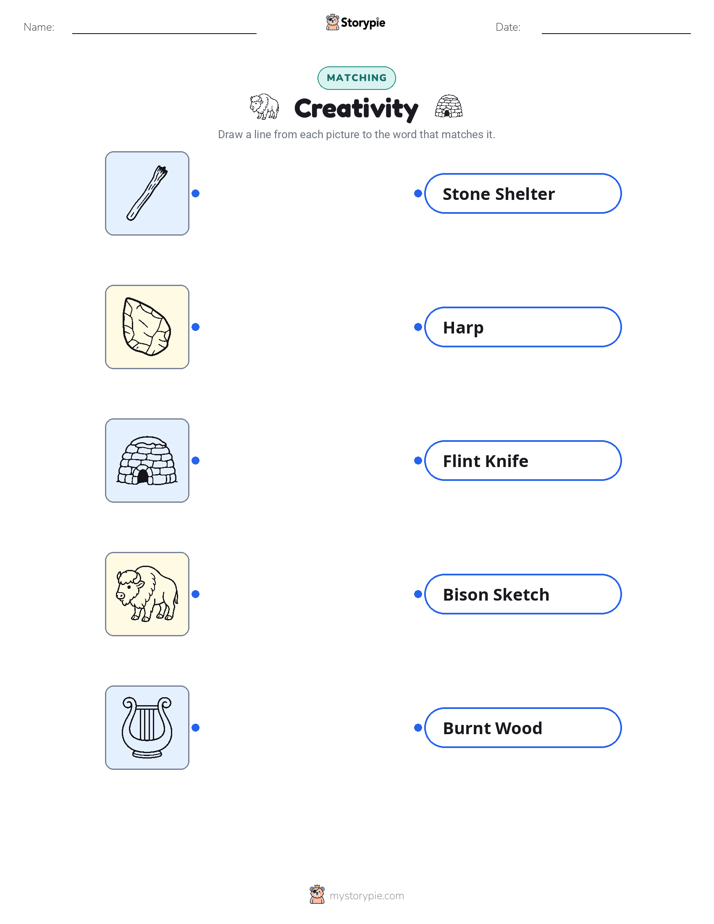
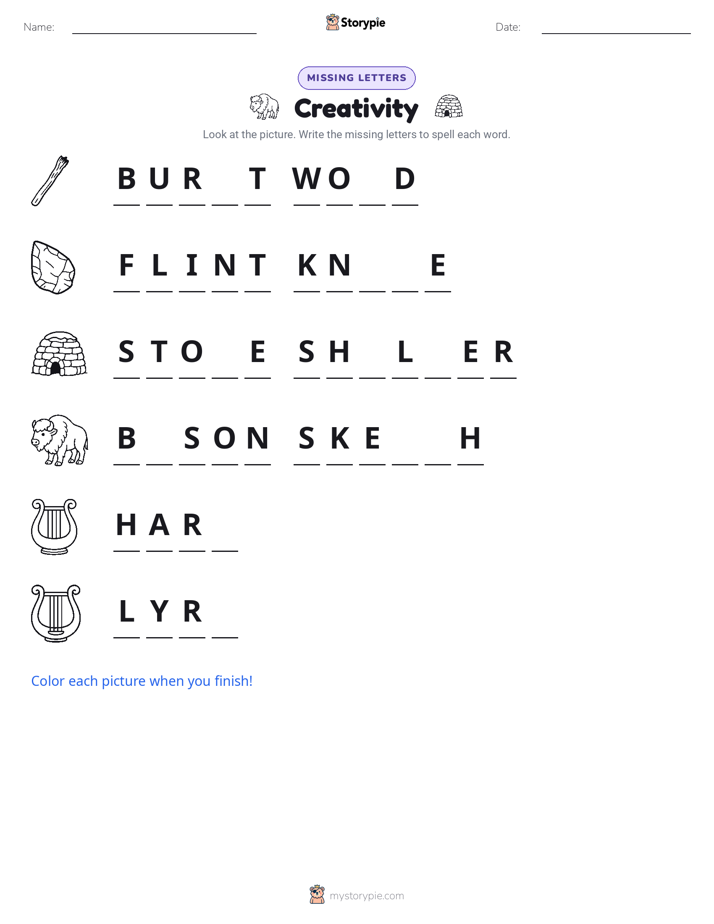
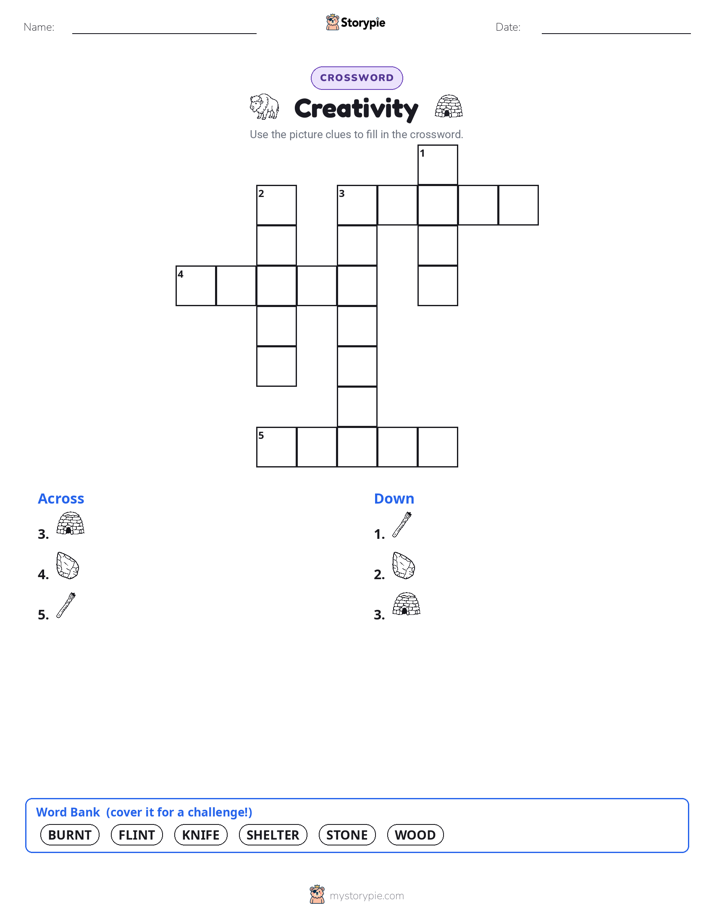
Imagine a world lit only by firelight, where survival was a daily struggle. In the deep, quiet corners of a mind, a tiny spark flickers. It is the feeling of two thoughts that have never met before suddenly connecting, like a bridge appearing out of thin air. It is the question that begins with 'what if?'. I was that spark. I was the reason a person, thousands of years ago, first picked up a burnt piece of wood and saw not just ash, but a tool for making a mark. In places like Chauvet Cave in what is now France, around 30,000 BCE, I guided a human hand to sketch the powerful shape of a bison on a cold stone wall, capturing its spirit forever. I was there in the Stone Age, a constant companion to early humans as they navigated a dangerous world. I helped them see that a sharp-edged flint could be more than just a rock; it could be a knife for hunting or a scraper for cleaning hides. I was the quiet whisper that suggested piling stones and mud in a certain way could create a warmer, safer shelter. I am the engine of change, the invisible force behind every invention, every solution, and every work of art. I am the whisper of possibility that turns a problem into a puzzle and a puzzle into a discovery. I am Creativity.
For a very long time, people felt my presence, but they didn't believe I came from inside of them. To them, I felt too magical, too powerful to be a simple human thought. In the sun-drenched lands of Ancient Greece, starting around the 8th century BCE, poets, musicians, and artists believed I was a divine gift, a whisper from heavenly spirits they called the Muses. There were nine of them, each responsible for inspiring a different art or science. A poet about to tell a grand story of heroes and gods would first call upon Calliope, the Muse of epic poetry, begging her to grant him the right words. They thought I flowed through them, not from them. One of their greatest thinkers, a philosopher named Plato, writing around 370 BCE, even gave my spark a dramatic name: 'divine madness.' He argued that a truly inspired poet wasn't in control of his own mind but was merely a channel, a vessel through which a god's voice spoke. People would build temples and make offerings, all in the hope that I would visit them. They didn't see me as a skill to be practiced, but as a blessing to be wished for, a mysterious force from another world that might, if they were lucky, choose them.
I Am Creativity
Imagine a world lit only by firelight, where survival was a daily struggle. In the deep, quiet corners of a mind, a tiny spark flickers. It is the feeling of two thoughts that have never met before suddenly connecting, like a bridge appearing out of thin air. It is the question that begins with 'what if?'. I was that spark. I was the reason a person, thousands of years ago, first picked up a burnt piece of wood and saw not just ash, but a tool for making a mark. In places like Chauvet Cave in what is now France, around 30,000 BCE, I guided a human hand to sketch the powerful shape of a bison on a cold stone wall, capturing its spirit forever. I was there in the Stone Age, a constant companion to early humans as they navigated a dangerous world. I helped them see that a sharp-edged flint could be more than just a rock; it could be a knife for hunting or a scraper for cleaning hides. I was the quiet whisper that suggested piling stones and mud in a certain way could create a warmer, safer shelter. I am the engine of change, the invisible force behind every invention, every solution, and every work of art. I am the whisper of possibility that turns a problem into a puzzle and a puzzle into a discovery. I am Creativity.
For a very long time, people felt my presence, but they didn't believe I came from inside of them. To them, I felt too magical, too powerful to be a simple human thought. In the sun-drenched lands of Ancient Greece, starting around the 8th century BCE, poets, musicians, and artists believed I was a divine gift, a whisper from heavenly spirits they called the Muses. There were nine of them, each responsible for inspiring a different art or science. A poet about to tell a grand story of heroes and gods would first call upon Calliope, the Muse of epic poetry, begging her to grant him the right words. They thought I flowed through them, not from them. One of their greatest thinkers, a philosopher named Plato, writing around 370 BCE, even gave my spark a dramatic name: 'divine madness.' He argued that a truly inspired poet wasn't in control of his own mind but was merely a channel, a vessel through which a god's voice spoke. People would build temples and make offerings, all in the hope that I would visit them. They didn't see me as a skill to be practiced, but as a blessing to be wished for, a mysterious force from another world that might, if they were lucky, choose them.
Centuries passed, and as the world moved into a period of extraordinary change in Europe known as the Renaissance, from the 14th to the 17th centuries, the way people thought about me began to transform. They started looking less to the heavens and more into the incredible potential of the human mind. They began to see me not as a fleeting gift from distant gods, but as a special, powerful light that burned brightly inside certain amazing individuals—the 'genius.' And no one embodied this new idea more than my great friend, Leonardo da Vinci. Between the year of his birth in 1452 and his death in 1519, he used me in ways no one had ever imagined. He saw connections everywhere. He would study the flight of a bird and use that knowledge to design a flying machine. He would dissect a human body to understand its muscles and then use that understanding to paint the most lifelike and expressive figures, like his famous Mona Lisa. For Leonardo, I wasn't divine madness; I was a tool for intense observation, relentless curiosity, and brilliant problem-solving. He showed the world that I could be a human force, a power that could be wielded by a single person to not only create beautiful art but also to understand the very fabric of the world and even shape its future.
Even after the magnificent breakthroughs of the Renaissance, the idea of the lone genius persisted for centuries. Most people still believed that I was a rare gift, something you were either born with or you weren't. They saw me in the grand symphonies of Mozart or the revolutionary scientific theories of Einstein and thought, 'That is for them, not for me.' But that way of thinking was about to be challenged. The world was changing fast in the 20th century, and people needed new ways to solve complex problems. Then, on a pivotal day in 1950, a psychologist named J.P. Guilford stood up and gave a famous speech to the American Psychological Association. He argued that I wasn't some magical, mysterious force reserved for a talented few. Instead, he proposed that I was a natural, normal human ability that could be scientifically studied, understood, and even improved. He introduced exciting ideas like 'divergent thinking'—the mental skill of branching out from a single problem to come up with lots of different possibilities and answers. Suddenly, the old myths began to crumble. Scientists, teachers, and business leaders realized that I wasn't a rare jewel but a part of every person's mind, like a muscle that was just waiting to be exercised and strengthened through practice and new ways of thinking.
So you see, my story is also your story. I am not just locked away in museums with Leonardo’s paintings or in history books with Plato’s philosophies. I am with you right now. I am that flicker of an idea you have when you invent a brand-new game with your friends on the playground. I am the clever solution you discover when you figure out a better way to organize the books and toys in your room. I am the voice that helps you write a story that no one has ever written before, with characters that came from your own imagination. I am the spark that helps you solve a tricky math problem by looking at it from a new angle, and I am the impulse that guides your hand as you draw a picture to express a feeling you can't quite put into words. I am a fundamental part of what makes you, you. Every time you ask 'what if?' or 'why not?', every time you try something new just to see what happens, you are exercising that muscle. You are helping me grow stronger, not just for yourself, but for everyone. You are making the world a more interesting, more beautiful, and more surprising place.
Wow facts
About
Creativity is the ability to generate or recognize ideas, alternatives, or possibilities that may be useful in solving problems, communicating with others, and entertaining ourselves and others.
Take a Quiz
Question 1 of 5
Why did Leonardo da Vinci's work change how people viewed creativity during the Renaissance?
Explore next




Want to do even more?
Go beyond exploring. Unlock tools that turn every story into real learning.

Storypie Plus for families
Full stories, quizzes, and printables. Nights and car rides, sorted.
- Unlimited audio stories
- Create Mode: your child stars in the story
- Offline downloads
- Printable worksheets & coloring pages

Why Storypie for Schools
Students engaged. Prep in seconds. Evenings back to you.
- Worksheets & Quizzes
- Classroom Management
- Formative Assessment
- Custom Curriculum & Lesson Plans
- 27 Languages

Why Storypie for Homeschool
Curriculum done. They'll ask for more. Hours back in your day.
- Worksheet Generator
- First-Person Audio Stories
- Built-in Comprehension Quizzes
- Custom Curriculum & Lesson Plans
- Print & Go Activities