English

Cursive Handwriting
Cursive is a style of penmanship in which letters are joined together in a flowing manner…
Reads at Grades 6–8 Listens at Grades 4–8
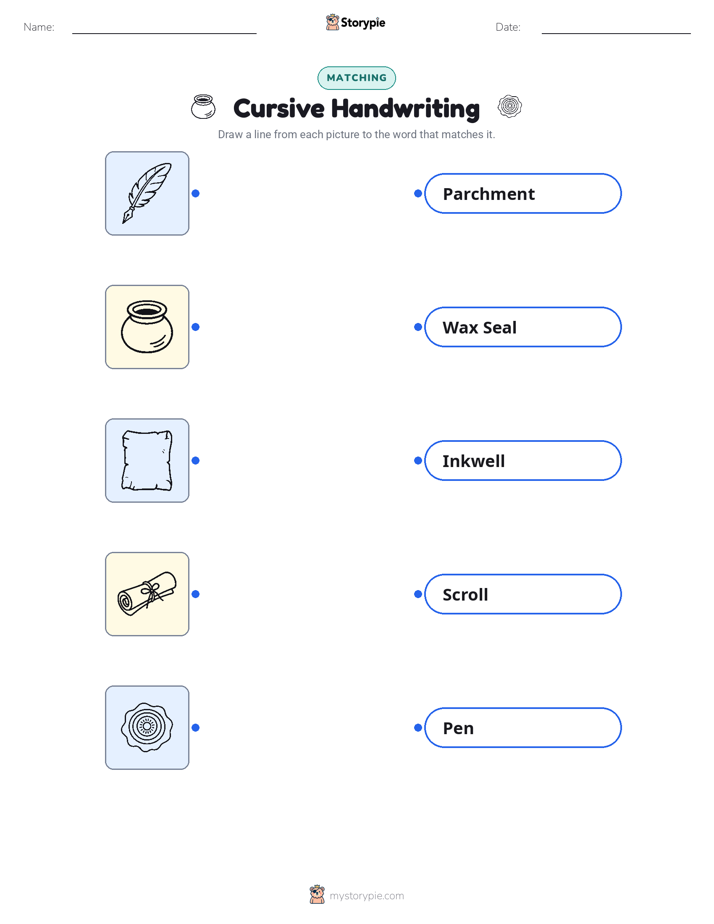
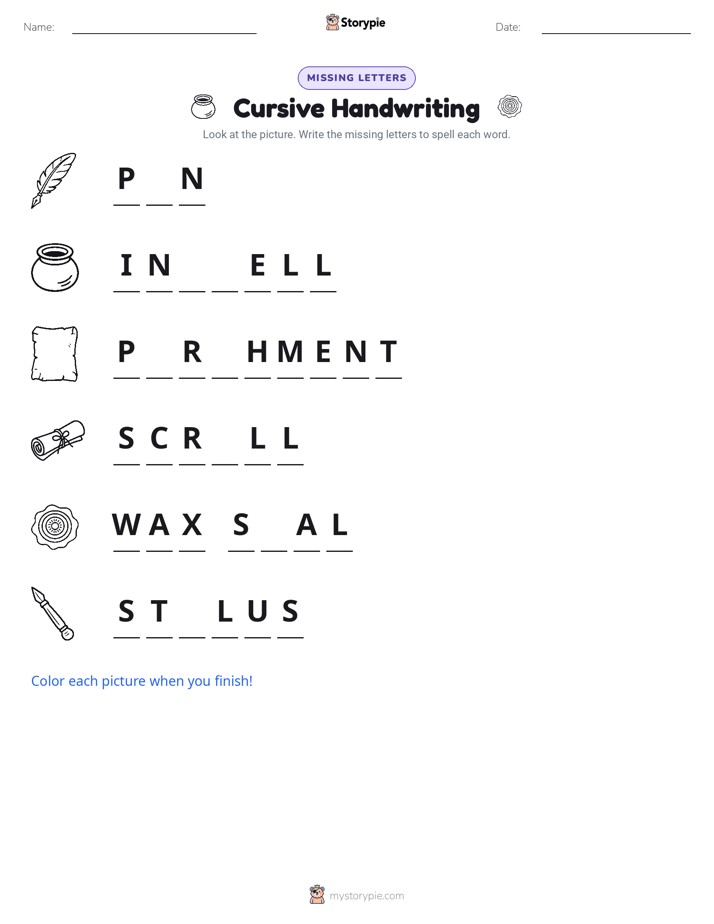
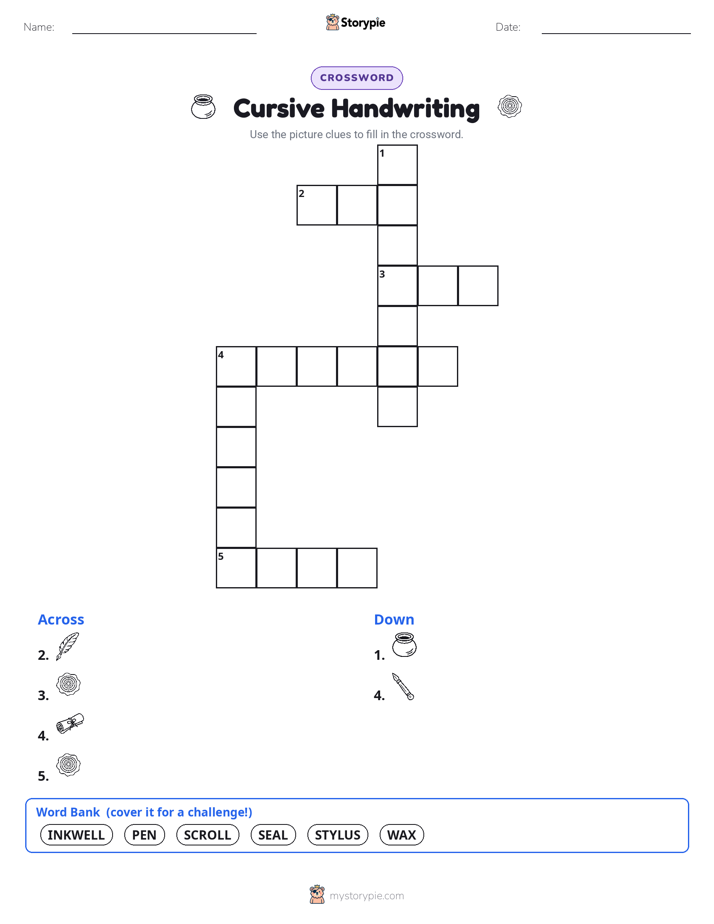
Print & create
Answer keys·No prep·Free with an account
28 worksheets · answer keys · full story · quiz · Ages 10-12 · CEFR B2
Plus adds 244,000+ more stories in 27 languages, audio for every one, and printables for all of them.
Just want Cursive Handwriting?
Have you ever seen writing that flows like a river, where all the letters hold hands in an unbroken, graceful line? It’s a dance of ink across the page, a series of loops, swirls, and connections that turn simple words into something personal and beautiful. I was born from a need for speed, to help thoughts travel from the brain to the hand without delay. I am the flourish on a signature, the secret script in a passed note, the elegant writing on a formal invitation. I am faster and more fluid than my blocky, separated cousins you might call print. Each person who uses me gives me a unique voice, a style that is theirs alone. My slant, my loops, my pressure on the page—all of it becomes a part of you. Have you seen me on an old family letter or on a historic document in a museum? I am a bridge to the past and a mark of your own identity. I am Cursive Handwriting.
My family tree is ancient, with roots stretching all the way back to the mighty Roman Empire. Around the 1st century CE, Roman merchants, soldiers, and officials were busy people. They didn't have time to carefully carve out each individual letter. They needed to write business deals, military orders, and personal letters quickly. So, they began to join their letters together in a practical, if not always pretty, scrawl. This was one of my earliest relatives, Roman Cursive. Centuries later, after the fall of Rome, writing became the work of monks in quiet monasteries. Around the year 800, a great emperor named Charlemagne wanted to bring order and clarity to his kingdom. He decreed that all books should be written in a new, clean script. His scribes developed a beautiful, rounded style called Carolingian Minuscule. Most of its letters stood alone, but it taught me about elegance and uniformity. From the Romans, I learned speed. From Charlemagne’s scribes, I learned grace. I was slowly learning how to be both useful and beautiful.
A River of Ink: The Story of Cursive Handwriting
Have you ever seen writing that flows like a river, where all the letters hold hands in an unbroken, graceful line? It’s a dance of ink across the page, a series of loops, swirls, and connections that turn simple words into something personal and beautiful. I was born from a need for speed, to help thoughts travel from the brain to the hand without delay. I am the flourish on a signature, the secret script in a passed note, the elegant writing on a formal invitation. I am faster and more fluid than my blocky, separated cousins you might call print. Each person who uses me gives me a unique voice, a style that is theirs alone. My slant, my loops, my pressure on the page—all of it becomes a part of you. Have you seen me on an old family letter or on a historic document in a museum? I am a bridge to the past and a mark of your own identity. I am Cursive Handwriting.
My family tree is ancient, with roots stretching all the way back to the mighty Roman Empire. Around the 1st century CE, Roman merchants, soldiers, and officials were busy people. They didn't have time to carefully carve out each individual letter. They needed to write business deals, military orders, and personal letters quickly. So, they began to join their letters together in a practical, if not always pretty, scrawl. This was one of my earliest relatives, Roman Cursive. Centuries later, after the fall of Rome, writing became the work of monks in quiet monasteries. Around the year 800, a great emperor named Charlemagne wanted to bring order and clarity to his kingdom. He decreed that all books should be written in a new, clean script. His scribes developed a beautiful, rounded style called Carolingian Minuscule. Most of its letters stood alone, but it taught me about elegance and uniformity. From the Romans, I learned speed. From Charlemagne’s scribes, I learned grace. I was slowly learning how to be both useful and beautiful.
My true moment to shine arrived in the 15th century in Italy, during a burst of creativity and learning known as the Renaissance. A marvelous invention, the printing press, had appeared around 1440, making it possible to produce books with perfect, uniform block letters. But what about everything else? For personal letters, business ledgers, and official documents, people still needed a way to write by hand that was faster than printing and more elegant than the old medieval scripts. That's where a scholar and scribe named Niccolò de' Niccoli came in. Working in Florence, he helped perfect a slanted, flowing style that was both swift and stylish. It became known as Italic script, and it was the real beginning of me as you know me today. I was no longer just a tool for speed; I was a form of art. Scholars used me to share revolutionary ideas about science and philosophy. Artists sketched out their plans with me. Merchants tracked their fortunes with my flowing lines. I traveled out of Italy and across Europe, carried in the hands of the thinkers and creators who were reshaping the world. I had found my rhythm.
My journey eventually led me across the Atlantic Ocean, to a new nation called America. In the early days of the United States, I was incredibly important. If you’ve ever seen a picture of the Declaration of Independence from July 4th, 1776, you’ve seen me in my finest form. The most famous signature on that document, that of John Hancock, is a bold and proud example of my power to make a statement. As America grew in the 19th century, I grew and changed with it. Around 1840, a teacher named Platt Rogers Spencer developed a style inspired by the graceful shapes of nature. His Spencerian script, with its beautiful ovals and flowing rhythm, became the standard for formal writing in America. But as the country’s businesses grew, the need for speed returned. Around the year 1888, a man named Austin Norman Palmer introduced a much simpler version of me. The Palmer Method used whole-arm movements instead of just the fingers, allowing people to write for hours without getting tired. It was less ornate than Spencerian, but it was incredibly practical. Your great-grandparents likely spent hours in school practicing my Palmer Method loops and lines.
Today, you live in a world of keyboards, touch screens, and voice-to-text. For a while, some people thought I might fade away, becoming a forgotten relic of the past. But I am still here, and I hold a few secret powers that screens can’t replicate. Scientists have discovered that the act of writing me is a special workout for your brain. The connected movements help build pathways between the left and right sides of your mind, improving your thinking and your fine motor skills. I am more than just a way to put words on paper; I am a direct connection between your thoughts and your physical body. I am a form of art, a dance you create with your own hand. Most importantly, I am your signature, a unique mark that proves who you are in a way no password can. Every time you sign your name, write a thank-you card to a friend, or jot down a thought in a flowing script, you are keeping a beautiful and powerful human tradition alive. You are making your own personal mark on the world, and that will always matter.
Wow facts
About
Cursive is a style of penmanship in which letters are joined together in a flowing manner, generally for the purpose of making writing faster.
Take a Quiz
Question 1 of 5
Why was a new style of handwriting, like Italic script, needed during the Renaissance even after the printing press was invented?
Explore next



Want to do even more?
Go beyond exploring. Unlock tools that turn every story into real learning.

Storypie Plus for families
Full stories, quizzes, and printables. Nights and car rides, sorted.
- Unlimited audio stories
- Create Mode: your child stars in the story
- Offline downloads
- Printable worksheets & coloring pages

Why Storypie for Schools
Students engaged. Prep in seconds. Evenings back to you.
- Worksheets & Quizzes
- Classroom Management
- Formative Assessment
- Custom Curriculum & Lesson Plans
- 27 Languages

Why Storypie for Homeschool
Curriculum done. They'll ask for more. Hours back in your day.
- Worksheet Generator
- First-Person Audio Stories
- Built-in Comprehension Quizzes
- Custom Curriculum & Lesson Plans
- Print & Go Activities