English

Eucalyptus
Eucalyptus is a genus of over 700 species, mostly tall, evergreen trees, but some are shrubs or mallees.
Reads at Grades 6–8 Listens at Grades 4–8
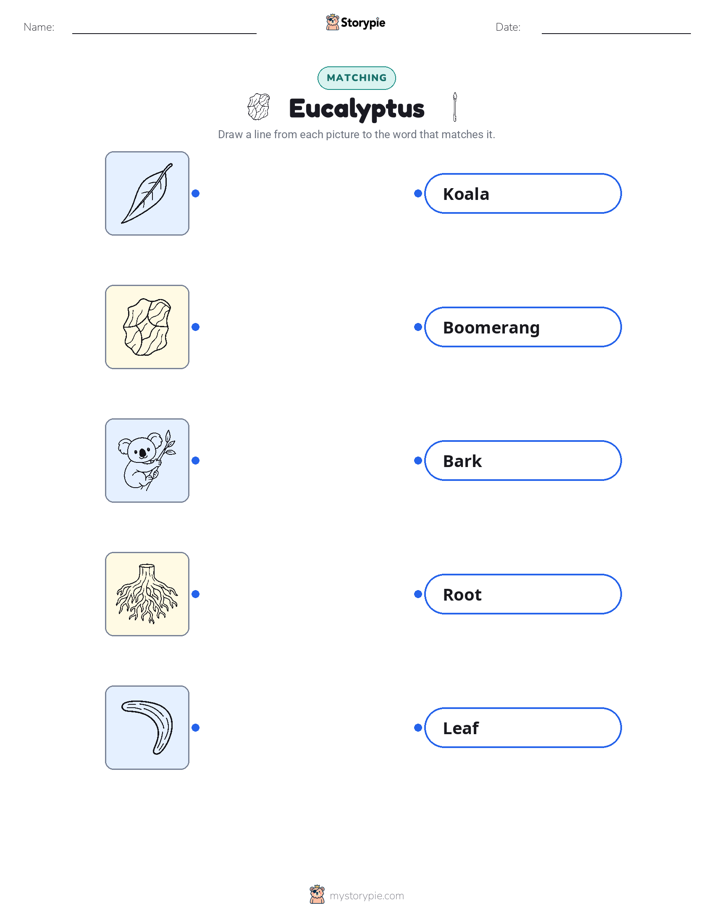
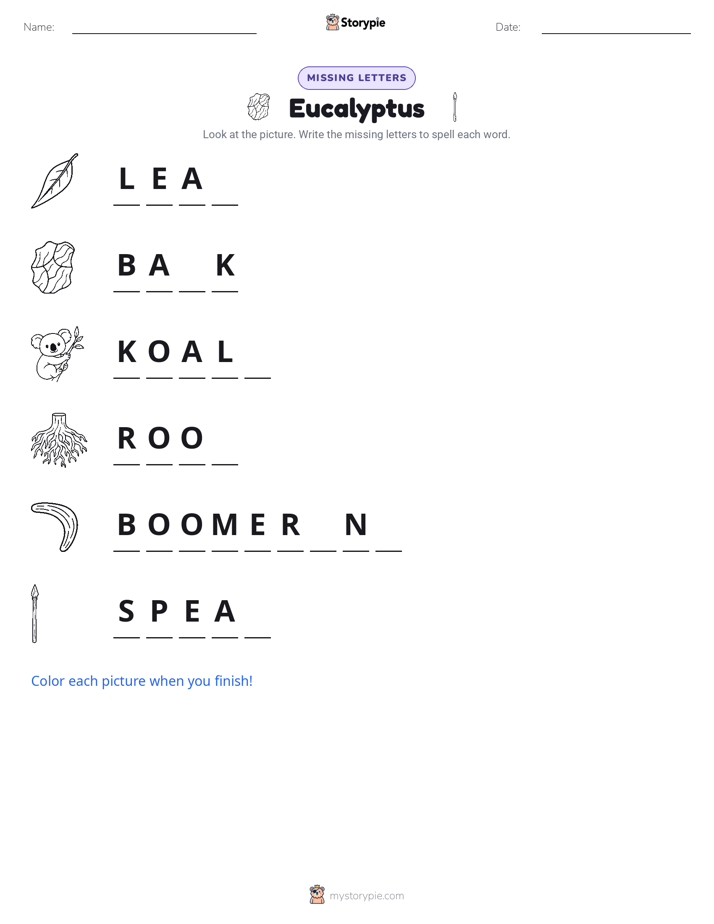
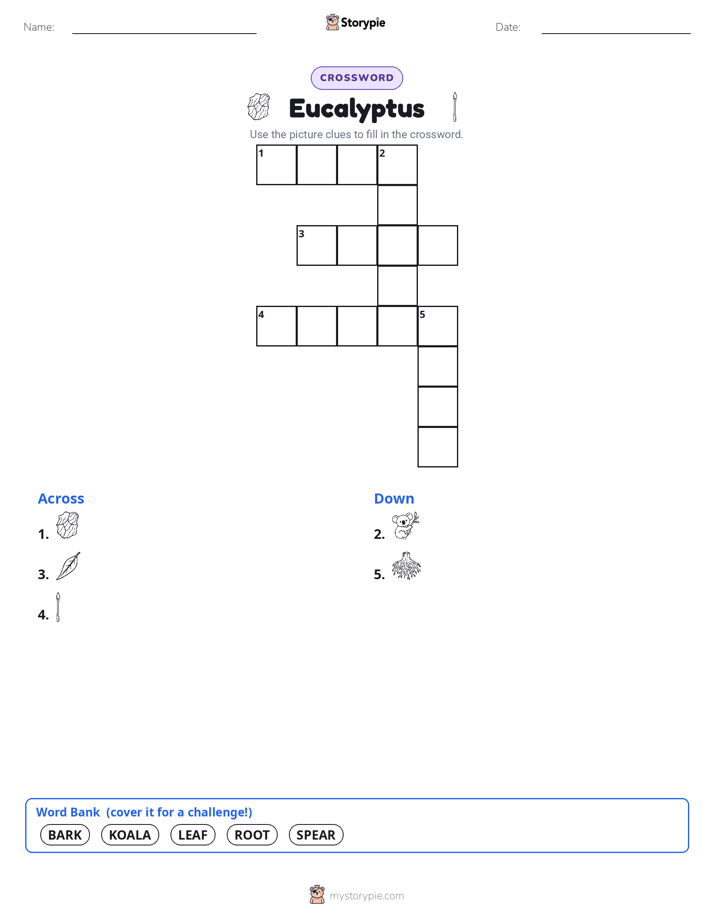
Print & create
Answer keys·No prep·Free with an account
28 worksheets · answer keys · full story · quiz · Ages 10-12 · CEFR B2
Plus adds 164,000+ more stories in 27 languages, audio for every one, and printables for all of them.
Just want Eucalyptus?
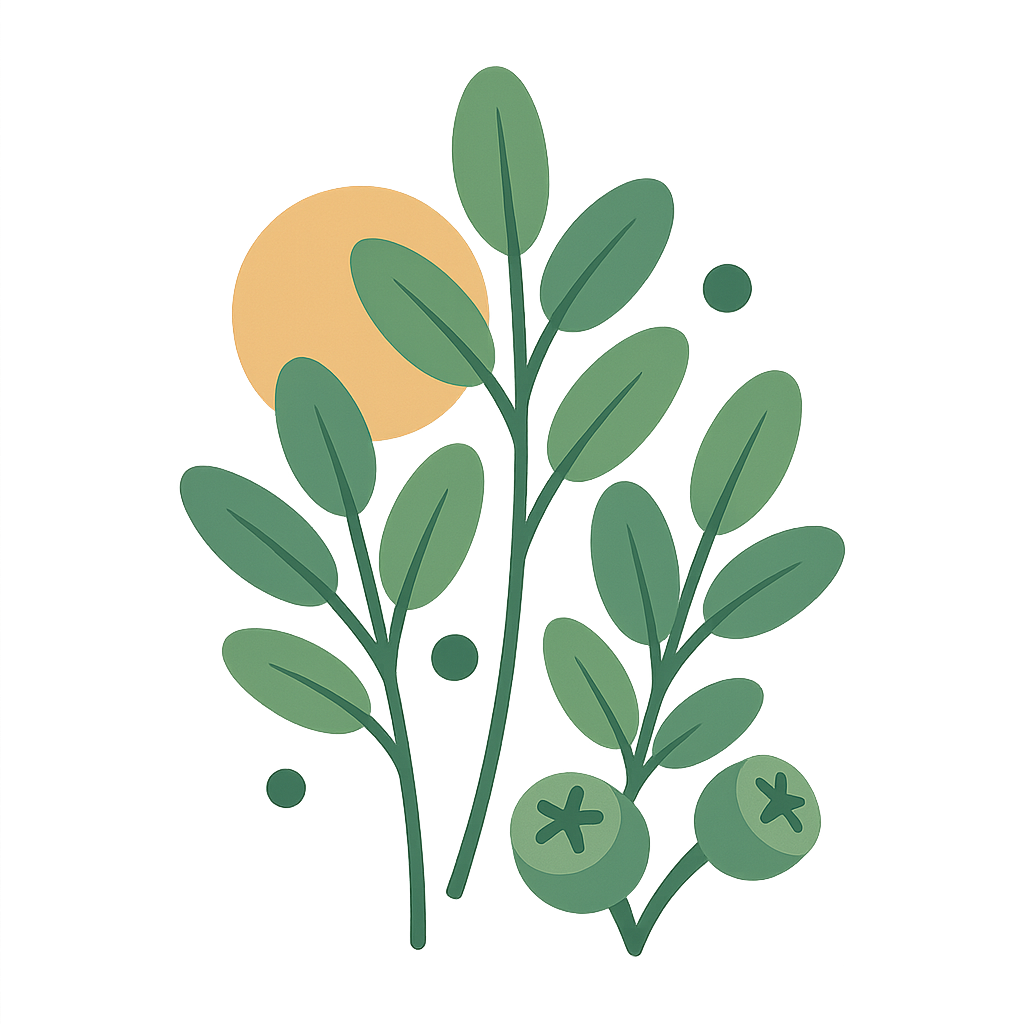
You might know me first by my scent. It is that sharp, clean, camphorous smell that perfumes the air after a good rain, a fragrance that speaks of ancient earth and wide-open skies. From my perspective, the world is a tapestry of sensations. I feel the wind rustling through my long, sickle-shaped leaves and the warm sun on my peeling, patchwork bark of gray, cream, and green. I hear the sleepy munching of my fussiest friend, the koala, who insists my leaves are the most delicious meal on the entire planet. I often stand tall, sometimes towering over every other flowering plant, with my roots dug deep, drinking from soil that holds millions of years of stories. I am a whisper of a land of red dust, vibrant bird calls, and brilliant blue skies. Before you even learn my name, you probably already know my smell. I am Eucalyptus, but to many, I am simply the Gum Tree, a true child of the Australian sun.
My family has been here for a very, very long time. My ancestors first appeared over 50 million years ago, evolving and spreading as the continent of Australia drifted apart from the supercontinent of Gondwana to become its own isolated world. For tens of thousands of years, I was a cherished and essential companion to the First Peoples of this land. They understood all my secrets and gifts. They knew my strong, dense wood was perfect for shaping into tools like boomerangs and spears, and for crafting the didgeridoo, whose deep drone sounds like the voice of the land itself. They carefully peeled my bark in large sheets to build canoes for traveling along rivers and to use as shingles for their shelters. They knew that crushing my leaves and inhaling the steam from boiled water could clear a stuffy nose and soothe a cough. My very roots were a map, a guide that led them to hidden sources of fresh water deep beneath the dry, cracked ground. I was their pharmacy, their hardware store, and their guide. Then one day in 1770, a great ship with towering white sails, the HMS Endeavour, anchored in a bay on the coast. Onboard were men from a faraway land who had never seen anything like me. Two botanists, Joseph Banks and Daniel Solander, walked through my forests with eyes wide in amazement. They collected my leaves, seeds, and flowers, carefully pressing them between the pages of their books to document me for people back in Europe. It wasn't until a bit later, on October 1st, 1788, that a French botanist in Paris named Charles Louis L'Héritier de Brutelle officially gave me my scientific name. He looked closely at the neat little cap that protects my flower buds before they bloom and called me 'Eucalyptus,' from the Greek words 'eu,' meaning 'well,' and 'kalyptos,' meaning 'covered.' I always thought that was a perfect description for my secret, well-kept blossoms.
A Story of the Gum Tree
You might know me first by my scent. It is that sharp, clean, camphorous smell that perfumes the air after a good rain, a fragrance that speaks of ancient earth and wide-open skies. From my perspective, the world is a tapestry of sensations. I feel the wind rustling through my long, sickle-shaped leaves and the warm sun on my peeling, patchwork bark of gray, cream, and green. I hear the sleepy munching of my fussiest friend, the koala, who insists my leaves are the most delicious meal on the entire planet. I often stand tall, sometimes towering over every other flowering plant, with my roots dug deep, drinking from soil that holds millions of years of stories. I am a whisper of a land of red dust, vibrant bird calls, and brilliant blue skies. Before you even learn my name, you probably already know my smell. I am Eucalyptus, but to many, I am simply the Gum Tree, a true child of the Australian sun.
My family has been here for a very, very long time. My ancestors first appeared over 50 million years ago, evolving and spreading as the continent of Australia drifted apart from the supercontinent of Gondwana to become its own isolated world. For tens of thousands of years, I was a cherished and essential companion to the First Peoples of this land. They understood all my secrets and gifts. They knew my strong, dense wood was perfect for shaping into tools like boomerangs and spears, and for crafting the didgeridoo, whose deep drone sounds like the voice of the land itself. They carefully peeled my bark in large sheets to build canoes for traveling along rivers and to use as shingles for their shelters. They knew that crushing my leaves and inhaling the steam from boiled water could clear a stuffy nose and soothe a cough. My very roots were a map, a guide that led them to hidden sources of fresh water deep beneath the dry, cracked ground. I was their pharmacy, their hardware store, and their guide. Then one day in 1770, a great ship with towering white sails, the HMS Endeavour, anchored in a bay on the coast. Onboard were men from a faraway land who had never seen anything like me. Two botanists, Joseph Banks and Daniel Solander, walked through my forests with eyes wide in amazement. They collected my leaves, seeds, and flowers, carefully pressing them between the pages of their books to document me for people back in Europe. It wasn't until a bit later, on October 1st, 1788, that a French botanist in Paris named Charles Louis L'Héritier de Brutelle officially gave me my scientific name. He looked closely at the neat little cap that protects my flower buds before they bloom and called me 'Eucalyptus,' from the Greek words 'eu,' meaning 'well,' and 'kalyptos,' meaning 'covered.' I always thought that was a perfect description for my secret, well-kept blossoms.
Once the stories from those explorers reached other countries, people all over the world became curious about me. They carefully packed my tiny seeds into crates and sailed them across vast, churning oceans. Throughout the 19th century, I began to put down new roots in unfamiliar soil. In California, during the great Gold Rush that began in the 1850s, people planted me by the thousands. They hoped my famously fast-growing wood would provide the timber needed to build their new, booming cities and lay down railroad tracks. In countries like Italy, Brazil, and Spain, they had a different problem. They planted me in swampy, marshy areas where disease-carrying mosquitoes thrived. My thirsty roots are incredibly efficient, and I drank up so much water that I helped dry out the soggy ground, drastically reducing the mosquito populations and helping to control the spread of malaria. I was a natural engineer. My family is enormous, with over 700 different species of brothers, sisters, and cousins, so I can adapt and look quite different depending on where I grow. My cousin, the Mountain Ash, is one of the tallest flowering plants in the entire world, sometimes stretching over 300 feet into the sky. Another cousin, the Rainbow Eucalyptus, has the most spectacular bark you can imagine. As it peels, it reveals vibrant streaks of green, orange, purple, and red, as if an artist had painted my trunk. I became a world traveler, bringing a piece of my Australian home and my many talents to almost every corner of the globe.
Today, I am still hard at work all around you, often in ways you might not even realize. That soothing, powerful oil extracted from my leaves is a key ingredient in cough drops, chest rubs, and medicines that help you breathe easier when you have a cold. My wood fibers are processed into pulp to make the very paper in the books you read and the notebooks you write in. My strong, durable timber is still used to build beautiful furniture, sturdy fences, and even parts of houses. I am, above all, a survivor. I have adapted to the often harsh Australian climate, especially its legendary bushfires. While the oil in my leaves is highly flammable, I am built to recover and regenerate. In fact, many of my seeds are sealed in woody capsules that only open to release their contents after the intense heat of a fire has passed. I can even sprout new growth directly from my trunk and base, a living symbol of resilience and new beginnings. I am a living link to an ancient past, a provider of medicine and materials, and a vital home for unique animals. So the next time you smell that fresh, clean, invigorating scent in the air, take a deep breath. It's me, Eucalyptus, reminding you of the power of nature to heal, to endure, and to connect us all across the world.
Wow facts
About
Eucalyptus is a genus of over 700 species, mostly tall, evergreen trees, but some are shrubs or mallees. They are native to Australia and are known for their special smell, fast growth, and many uses from wood to helpful oils.
Take a Quiz
Question 1 of 5
The story describes Eucalyptus as a 'symbol of resilience and new beginnings.' What evidence from the text best supports this statement?
Explore next





Want to do even more?
Go beyond exploring. Unlock tools that turn every story into real learning.

Storypie Plus for families
Full stories, quizzes, and printables. Nights and car rides, sorted.
- Unlimited audio stories
- Create Mode: your child stars in the story
- Offline downloads
- Printable worksheets & coloring pages

Why Storypie for Schools
Students engaged. Prep in seconds. Evenings back to you.
- Worksheets & Quizzes
- Classroom Management
- Formative Assessment
- Custom Curriculum & Lesson Plans
- 27 Languages

Why Storypie for Homeschool
Curriculum done. They'll ask for more. Hours back in your day.
- Worksheet Generator
- First-Person Audio Stories
- Built-in Comprehension Quizzes
- Custom Curriculum & Lesson Plans
- Print & Go Activities