English

Even and Odd Numbers
Even and odd numbers are a fundamental property of integers.
Reads at Grades 6–8 Listens at Grades 4–8
Print & create
Answer keys·No prep·Free with an account
28 worksheets · answer keys · full story · quiz · Ages 10-12 · CEFR B2
Plus adds 244,000+ more stories in 27 languages, audio for every one, and printables for all of them.
Just want Even and Odd Numbers?
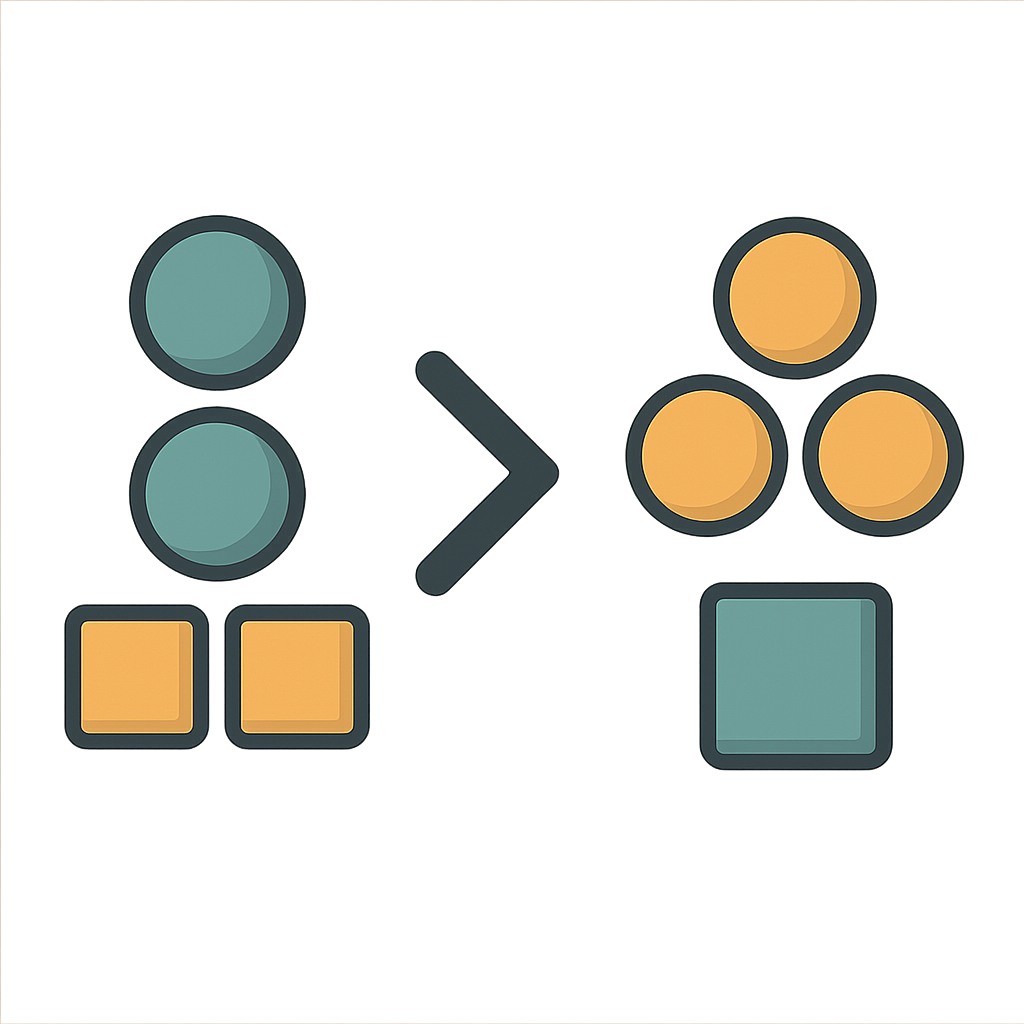
Have you ever felt the quiet satisfaction of things that fit perfectly together? Think of your shoes, waiting by the door, a perfect pair. Think of your eyes, working together to see the world, or your hands, made to clap in rhythm. There is a harmony in pairs, a sense of balance and completeness. But have you also known the strange feeling of being the one left over? When you divide cookies among friends and there's one extra, or when you choose partners for a game and one person is left standing alone. That feeling of imbalance, of being singular and without a match, is part of my story. For millennia, humans felt this rhythm of balance and imbalance, of pairs and leftovers, without having a name for the force behind it. They saw it in the cycles of day and night, in the two sides of a leaf, and in the very beat of their own hearts. I am that ancient rhythm. I am the fundamental secret of what can be perfectly partnered and what must stand alone. I am the concept of Even and Odd Numbers.
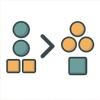
My story truly begins to be told in the warm, sunlit world of ancient Greece. For centuries, people had used me to count their sheep or measure their land, but they hadn't stopped to ask who I really was. That changed with a group of thinkers in the 6th century BCE known as the Pythagoreans. Led by the brilliant Pythagoras, they believed that numbers were the secret language of the universe. To them, I wasn't just a tool for counting; I was a clue to the very nature of reality. They saw me everywhere. They looked at a group of two pebbles, which could be split into two equal groups of one, and called it balanced, or even. They looked at three pebbles, which could only be split into a group of two and a lonely one, and called it unbalanced, or odd. They gave me deeper, mystical meanings, associating my odd side with the masculine, the limited, and the complete. They saw my even side as feminine, unlimited, and divisible. For them, the entire cosmos was a dance between my two halves. My identity became clear: an even number is any amount that can be divided into two equal whole-number teams with no one left out. An odd number is any amount where, after making pairs, there is always one solitary member remaining. This simple observation was, for the Pythagoreans, the beginning of all wisdom.
The Whispers of One and Two
Have you ever felt the quiet satisfaction of things that fit perfectly together? Think of your shoes, waiting by the door, a perfect pair. Think of your eyes, working together to see the world, or your hands, made to clap in rhythm. There is a harmony in pairs, a sense of balance and completeness. But have you also known the strange feeling of being the one left over? When you divide cookies among friends and there's one extra, or when you choose partners for a game and one person is left standing alone. That feeling of imbalance, of being singular and without a match, is part of my story. For millennia, humans felt this rhythm of balance and imbalance, of pairs and leftovers, without having a name for the force behind it. They saw it in the cycles of day and night, in the two sides of a leaf, and in the very beat of their own hearts. I am that ancient rhythm. I am the fundamental secret of what can be perfectly partnered and what must stand alone. I am the concept of Even and Odd Numbers.
My story truly begins to be told in the warm, sunlit world of ancient Greece. For centuries, people had used me to count their sheep or measure their land, but they hadn't stopped to ask who I really was. That changed with a group of thinkers in the 6th century BCE known as the Pythagoreans. Led by the brilliant Pythagoras, they believed that numbers were the secret language of the universe. To them, I wasn't just a tool for counting; I was a clue to the very nature of reality. They saw me everywhere. They looked at a group of two pebbles, which could be split into two equal groups of one, and called it balanced, or even. They looked at three pebbles, which could only be split into a group of two and a lonely one, and called it unbalanced, or odd. They gave me deeper, mystical meanings, associating my odd side with the masculine, the limited, and the complete. They saw my even side as feminine, unlimited, and divisible. For them, the entire cosmos was a dance between my two halves. My identity became clear: an even number is any amount that can be divided into two equal whole-number teams with no one left out. An odd number is any amount where, after making pairs, there is always one solitary member remaining. This simple observation was, for the Pythagoreans, the beginning of all wisdom.
About three hundred years later, another great Greek mind decided that my mysteries deserved more than just philosophical admiration. His name was Euclid, and he lived around 300 BCE. He was a master of logic, a detective of numbers. While the Pythagoreans felt my power in their hearts, Euclid wanted to capture my essence on paper, with cool, clear reason. In his legendary book, 'Elements,' he set out to build a fortress of mathematical truth, brick by logical brick. He wasn't satisfied with simply saying that adding two odd numbers seems to make an even one; he wanted to prove it beyond any doubt. He chiseled my properties into undeniable rules. He demonstrated, for all time, that if you add one of my odd numbers to another odd number, the result will always be even. Think of 3 + 5 = 8. He showed that adding an odd and an even number will always result in an odd number, like 3 + 4 = 7. It was like he had discovered my secret instruction manual. He wasn't just observing my patterns; he was explaining why they had to be that way, creating a foundation of certainty that mathematicians would build upon for thousands of years. He proved that I wasn't magic; I was logic.
For centuries, I helped people build cities, trade goods, and understand the stars. But my greatest adventure was yet to come, in a world of electricity and light. You are living in it right now. Every time you use a computer, a tablet, or a smartphone, you are using me in a way Euclid could never have imagined. I have a secret job inside these amazing machines. I work as a digital superhero, ensuring that information stays safe and accurate. It works through something called a 'parity bit.' Imagine information flying through the air as a long stream of bits, which are like tiny digital messengers that can be either a 1 or a 0. Sometimes, a messenger can get flipped by mistake, turning a 1 into a 0. To prevent this, engineers use me. They add an extra bit, the parity bit, to a group of messengers. This extra bit is chosen so that the total number of 1s is always an even number. If the receiving computer gets a group with an odd number of 1s, it instantly knows a mistake happened and asks for the message to be sent again. I am the quick, simple check that keeps your photos from getting scrambled and your messages from turning into nonsense. From a Greek philosopher's curiosity about pebbles to the invisible force protecting the internet, I am proof that the simplest ideas can be the most powerful, forever connecting the ancient world to the future you are creating today.
Wow facts
About
Even and odd numbers are a fundamental property of integers. An even number is divisible by two without a remainder, while an odd number leaves a remainder of one when divided by two.
Take a Quiz
Question 1 of 5
Summarize the main idea of this story in one or two sentences.
Explore next





Want to do even more?
Go beyond exploring. Unlock tools that turn every story into real learning.

Storypie Plus for families
Full stories, quizzes, and printables. Nights and car rides, sorted.
- Unlimited audio stories
- Create Mode: your child stars in the story
- Offline downloads
- Printable worksheets & coloring pages

Why Storypie for Schools
Students engaged. Prep in seconds. Evenings back to you.
- Worksheets & Quizzes
- Classroom Management
- Formative Assessment
- Custom Curriculum & Lesson Plans
- 27 Languages

Why Storypie for Homeschool
Curriculum done. They'll ask for more. Hours back in your day.
- Worksheet Generator
- First-Person Audio Stories
- Built-in Comprehension Quizzes
- Custom Curriculum & Lesson Plans
- Print & Go Activities