English

General Theory of Relativity
Albert Einstein's theory describing gravity as a curvature of spacetime caused by mass and energy…
Reads at Grades 6–8 Listens at Grades 4–8
Print & create
Answer keys·No prep·Free with an account
28 worksheets · answer keys · full story · quiz · Ages 10-12 · CEFR B2
Plus adds 164,000+ more stories in 27 languages, audio for every one, and printables for all of them.
Just want General Theory of Relativity?
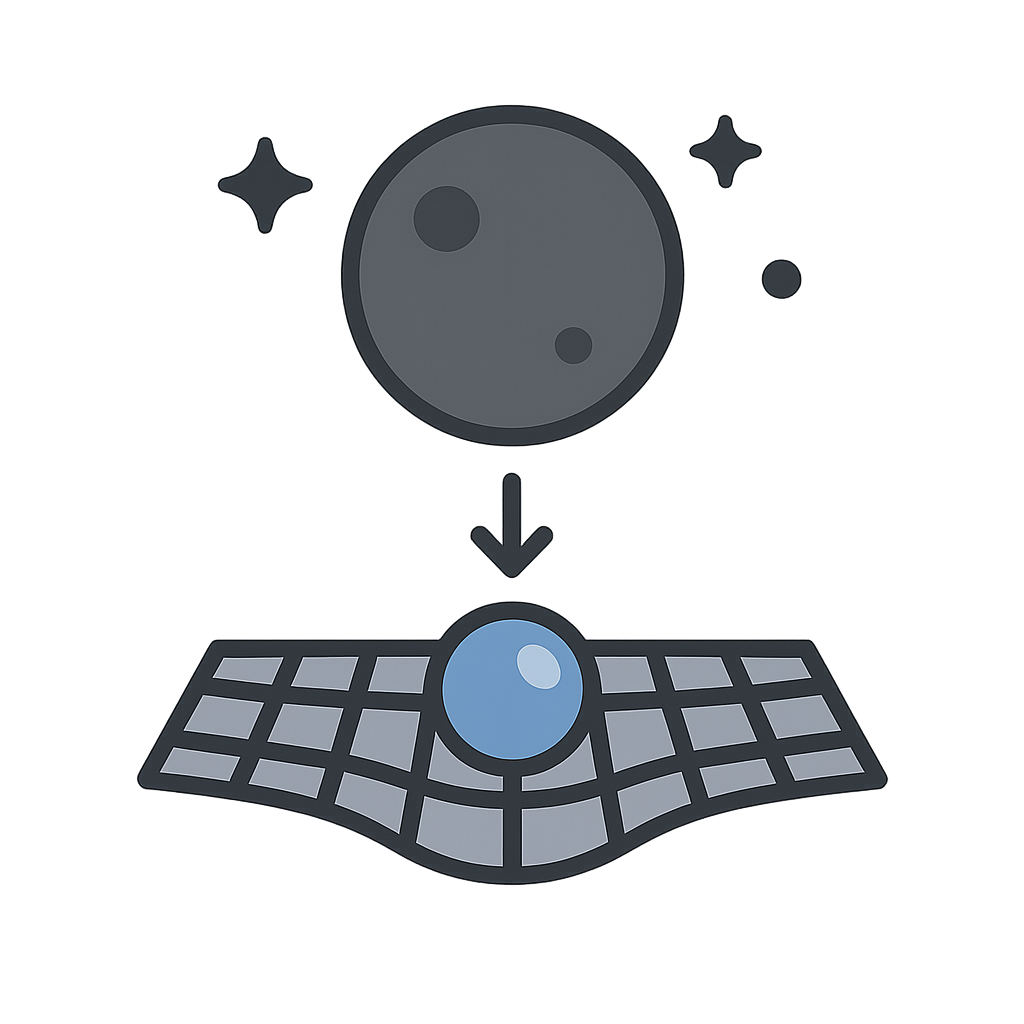
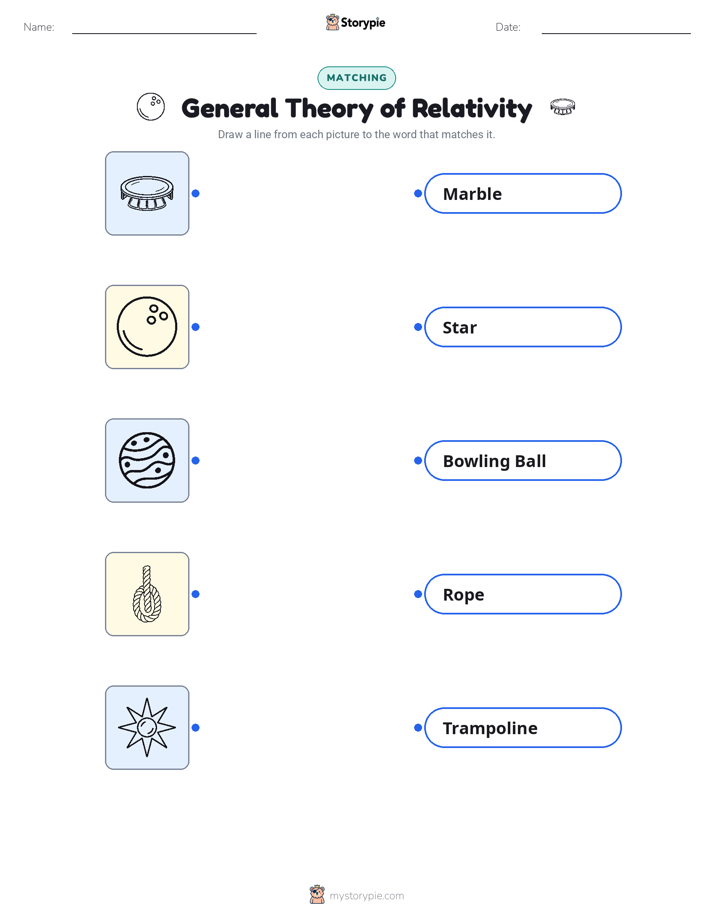
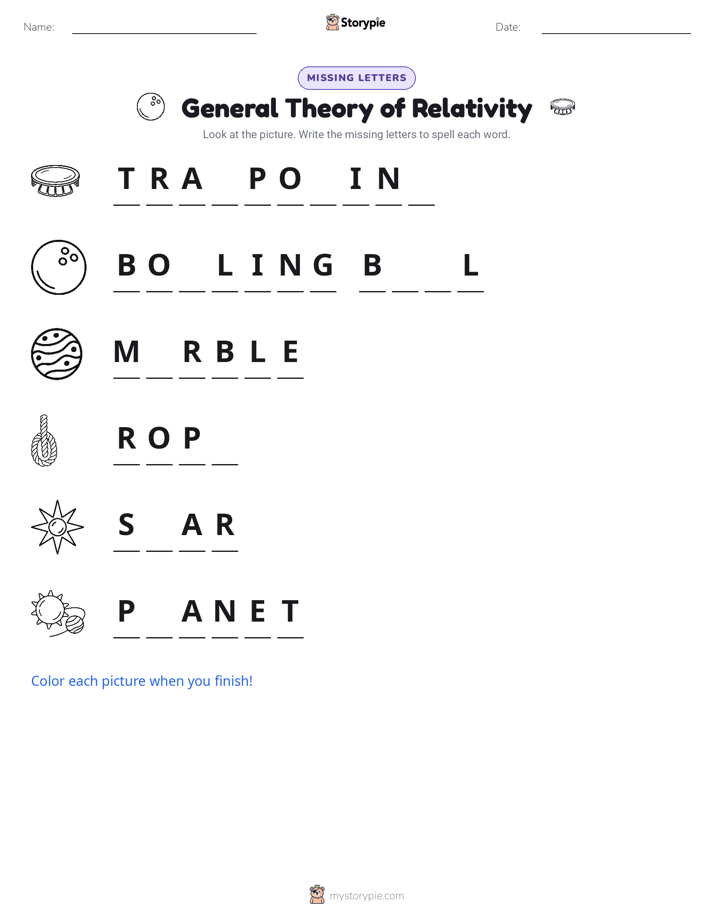
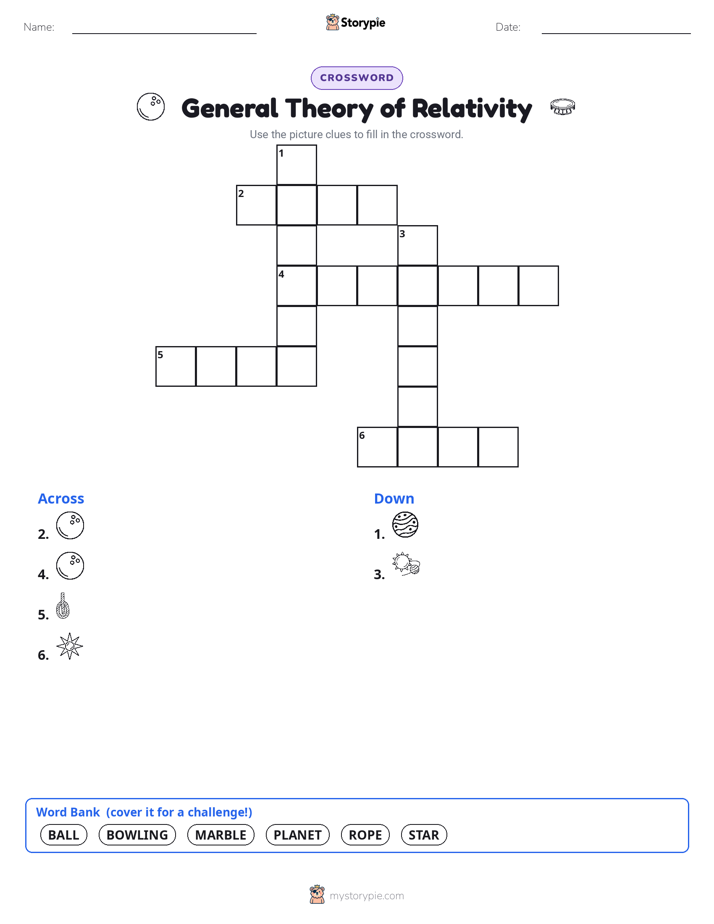
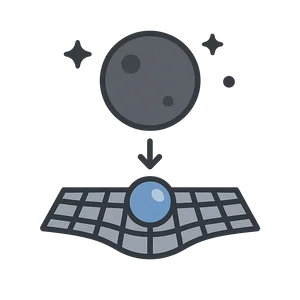
Imagine the universe is a giant, stretchy trampoline. Now, picture placing a huge bowling ball right in the middle. See how it creates a deep dip? That's what massive things like stars and planets do to the fabric of space and time. They bend and curve it. I am that bending and curving. When a smaller marble rolls nearby, it doesn't travel in a straight line anymore; it follows the curve made by the bowling ball. That's me in action. For a long time, people thought gravity was just an invisible rope pulling things together, a mysterious force described by Sir Isaac Newton back in the 17th century. His ideas were brilliant and worked for most things, but they weren't the whole story. I am something much more wondrous and fundamental. I am the shape of the universe itself. I am the reason planets orbit suns, and galaxies whirl in giant cosmic dances. I am the secret whisper that tells matter how to move and the gentle curve that guides light on its journey across billions of years. My real name is a bit of a mouthful, but it describes me perfectly. Hello, I am the General Theory of Relativity.
I wasn't just discovered; I was imagined by one of the most brilliant minds in human history: Albert Einstein. Around 1907, he began to think very deeply about gravity. He knew Newton's ideas were amazing, but they didn't explain everything, especially what happened near very massive objects or at very high speeds. Einstein was bothered by the idea of a force that could act instantly across vast, empty distances. He had a famous 'happiest thought' where he imagined a man falling from a roof. He realized the man wouldn't feel his own weight—he'd be in freefall. In that moment, gravity would seem to disappear. This led Einstein to a revolutionary idea called the equivalence principle: the effects of gravity are indistinguishable from the effects of acceleration. For the next eight years, from about 1907 to 1915, Einstein wrestled with incredibly complex mathematics to turn this beautiful idea into a complete theory. It was a long, difficult struggle full of dead ends and breakthroughs. He pictured space and time not as a fixed background, but as a single, four-dimensional fabric he called spacetime, which could be warped and stretched by matter and energy. Finally, on November 25th, 1915, he presented his completed field equations to the Prussian Academy of Sciences in Berlin. That was my official birthday. I was born from pure thought, a new and beautiful way to understand the force that holds the universe together.
The Universe's Secret Shape
Imagine the universe is a giant, stretchy trampoline. Now, picture placing a huge bowling ball right in the middle. See how it creates a deep dip? That's what massive things like stars and planets do to the fabric of space and time. They bend and curve it. I am that bending and curving. When a smaller marble rolls nearby, it doesn't travel in a straight line anymore; it follows the curve made by the bowling ball. That's me in action. For a long time, people thought gravity was just an invisible rope pulling things together, a mysterious force described by Sir Isaac Newton back in the 17th century. His ideas were brilliant and worked for most things, but they weren't the whole story. I am something much more wondrous and fundamental. I am the shape of the universe itself. I am the reason planets orbit suns, and galaxies whirl in giant cosmic dances. I am the secret whisper that tells matter how to move and the gentle curve that guides light on its journey across billions of years. My real name is a bit of a mouthful, but it describes me perfectly. Hello, I am the General Theory of Relativity.
I wasn't just discovered; I was imagined by one of the most brilliant minds in human history: Albert Einstein. Around 1907, he began to think very deeply about gravity. He knew Newton's ideas were amazing, but they didn't explain everything, especially what happened near very massive objects or at very high speeds. Einstein was bothered by the idea of a force that could act instantly across vast, empty distances. He had a famous 'happiest thought' where he imagined a man falling from a roof. He realized the man wouldn't feel his own weight—he'd be in freefall. In that moment, gravity would seem to disappear. This led Einstein to a revolutionary idea called the equivalence principle: the effects of gravity are indistinguishable from the effects of acceleration. For the next eight years, from about 1907 to 1915, Einstein wrestled with incredibly complex mathematics to turn this beautiful idea into a complete theory. It was a long, difficult struggle full of dead ends and breakthroughs. He pictured space and time not as a fixed background, but as a single, four-dimensional fabric he called spacetime, which could be warped and stretched by matter and energy. Finally, on November 25th, 1915, he presented his completed field equations to the Prussian Academy of Sciences in Berlin. That was my official birthday. I was born from pure thought, a new and beautiful way to understand the force that holds the universe together.
Being a brand-new idea, especially one that changed everything people thought they knew about gravity, I had to prove I was right. My biggest and boldest prediction was that gravity is so powerful it can even bend the path of light. Einstein calculated that the massive gravity of the Sun should warp spacetime enough to bend the light from distant stars as it passes by. The problem was that you can't see stars during the day when the Sun's bright glare washes them out. But there was a clever solution: a total solar eclipse. On May 29th, 1919, a British astronomer named Sir Arthur Eddington led expeditions to two different parts of the world—one to the island of Príncipe off the coast of Africa and another to Brazil—to observe one. As the Moon perfectly blocked the Sun's bright light, the sky went dark, and the stars near the Sun became visible for a few precious minutes. The astronomers took photographs and carefully measured the positions of those stars. When they later compared these photos to pictures of the same stars taken at night months earlier, they found something amazing. The stars' apparent positions had shifted. The light from them had indeed been bent by the Sun's gravity, by the exact amount I had predicted. The news spread like wildfire around the world. I had passed my first big test, and Einstein became world-famous overnight. I also solved an old puzzle about the planet Mercury, whose orbit had a strange little wobble that Newton's theory couldn't quite explain. I showed that the wobble was caused by the Sun's powerful warping of spacetime close to it.
Today, I'm not just a revolutionary idea in a textbook. I am a working part of your everyday life. Do you ever use a GPS to find your way? Your phone's GPS talks to satellites orbiting high above Earth. Because those satellites are in a weaker gravitational field and are moving so fast, their clocks actually run slightly faster than clocks down here on the ground. It's a tiny difference, but it adds up. If scientists didn't use my equations to constantly correct for this time-stretching effect, your GPS would become inaccurate by several miles every single day. I also predict some of the most mind-boggling and awesome objects in the universe, like black holes, which are regions of spacetime curved so intensely that nothing, not even light, can escape. For decades, they were just a theoretical possibility. I also predicted that when massive objects like black holes or neutron stars collide, they send out ripples in the fabric of spacetime itself called gravitational waves. For a hundred years, these were just a prediction, but on September 14th, 2015, scientists finally detected them for the first time using the LIGO observatory. It was like hearing the universe's drumbeat from over a billion years ago. My story shows that curiosity and imagination can change the world. I am a reminder that the universe is far more strange and wonderful than we can see, and there are always new mysteries waiting to be solved. So keep looking up, keep asking questions, and who knows what new ideas you might bring to life.
Wow facts
About
Albert Einstein's theory describing gravity as a curvature of spacetime caused by mass and energy, which governs the motion of planets, stars, and the expansion of the universe.
Take a Quiz
Question 1 of 5
In your own words, describe the main events of the 1919 expedition that helped prove the theory was correct.
Explore next





Want to do even more?
Go beyond exploring. Unlock tools that turn every story into real learning.

Storypie Plus for families
Full stories, quizzes, and printables. Nights and car rides, sorted.
- Unlimited audio stories
- Create Mode: your child stars in the story
- Offline downloads
- Printable worksheets & coloring pages

Why Storypie for Schools
Students engaged. Prep in seconds. Evenings back to you.
- Worksheets & Quizzes
- Classroom Management
- Formative Assessment
- Custom Curriculum & Lesson Plans
- 27 Languages

Why Storypie for Homeschool
Curriculum done. They'll ask for more. Hours back in your day.
- Worksheet Generator
- First-Person Audio Stories
- Built-in Comprehension Quizzes
- Custom Curriculum & Lesson Plans
- Print & Go Activities