English

General Theory of Relativity
Albert Einstein's theory describing gravity as a curvature of spacetime caused by mass and energy…
Reads at Grades 3–5 Listens at Grades 1–5
Print & create
Answer keys·No prep·Free with an account
28 worksheets · answer keys · full story · quiz · Ages 8-10 · CEFR B1
Plus adds 164,000+ more stories in 27 languages, audio for every one, and printables for all of them.
Just want General Theory of Relativity?
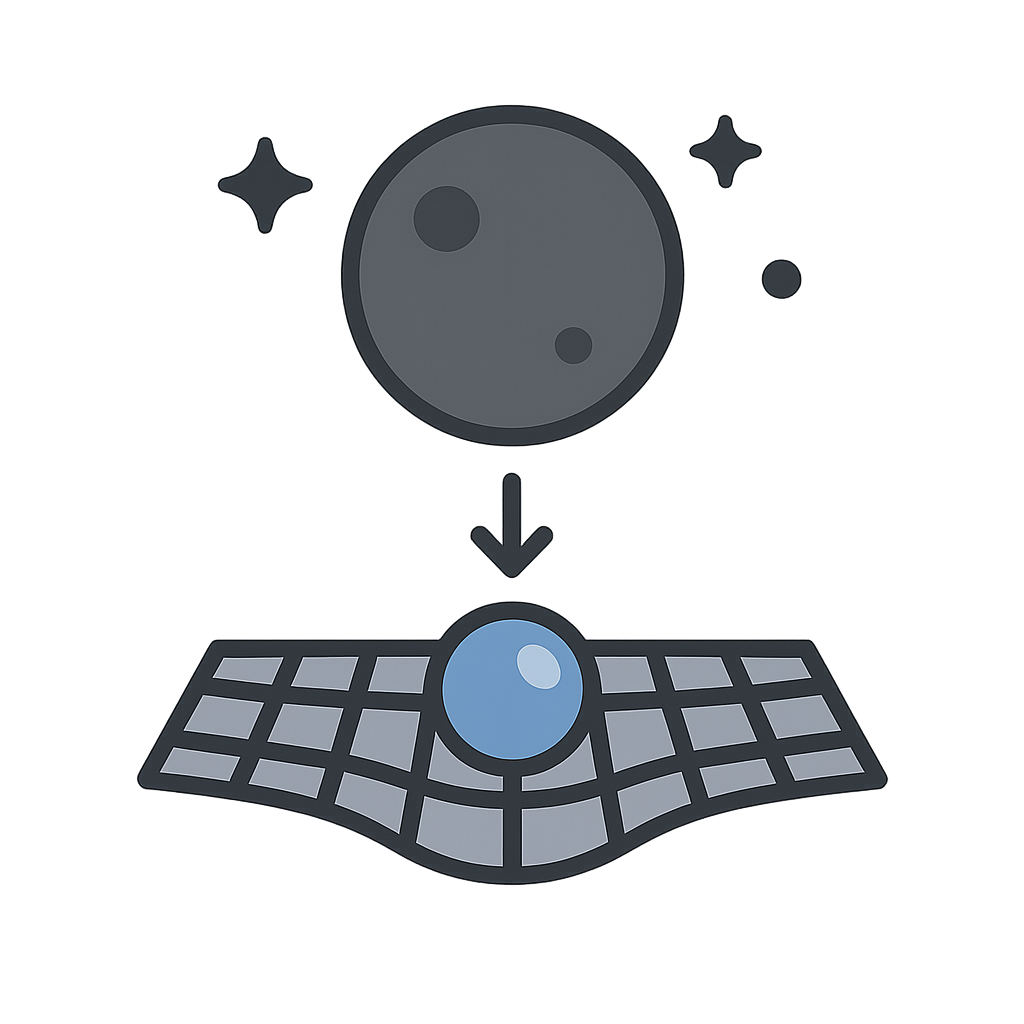
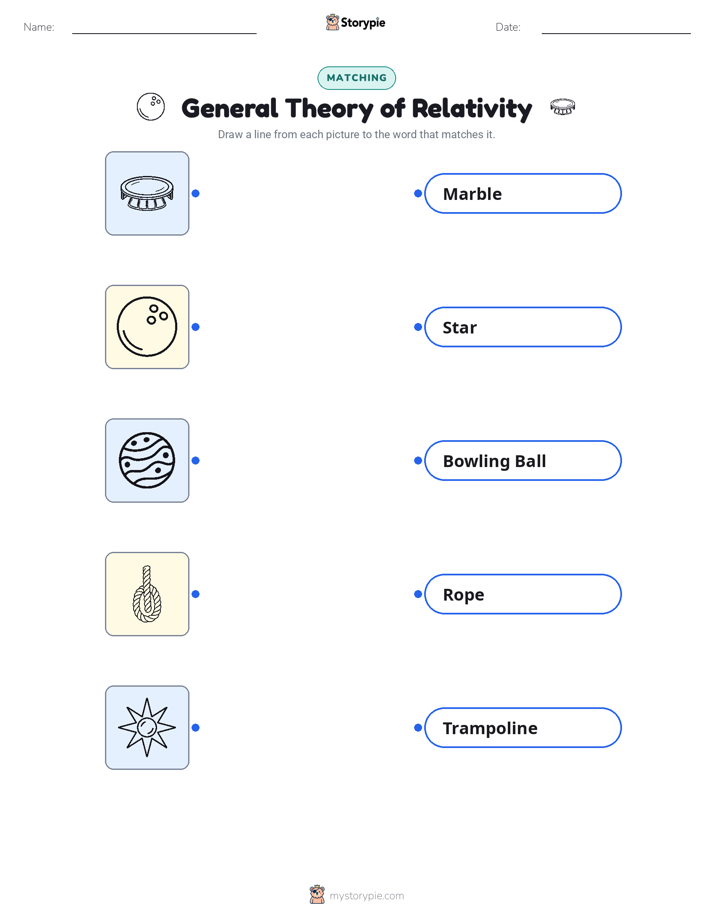
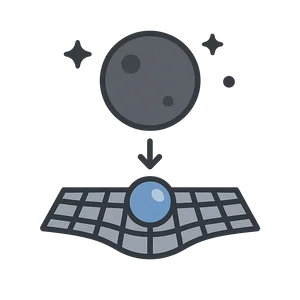
Have you ever looked up at the night sky and wondered what keeps the Moon from floating away from the Earth? Or why all the planets in our solar system travel in huge, looping paths around the Sun, like they are on a cosmic racetrack? For a very long time, people thought it was a mysterious, invisible rope pulling everything together. But that’s not quite the whole picture. Can you imagine that the entire universe, all of space and time, is like one giant, stretchy trampoline? Now, picture placing a very heavy bowling ball right in the middle. What happens? It sinks down, creating a big curve in the fabric. That’s what massive objects like the Sun do to the fabric of space. And smaller objects, like our planet Earth, are not being pulled by a rope. They are just rolling along the curved path created by the Sun, like a marble circling the dip made by the bowling ball. It’s a whole new way of seeing the invisible force that holds everything together, a dance of curves and paths instead of a simple tug-of-war. I am the idea that explains this cosmic dance. I am the General Theory of Relativity.
I was brought to life by a very clever man with famously wild hair and a playful twinkle in his eye. His name was Albert Einstein. The first spark of my existence came to him in 1907 in what he called his “happiest thought.” He was sitting in his office when he suddenly imagined a person falling from a roof. He realized that this person wouldn't feel their own weight—it would be just like floating in space. Then he thought about a person in an elevator that was accelerating upward very fast. They would feel pressed to the floor, exactly as if gravity had suddenly gotten stronger. This simple idea, that feeling gravity is the same as feeling acceleration, was the tiny seed from which I grew. But turning that happy thought into a complete theory was incredibly hard work. It took Einstein eight more years of wrestling with some of the most difficult math you can imagine. He filled notebook after notebook with complicated equations, trying to describe the universe’s trampoline. Finally, on November 25th, 1915, he was ready. He shared me with the world. But a great idea needs proof. That proof came during a total solar eclipse on May 29th, 1919. A team of scientists led by Sir Arthur Eddington traveled to distant places to watch as the Moon blocked the Sun. They took pictures of the stars that appeared in the sky near the hidden Sun. They saw that the light from those distant stars was actually bent as it passed by the Sun's massive curve in space, exactly as I had predicted. The universe really was a trampoline.
The Universe's Invisible Trampoline
Have you ever looked up at the night sky and wondered what keeps the Moon from floating away from the Earth? Or why all the planets in our solar system travel in huge, looping paths around the Sun, like they are on a cosmic racetrack? For a very long time, people thought it was a mysterious, invisible rope pulling everything together. But that’s not quite the whole picture. Can you imagine that the entire universe, all of space and time, is like one giant, stretchy trampoline? Now, picture placing a very heavy bowling ball right in the middle. What happens? It sinks down, creating a big curve in the fabric. That’s what massive objects like the Sun do to the fabric of space. And smaller objects, like our planet Earth, are not being pulled by a rope. They are just rolling along the curved path created by the Sun, like a marble circling the dip made by the bowling ball. It’s a whole new way of seeing the invisible force that holds everything together, a dance of curves and paths instead of a simple tug-of-war. I am the idea that explains this cosmic dance. I am the General Theory of Relativity.
I was brought to life by a very clever man with famously wild hair and a playful twinkle in his eye. His name was Albert Einstein. The first spark of my existence came to him in 1907 in what he called his “happiest thought.” He was sitting in his office when he suddenly imagined a person falling from a roof. He realized that this person wouldn't feel their own weight—it would be just like floating in space. Then he thought about a person in an elevator that was accelerating upward very fast. They would feel pressed to the floor, exactly as if gravity had suddenly gotten stronger. This simple idea, that feeling gravity is the same as feeling acceleration, was the tiny seed from which I grew. But turning that happy thought into a complete theory was incredibly hard work. It took Einstein eight more years of wrestling with some of the most difficult math you can imagine. He filled notebook after notebook with complicated equations, trying to describe the universe’s trampoline. Finally, on November 25th, 1915, he was ready. He shared me with the world. But a great idea needs proof. That proof came during a total solar eclipse on May 29th, 1919. A team of scientists led by Sir Arthur Eddington traveled to distant places to watch as the Moon blocked the Sun. They took pictures of the stars that appeared in the sky near the hidden Sun. They saw that the light from those distant stars was actually bent as it passed by the Sun's massive curve in space, exactly as I had predicted. The universe really was a trampoline.
It might seem like I only deal with giant stars and planets, but I am actually working in your life right now in ways you might not expect. Do you or your family ever use a GPS to find your way to a new place? Well, you have me to thank for that. The satellites that circle the Earth, telling your phone where you are, are moving very fast and are far away from Earth's gravity. Because of me, time for those satellites actually ticks just a tiny bit faster than it does for us down here. If the clever scientists didn't use my equations to adjust their clocks, the GPS directions would be off by about seven miles every single day. Your map might tell you to turn into a lake. I also help scientists understand some of the most mysterious and powerful things in the universe, like giant black holes where gravity is so strong that not even light can escape, and how the entire universe began. I am proof that there are always incredible new ways to look at the world. So keep looking up, keep asking questions, and never stop being curious. You never know when you might have your own “happiest thought.”
Wow facts
About
Albert Einstein's theory describing gravity as a curvature of spacetime caused by mass and energy, which governs the motion of planets, stars, and the expansion of the universe.
Take a Quiz
Question 1 of 5
In the story, the universe is compared to a 'giant, stretchy trampoline.' What does this comparison help explain?
Explore next




Want to do even more?
Go beyond exploring. Unlock tools that turn every story into real learning.

Storypie Plus for families
Full stories, quizzes, and printables. Nights and car rides, sorted.
- Unlimited audio stories
- Create Mode: your child stars in the story
- Offline downloads
- Printable worksheets & coloring pages

Why Storypie for Schools
Students engaged. Prep in seconds. Evenings back to you.
- Worksheets & Quizzes
- Classroom Management
- Formative Assessment
- Custom Curriculum & Lesson Plans
- 27 Languages

Why Storypie for Homeschool
Curriculum done. They'll ask for more. Hours back in your day.
- Worksheet Generator
- First-Person Audio Stories
- Built-in Comprehension Quizzes
- Custom Curriculum & Lesson Plans
- Print & Go Activities