English

Lines, Rays, and Line Segments
A fundamental concept in geometry defining straight paths.
Reads at Grades 3–5 Listens at Grades 1–5
Print & create
Answer keys·No prep·Free with an account
28 worksheets · answer keys · full story · quiz · Ages 8-10 · CEFR B1
Plus adds 244,000+ more stories in 27 languages, audio for every one, and printables for all of them.
Just want Lines, Rays, and Line Segments?

Imagine the very edge of your book, perfectly straight and sharp. See the bright yellow stripe painted down the middle of a busy road, dividing it perfectly? Or think about the path a flashlight beam makes when you shine it into the dark night, a long, straight shot of light. That’s me. I can be very short and definite, like one side of a tiny sugar cube, or I can seem to stretch on forever and ever, like the horizon line where the big blue sky meets the ocean. Sometimes I have a clear beginning and a clear end, making a neat little piece of a path. Other times, I start at one point and just keep on going, like a ray of sunshine shooting all the way from the sun to your window. Can you imagine a world without straight paths or sharp edges? It would be a very wobbly and confusing place. You wouldn’t have buildings that stand up tall or roads that lead you directly home. What am I? I am the family of Lines, Rays, and Line Segments, the simple, powerful building blocks for so much of what you see, build, and draw every single day.
My story begins a very, very long time ago, even before the great pyramids were built. In ancient Egypt, around 3000 BCE, people's lives depended on the mighty Nile River. Every year, the river would flood, bringing rich soil for farming, but it would also wash away all the little stone markers that showed where one farmer's field ended and another's began. As you can imagine, this could cause big arguments. To solve the problem, special workers called 'rope-stretchers' would come. They used long ropes with knots tied at even spaces. By pulling the ropes tight between two points, they created me—a perfectly straight line segment—to measure and redraw the boundaries so everything was fair again. For a long time, I was just a simple, useful tool for measuring land. But my story didn't end in the muddy fields. Thousands of years later, in ancient Greece, a brilliant thinker named Euclid, who lived around the 3rd century BCE, saw me as more than just a tool. He saw me as a powerful idea. In his famous book called 'Elements,' he gave me and my family official names and descriptions that people still use today. He explained that a Line Segment has two endpoints, just like the rope-stretchers' rope. He described a Ray as having one starting point but going on forever in one direction, like that beam of sunlight. And a true Line? He said a line goes on forever in both directions, something so long you can only truly see it in your mind. He helped everyone understand my rules, turning me from a rope in the mud into a perfect idea.
A Straight Path Through Your World
Imagine the very edge of your book, perfectly straight and sharp. See the bright yellow stripe painted down the middle of a busy road, dividing it perfectly? Or think about the path a flashlight beam makes when you shine it into the dark night, a long, straight shot of light. That’s me. I can be very short and definite, like one side of a tiny sugar cube, or I can seem to stretch on forever and ever, like the horizon line where the big blue sky meets the ocean. Sometimes I have a clear beginning and a clear end, making a neat little piece of a path. Other times, I start at one point and just keep on going, like a ray of sunshine shooting all the way from the sun to your window. Can you imagine a world without straight paths or sharp edges? It would be a very wobbly and confusing place. You wouldn’t have buildings that stand up tall or roads that lead you directly home. What am I? I am the family of Lines, Rays, and Line Segments, the simple, powerful building blocks for so much of what you see, build, and draw every single day.
My story begins a very, very long time ago, even before the great pyramids were built. In ancient Egypt, around 3000 BCE, people's lives depended on the mighty Nile River. Every year, the river would flood, bringing rich soil for farming, but it would also wash away all the little stone markers that showed where one farmer's field ended and another's began. As you can imagine, this could cause big arguments. To solve the problem, special workers called 'rope-stretchers' would come. They used long ropes with knots tied at even spaces. By pulling the ropes tight between two points, they created me—a perfectly straight line segment—to measure and redraw the boundaries so everything was fair again. For a long time, I was just a simple, useful tool for measuring land. But my story didn't end in the muddy fields. Thousands of years later, in ancient Greece, a brilliant thinker named Euclid, who lived around the 3rd century BCE, saw me as more than just a tool. He saw me as a powerful idea. In his famous book called 'Elements,' he gave me and my family official names and descriptions that people still use today. He explained that a Line Segment has two endpoints, just like the rope-stretchers' rope. He described a Ray as having one starting point but going on forever in one direction, like that beam of sunlight. And a true Line? He said a line goes on forever in both directions, something so long you can only truly see it in your mind. He helped everyone understand my rules, turning me from a rope in the mud into a perfect idea.
Once Euclid wrote everything down, people had a clear, shared language to talk about me, and they started using me in amazing new ways. Have you ever seen pictures of the ancient Roman aqueducts? They were like long water bridges that carried fresh water to cities from miles and miles away. Roman engineers used me to design them, making sure they were strong, straight, and had the perfect gentle slope to keep the water flowing. Centuries later, during a time of incredible art and learning called the Renaissance, around the 15th century, artists made a huge discovery. They realized they could use me to create a kind of magic on a flat canvas. By drawing lines that all seemed to point toward a single spot in the distance, they created something called perspective. Suddenly, their paintings looked so real you felt like you could step right inside. I helped them draw roads that stretched far away and buildings that looked solid and three-dimensional, not flat. I wasn't just for measuring land anymore; I was helping people see the world in a whole new way.
Today, I am still everywhere, quietly helping you in ways you might not even notice. I am in the computer code that creates the worlds in your favorite video games, mapping out the paths for characters to follow. I am in the architect's blueprints that plan for towering skyscrapers, making sure every wall is straight and every floor is level. I am in the flight plans that guide airplanes safely across the sky from one city to another, showing them the most direct route. I am a connection between two points. I am a direction showing you where to go. I am a boundary that forms the edges of all the wonderful shapes you can imagine. Whenever you draw a straight path, build a tower with blocks, or simply point the way for a friend, you are using my ancient and powerful idea to connect your thoughts to the world. You are part of my story.
Wow facts
About
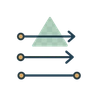
A fundamental concept in geometry defining straight paths. A line extends infinitely in two directions, a ray has one starting point and extends infinitely in one direction, and a line segment is a finite portion of a line with two endpoints.
Take a Quiz
Question 1 of 5
In the story, the Egyptian workers were called 'rope-stretchers.' Why was this a good name for them?
Explore next




Want to do even more?
Go beyond exploring. Unlock tools that turn every story into real learning.

Storypie Plus for families
Full stories, quizzes, and printables. Nights and car rides, sorted.
- Unlimited audio stories
- Create Mode: your child stars in the story
- Offline downloads
- Printable worksheets & coloring pages

Why Storypie for Schools
Students engaged. Prep in seconds. Evenings back to you.
- Worksheets & Quizzes
- Classroom Management
- Formative Assessment
- Custom Curriculum & Lesson Plans
- 27 Languages

Why Storypie for Homeschool
Curriculum done. They'll ask for more. Hours back in your day.
- Worksheet Generator
- First-Person Audio Stories
- Built-in Comprehension Quizzes
- Custom Curriculum & Lesson Plans
- Print & Go Activities