English

Paleontology
Paleontology is the scientific study of the history of life on Earth based on fossils…
Reads at Grades 6–8 Listens at Grades 4–8
Print & create
Answer keys·No prep·Free with an account
28 worksheets · answer keys · full story · quiz · Ages 10-12 · CEFR B2
Plus adds 164,000+ more stories in 27 languages, audio for every one, and printables for all of them.
Just want Paleontology?
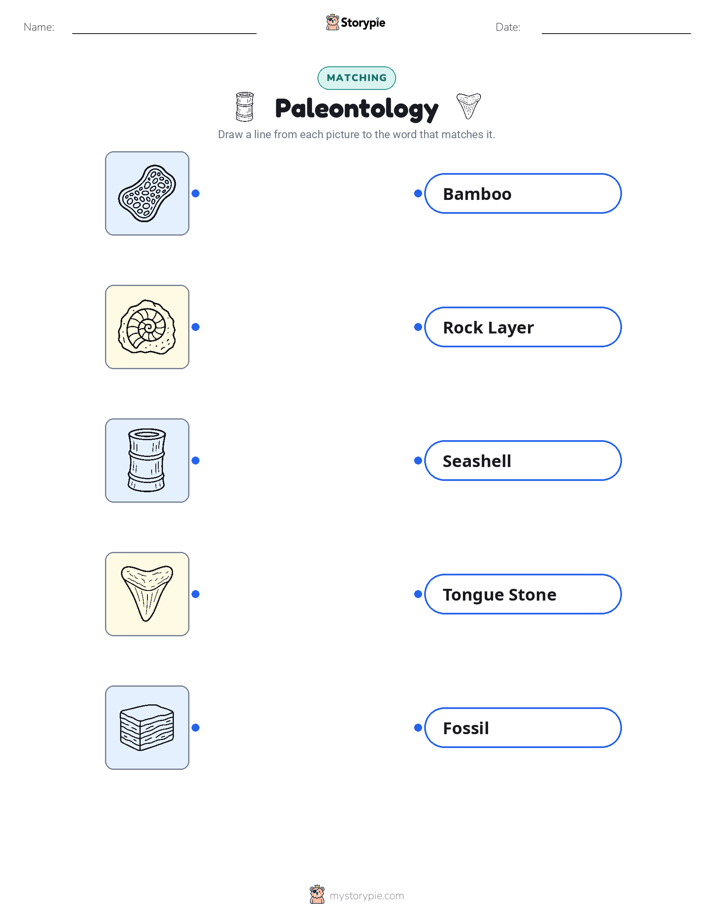
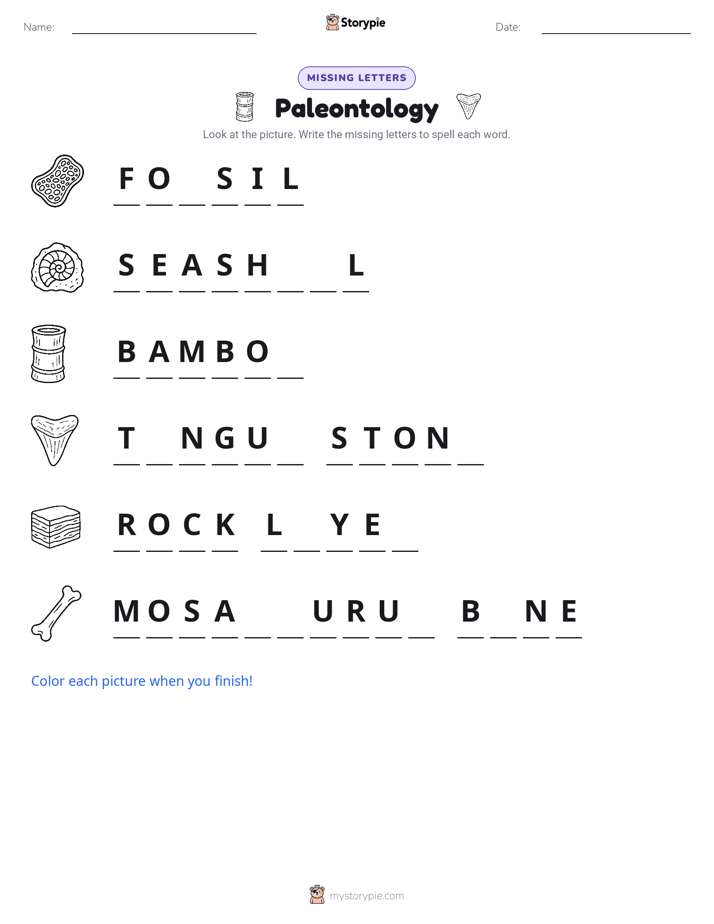
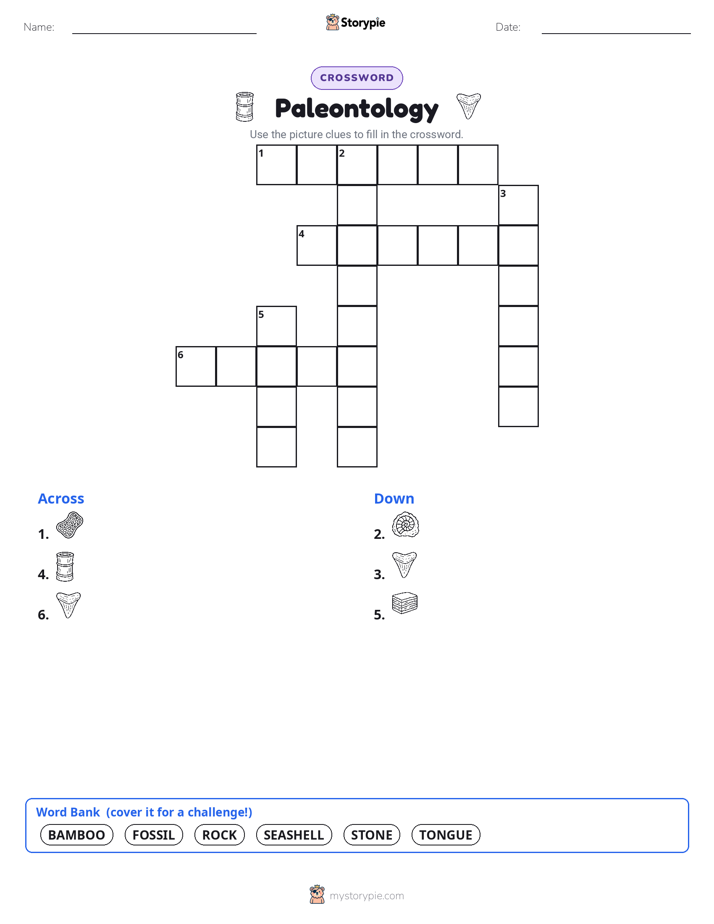
I am the keeper of Earth’s oldest secrets, stories written not in ink, but in stone. For thousands of years, people stumbled upon my clues without knowing how to read them. They found bones turned to rock, delicate seashells resting on high mountaintops, and giant footprints that the rain could never wash away. These were whispers of a world long vanished. As far back as the 6th century BCE, a Greek thinker named Xenophanes saw fossil seashells high in the mountains and correctly guessed that the land must have once been underwater. Millennia later, in 11th-century China, a brilliant scholar named Shen Kuo discovered fossilized bamboo in a dry northern region and deduced that the climate there must have been dramatically different in the ancient past. But for most of history, people explained my mysteries with myths. My giant bones were thought to belong to dragons, griffins, or mythical giants from epic tales. I was a puzzle scattered across the globe, a collection of riddles waiting for someone to find the key. I am the story of life itself, written in the layers of the world. I am the study of ancient life. I am Paleontology.
For centuries, the shift from myth to science was slow, built piece by piece by curious minds. In the 17th century, a Danish scientist named Nicolas Steno began to truly read my stories. In 1669, while studying the head of a huge shark, he proved that mysterious triangular stones called ‘tongue stones’ were actually the fossilized teeth of ancient sharks. More importantly, he realized that the layers of rock, or strata, were like pages in a history book. He explained that the oldest layers were at the bottom and the youngest were at the top, giving humanity a way to read Earth’s timeline. Then came Georges Cuvier in France, a man often called my father. Around 1796, he began meticulously studying the bones of enormous animals like the Mosasaurus and the mammoth. He compared them to the skeletons of living animals and proved they were not related to any creature alive on Earth. They were extinct. This was a revolutionary and shocking idea. It meant that entire worlds of animals had lived and then vanished completely from the planet. At the same time, in the early 19th century, a brilliant and determined young woman named Mary Anning was making world-changing discoveries on the crumbling cliffs of Lyme Regis, England. Though she was not formally recognized as a scientist because of her gender and social class, her skill was unmatched. Around 1811, she unearthed the first complete skeleton of an Ichthyosaur, a fish-like reptile, and in 1823, she found a stunning, long-necked Plesiosaur. Mary Anning’s fossils showed the world the strange and wonderful creatures that once swam in ancient seas.
The Earth's Stone Storybook
I am the keeper of Earth’s oldest secrets, stories written not in ink, but in stone. For thousands of years, people stumbled upon my clues without knowing how to read them. They found bones turned to rock, delicate seashells resting on high mountaintops, and giant footprints that the rain could never wash away. These were whispers of a world long vanished. As far back as the 6th century BCE, a Greek thinker named Xenophanes saw fossil seashells high in the mountains and correctly guessed that the land must have once been underwater. Millennia later, in 11th-century China, a brilliant scholar named Shen Kuo discovered fossilized bamboo in a dry northern region and deduced that the climate there must have been dramatically different in the ancient past. But for most of history, people explained my mysteries with myths. My giant bones were thought to belong to dragons, griffins, or mythical giants from epic tales. I was a puzzle scattered across the globe, a collection of riddles waiting for someone to find the key. I am the story of life itself, written in the layers of the world. I am the study of ancient life. I am Paleontology.
For centuries, the shift from myth to science was slow, built piece by piece by curious minds. In the 17th century, a Danish scientist named Nicolas Steno began to truly read my stories. In 1669, while studying the head of a huge shark, he proved that mysterious triangular stones called ‘tongue stones’ were actually the fossilized teeth of ancient sharks. More importantly, he realized that the layers of rock, or strata, were like pages in a history book. He explained that the oldest layers were at the bottom and the youngest were at the top, giving humanity a way to read Earth’s timeline. Then came Georges Cuvier in France, a man often called my father. Around 1796, he began meticulously studying the bones of enormous animals like the Mosasaurus and the mammoth. He compared them to the skeletons of living animals and proved they were not related to any creature alive on Earth. They were extinct. This was a revolutionary and shocking idea. It meant that entire worlds of animals had lived and then vanished completely from the planet. At the same time, in the early 19th century, a brilliant and determined young woman named Mary Anning was making world-changing discoveries on the crumbling cliffs of Lyme Regis, England. Though she was not formally recognized as a scientist because of her gender and social class, her skill was unmatched. Around 1811, she unearthed the first complete skeleton of an Ichthyosaur, a fish-like reptile, and in 1823, she found a stunning, long-necked Plesiosaur. Mary Anning’s fossils showed the world the strange and wonderful creatures that once swam in ancient seas.
After Mary Anning’s sea monsters captured the world’s imagination, people began finding the remains of giant land creatures. In 1824, a professor at Oxford named William Buckland described the first of these, a fearsome predator he named Megalosaurus. A few years later, a country doctor named Gideon Mantell and his wife Mary Ann discovered the fossilized teeth of a giant plant-eater they called Iguanodon. These bones were so large and so strange that in 1842, a brilliant scientist named Richard Owen decided they needed their own special group. He coined the term ‘Dinosauria,’ which means ‘terrible lizards,’ and the world has been fascinated ever since. This excitement exploded into the ‘Bone Wars’ in the United States during the late 19th century. Two rival paleontologists, Edward Drinker Cope and Othniel Charles Marsh, engaged in a fierce and often bitter competition to discover more dinosaurs than the other. They raced across the American West, uncovering incredible skeletons of now-famous dinosaurs like Stegosaurus, Triceratops, and Allosaurus. Their rivalry was chaotic, but it filled museums with wonders and gave us a much richer, more detailed picture of the world I study. It was also during this period, in 1861, that a remarkable fossil was found in Germany. It was Archaeopteryx, a creature with the feathered wings of a bird but the teeth and bony tail of a dinosaur. It was the first major clue to a puzzle that would take more than a century to solve.
Today, the people who work with me are high-tech detectives solving ancient mysteries. Modern paleontologists use CT scanners to peer inside a fossilized skull without ever breaking it, and they use powerful computers to model how a dinosaur might have moved, hunted, and lived. The questions I help them answer have grown even bigger and more profound. In 1980, the father-son team of Luis and Walter Alvarez proposed a groundbreaking theory that a giant asteroid impact caused the mass extinction that wiped out the dinosaurs 66 million years ago, a theory now widely accepted. Then, in the 1990s, incredible fossils of dinosaurs covered in feathers were discovered in China. These fossils provided the final, conclusive proof that birds are the direct descendants of dinosaurs, meaning dinosaurs never truly vanished. I am not just a story about the past. By studying how life on Earth responded to ancient climate change and mass extinctions, I give humans crucial insights into our own planet’s future. I am a living, growing story, a book with countless pages yet to be unearthed. And there are still so many secrets locked in stone, just waiting for the next curious mind to discover them.
Wow facts
About
Paleontology is the scientific study of the history of life on Earth based on fossils, which are the remains of plants, animals, and other organisms from the distant past.
Take a Quiz
Question 1 of 5
What major problem did Georges Cuvier's work solve, and what revolutionary idea did it introduce to the world?
Explore next






Want to do even more?
Go beyond exploring. Unlock tools that turn every story into real learning.

Storypie Plus for families
Full stories, quizzes, and printables. Nights and car rides, sorted.
- Unlimited audio stories
- Create Mode: your child stars in the story
- Offline downloads
- Printable worksheets & coloring pages

Why Storypie for Schools
Students engaged. Prep in seconds. Evenings back to you.
- Worksheets & Quizzes
- Classroom Management
- Formative Assessment
- Custom Curriculum & Lesson Plans
- 27 Languages

Why Storypie for Homeschool
Curriculum done. They'll ask for more. Hours back in your day.
- Worksheet Generator
- First-Person Audio Stories
- Built-in Comprehension Quizzes
- Custom Curriculum & Lesson Plans
- Print & Go Activities