English

Plot (narrative)
Plot is the sequence of interconnected events within a story…
Reads at Grades 6–8 Listens at Grades 4–8
Print & create
Answer keys·No prep·Free with an account
28 worksheets · answer keys · full story · quiz · Ages 10-12 · CEFR B2
Plus adds 102,000+ more stories in 27 languages, audio for every one, and printables for all of them.
Just want Plot (narrative)?

Have you ever felt a story pull you in so deeply that the world around you seems to fade away. Your heart thumps during a daring escape, you hold your breath as a secret is about to be revealed, and you feel a rush of triumph when the hero finally succeeds. You are following an invisible path, one that I carefully lay from the first page to the last. Sometimes I am a winding road through a mysterious forest, full of twists and turns you never see coming. Other times, I am a steep mountain to be climbed, a struggle that builds and builds until you reach a breathtaking peak with a stunning view. I am the blueprint an author uses to build their world, the thread that weaves characters, challenges, and solutions into a single, beautiful tapestry. Without me, a story is just a jumble of things that happen. A king is crowned. A dragon attacks. A knight fights it. The kingdom is saved. It’s a list of events, but it isn’t a story. I am the 'because' that connects them all. The dragon attacks *because* it was awoken by the king's celebration, and the knight must fight it *because* it is the only way to save the people he loves. I create the questions that keep you turning the page: What will happen next. Why did they do that. How will they ever get out of this. I am the engine of every adventure, the heartbeat of every tale. I am Plot.
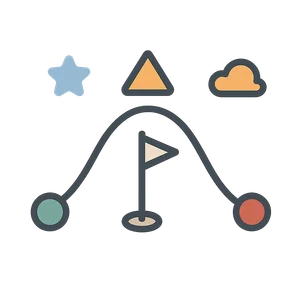
I have existed for as long as humans have gathered to share their experiences. I was there in the flickering firelight of ancient caves, my shape echoing in the tales of a great hunt. I was carved into the clay tablets of Mesopotamia, giving structure to the epic journey of a hero named Gilgamesh way back around 2100 BCE. For thousands of years, people used me without knowing my name or understanding my anatomy. They just knew that a good story felt a certain way; it had a satisfying shape. It wasn't until a brilliant thinker in ancient Greece decided to look at stories like a scientist that I was truly discovered. His name was Aristotle, and around 335 BCE, he wrote a book called 'Poetics.' In it, he examined plays and poems and realized that the best ones all shared my basic structure. He saw that I had a clear beginning, a complicated middle, and a tidy end. He was the first to explain that my events weren't random, but were linked by cause and effect, where each action logically triggered the next. This was a monumental idea, but it was still a very general map of who I am. For centuries, that was enough for most storytellers. Then, much more recently, a German writer named Gustav Freytag gave me a detailed physical form. In 1863, Freytag was studying classic plays and novels, and he noticed a recurring pattern, a rhythm that most successful stories followed. He drew a diagram to show it, which is now famously known as Freytag's Pyramid. He gave names to my different parts, showing everyone the secret architecture I use to build emotion and suspense. He labeled my beginning the 'exposition,' where the characters and setting are introduced. Then comes the 'rising action,' a series of conflicts and challenges that build tension. The peak of his pyramid is the 'climax,' the story's most exciting turning point. After that comes the 'falling action,' where the immediate crisis is over and things begin to wind down. Finally, there is the 'resolution,' where the story's conflicts are settled and a new normal is established. Freytag didn't invent me, but he gave everyone a crystal-clear map of my territory.
The Secret Path of Stories
Have you ever felt a story pull you in so deeply that the world around you seems to fade away. Your heart thumps during a daring escape, you hold your breath as a secret is about to be revealed, and you feel a rush of triumph when the hero finally succeeds. You are following an invisible path, one that I carefully lay from the first page to the last. Sometimes I am a winding road through a mysterious forest, full of twists and turns you never see coming. Other times, I am a steep mountain to be climbed, a struggle that builds and builds until you reach a breathtaking peak with a stunning view. I am the blueprint an author uses to build their world, the thread that weaves characters, challenges, and solutions into a single, beautiful tapestry. Without me, a story is just a jumble of things that happen. A king is crowned. A dragon attacks. A knight fights it. The kingdom is saved. It’s a list of events, but it isn’t a story. I am the 'because' that connects them all. The dragon attacks because it was awoken by the king's celebration, and the knight must fight it because it is the only way to save the people he loves. I create the questions that keep you turning the page: What will happen next. Why did they do that. How will they ever get out of this. I am the engine of every adventure, the heartbeat of every tale. I am Plot.
I have existed for as long as humans have gathered to share their experiences. I was there in the flickering firelight of ancient caves, my shape echoing in the tales of a great hunt. I was carved into the clay tablets of Mesopotamia, giving structure to the epic journey of a hero named Gilgamesh way back around 2100 BCE. For thousands of years, people used me without knowing my name or understanding my anatomy. They just knew that a good story felt a certain way; it had a satisfying shape. It wasn't until a brilliant thinker in ancient Greece decided to look at stories like a scientist that I was truly discovered. His name was Aristotle, and around 335 BCE, he wrote a book called 'Poetics.' In it, he examined plays and poems and realized that the best ones all shared my basic structure. He saw that I had a clear beginning, a complicated middle, and a tidy end. He was the first to explain that my events weren't random, but were linked by cause and effect, where each action logically triggered the next. This was a monumental idea, but it was still a very general map of who I am. For centuries, that was enough for most storytellers. Then, much more recently, a German writer named Gustav Freytag gave me a detailed physical form. In 1863, Freytag was studying classic plays and novels, and he noticed a recurring pattern, a rhythm that most successful stories followed. He drew a diagram to show it, which is now famously known as Freytag's Pyramid. He gave names to my different parts, showing everyone the secret architecture I use to build emotion and suspense. He labeled my beginning the 'exposition,' where the characters and setting are introduced. Then comes the 'rising action,' a series of conflicts and challenges that build tension. The peak of his pyramid is the 'climax,' the story's most exciting turning point. After that comes the 'falling action,' where the immediate crisis is over and things begin to wind down. Finally, there is the 'resolution,' where the story's conflicts are settled and a new normal is established. Freytag didn't invent me, but he gave everyone a crystal-clear map of my territory.
Today, that map is still one of the most useful tools for anyone who wants to tell a story. You can see my skeleton, the one Freytag diagrammed, in almost everything you watch, read, or play. I am the backbone of your favorite superhero movie, the quest structure in an epic video game, and the reason a mystery novel is so hard to put down. Even the simple stories you tell your friends have a shape. You set the scene (exposition), explain the problem you faced (rising action), describe the most intense moment (climax), explain what happened right after (falling action), and tell them how it all ended up (resolution). My purpose goes far beyond entertainment. I am a tool for understanding. By arranging chaotic events into a sequence of cause and effect, I help you make sense of the world and the consequences of our actions. When you follow a character through their journey, you feel what they feel—their hope, their fear, their joy. This builds empathy, allowing you to walk in someone else's shoes and see the world from a different perspective. I am not a rigid set of rules you must follow, but a powerful guide you can use. Every person on this planet has a unique and important story to tell. I am the path that can help you share it. So look at the events of your own life, the challenges you have overcome, and the lessons you have learned. I am here to help you weave them into a tale that only you can tell, a story that can inspire, teach, and connect with others across the world.
Wow facts
About
Plot is the sequence of interconnected events within a story, forming the narrative arc that guides characters from a beginning, through a middle, to an end.
Take a Quiz
Question 1 of 5
According to the story, what were the five key parts of a plot that Gustav Freytag mapped out in his pyramid?
Explore next




Want to do even more?
Go beyond exploring. Unlock tools that turn every story into real learning.

Storypie Plus for families
Full stories, quizzes, and printables. Nights and car rides, sorted.
- Unlimited audio stories
- Create Mode: your child stars in the story
- Offline downloads
- Printable worksheets & coloring pages

Why Storypie for Schools
Students engaged. Prep in seconds. Evenings back to you.
- Worksheets & Quizzes
- Classroom Management
- Formative Assessment
- Custom Curriculum & Lesson Plans
- 27 Languages

Why Storypie for Homeschool
Curriculum done. They'll ask for more. Hours back in your day.
- Worksheet Generator
- First-Person Audio Stories
- Built-in Comprehension Quizzes
- Custom Curriculum & Lesson Plans
- Print & Go Activities