English

Scientific Method
The Scientific Method is a systematic process that scientists and curious people use to investigate…
Reads at Grades 3–5 Listens at Grades 1–5
Print & create
Answer keys·No prep·Free with an account
28 worksheets · answer keys · full story · quiz · Ages 8-10 · CEFR B1
Plus adds 208,000+ more stories in 27 languages, audio for every one, and printables for all of them.
Just want Scientific Method?
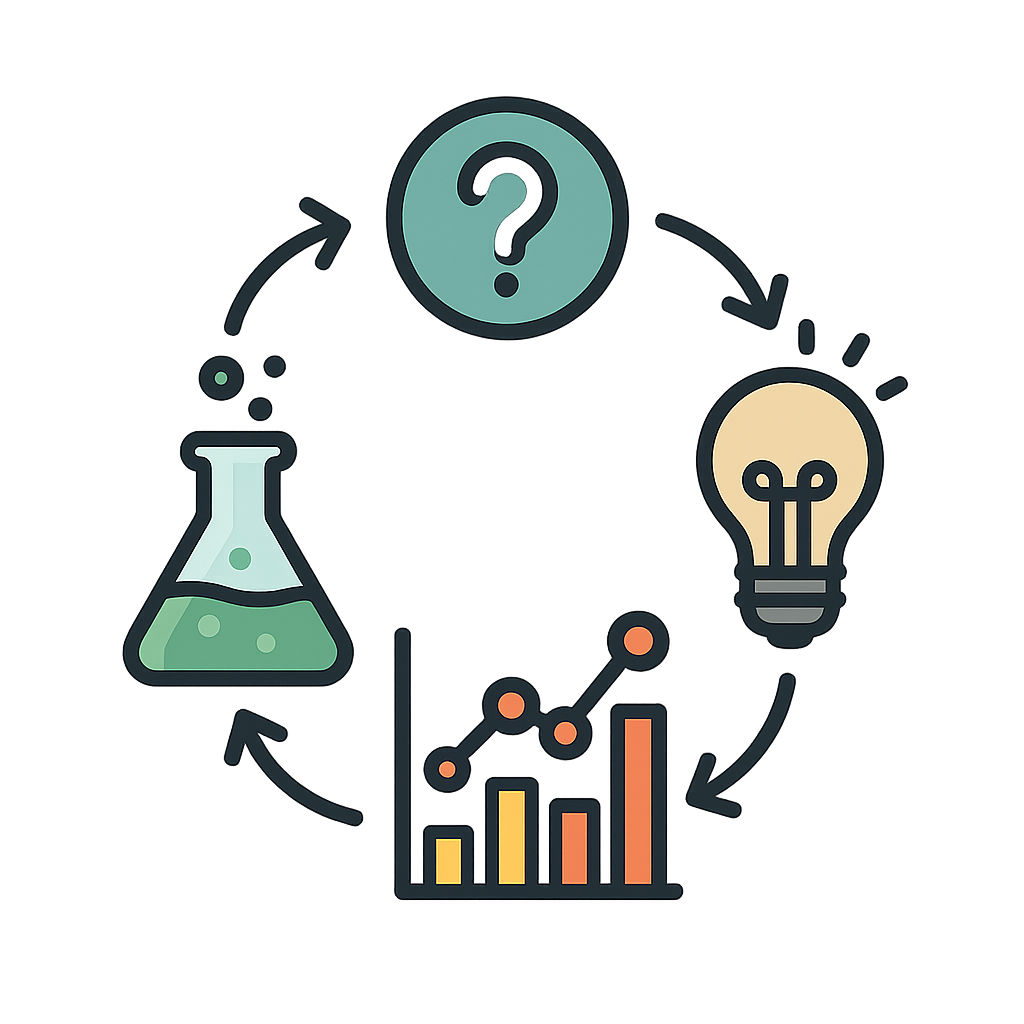
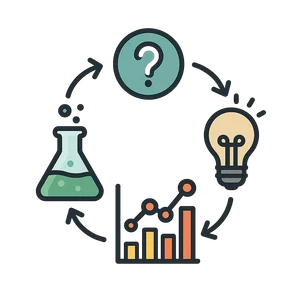
Have you ever looked up at the sky and wondered why it’s blue?. Or watched a colorful bubble float through the air and asked yourself why it's always perfectly round?. Maybe you've seen a bird soar high above the trees and thought, how in the world does it do that?. These big, curious questions are my favorite starting place. I’m not a person, you see. I’m more like a secret recipe for discovery or a special map for a detective trying to solve a tricky mystery. You can think of me as a special set of steps, a path that anyone can follow to find answers in a careful and organized way. First, you start with a question about something you've noticed. Next, you make a smart guess, a possible answer that scientists like to call a hypothesis. After that comes the really exciting part: you design a test, an experiment, to see if your guess holds up. While you're testing, you have to be a super observer, watching carefully and writing down everything you see. This process helps make sure your answers are based on what really happens, not just on what you wish would happen. I am the tool that helps turn 'I wonder' into 'I know.'. I am the Scientific Method.
My story didn't begin all at once. I wasn't invented on a single day by a single person with a flash of inspiration. Instead, I was carefully built, piece by piece, over many hundreds of years by curious people all over the world who shared a deep desire to understand things better. My journey started a very long time ago, with brilliant thinkers in ancient Greece. One of them, a famous philosopher named Aristotle who lived in the 4th century BCE, taught everyone how important it was to look closely at the world. He believed that the first step to understanding anything, from the smallest insect to the largest star, was careful and detailed observation. He would spend hours watching plants grow and studying animals to learn their secrets, writing down everything he saw. He got the ball rolling by making observation the foundation of knowledge. Hundreds of years later, my journey continued during a time of incredible learning called the Islamic Golden Age. A remarkable scholar named Ibn al-Haytham took me to the next level. Working in the 11th century, he understood that observation alone wasn't enough. He showed the world how incredibly important it is to test your ideas with experiments. He was fascinated by how our eyes see things, and he didn't just guess. He set up clever experiments in a dark room with light sources to test his hypothesis about how light travels in straight lines to our eyes. He proved that you couldn't just think about an answer; you had to design a test and prove it!. His insistence on experiments became a crucial part of who I am today. Then, my journey brought me to Europe during the 17th century, a time buzzing with new ideas called the Scientific Revolution. A wise thinker named Francis Bacon helped write down all my steps in a clear and organized way so that everyone could use me properly. He made me into the reliable system you might learn about in school. Around that same time, a famous astronomer named Galileo Galilei used me to completely change how we see our place in the universe. Most people at the time believed the old idea that the Sun and planets revolved around the Earth. But Galileo had a different hypothesis. He built his own telescope to observe the moons of Jupiter and the phases of Venus, gathering evidence that showed the Earth actually moved around the Sun. He wasn't afraid to question old ideas, and by using me—by observing, hypothesizing, and testing—he made one of the most important discoveries in the history of science. From Aristotle's observations to Galileo's bold experiments, I grew into the powerful tool for learning that I am today.
The Scientific Method's Great Adventure
Have you ever looked up at the sky and wondered why it’s blue?. Or watched a colorful bubble float through the air and asked yourself why it's always perfectly round?. Maybe you've seen a bird soar high above the trees and thought, how in the world does it do that?. These big, curious questions are my favorite starting place. I’m not a person, you see. I’m more like a secret recipe for discovery or a special map for a detective trying to solve a tricky mystery. You can think of me as a special set of steps, a path that anyone can follow to find answers in a careful and organized way. First, you start with a question about something you've noticed. Next, you make a smart guess, a possible answer that scientists like to call a hypothesis. After that comes the really exciting part: you design a test, an experiment, to see if your guess holds up. While you're testing, you have to be a super observer, watching carefully and writing down everything you see. This process helps make sure your answers are based on what really happens, not just on what you wish would happen. I am the tool that helps turn 'I wonder' into 'I know.'. I am the Scientific Method.
My story didn't begin all at once. I wasn't invented on a single day by a single person with a flash of inspiration. Instead, I was carefully built, piece by piece, over many hundreds of years by curious people all over the world who shared a deep desire to understand things better. My journey started a very long time ago, with brilliant thinkers in ancient Greece. One of them, a famous philosopher named Aristotle who lived in the 4th century BCE, taught everyone how important it was to look closely at the world. He believed that the first step to understanding anything, from the smallest insect to the largest star, was careful and detailed observation. He would spend hours watching plants grow and studying animals to learn their secrets, writing down everything he saw. He got the ball rolling by making observation the foundation of knowledge. Hundreds of years later, my journey continued during a time of incredible learning called the Islamic Golden Age. A remarkable scholar named Ibn al-Haytham took me to the next level. Working in the 11th century, he understood that observation alone wasn't enough. He showed the world how incredibly important it is to test your ideas with experiments. He was fascinated by how our eyes see things, and he didn't just guess. He set up clever experiments in a dark room with light sources to test his hypothesis about how light travels in straight lines to our eyes. He proved that you couldn't just think about an answer; you had to design a test and prove it!. His insistence on experiments became a crucial part of who I am today. Then, my journey brought me to Europe during the 17th century, a time buzzing with new ideas called the Scientific Revolution. A wise thinker named Francis Bacon helped write down all my steps in a clear and organized way so that everyone could use me properly. He made me into the reliable system you might learn about in school. Around that same time, a famous astronomer named Galileo Galilei used me to completely change how we see our place in the universe. Most people at the time believed the old idea that the Sun and planets revolved around the Earth. But Galileo had a different hypothesis. He built his own telescope to observe the moons of Jupiter and the phases of Venus, gathering evidence that showed the Earth actually moved around the Sun. He wasn't afraid to question old ideas, and by using me—by observing, hypothesizing, and testing—he made one of the most important discoveries in the history of science. From Aristotle's observations to Galileo's bold experiments, I grew into the powerful tool for learning that I am today.
Now, you might think I’m only for famous scientists in big laboratories wearing white coats, but that’s not true at all. I am a tool for everyone, every single day. Can you imagine using me to win a paper airplane contest?. You can!. Let's say you want to build a plane that flies the farthest. Your question is, 'Which design works best?'. Your hypothesis might be, 'I think a plane with long, narrow wings will fly farther.'. Then comes the experiment: you build a few different planes—one with long wings, one with short wings, and one with wide wings. You throw each one three times and measure the distance. Your observation might show that the plane with long wings really did fly the farthest!. You just used me to solve a problem. The best part about me is that I am all about curiosity, and making mistakes is a totally normal part of learning. Maybe your first guess was wrong, but that mistake just taught you something new. I help people invent new medicines, explore deep space, and understand our amazing planet. I live inside every person who looks at the world and asks that wonderful, powerful question, 'Why?'.
Wow facts
About
The Scientific Method is a systematic process that scientists and curious people use to investigate observations, solve problems, and acquire new knowledge about the natural world.
Take a Quiz
Question 1 of 5
In the story, I said a hypothesis is a 'smart guess.' What makes a guess 'smart' in science?
Explore next


Want to do even more?
Go beyond exploring. Unlock tools that turn every story into real learning.

Storypie Plus for families
Full stories, quizzes, and printables. Nights and car rides, sorted.
- Unlimited audio stories
- Create Mode: your child stars in the story
- Offline downloads
- Printable worksheets & coloring pages

Why Storypie for Schools
Students engaged. Prep in seconds. Evenings back to you.
- Worksheets & Quizzes
- Classroom Management
- Formative Assessment
- Custom Curriculum & Lesson Plans
- 27 Languages

Why Storypie for Homeschool
Curriculum done. They'll ask for more. Hours back in your day.
- Worksheet Generator
- First-Person Audio Stories
- Built-in Comprehension Quizzes
- Custom Curriculum & Lesson Plans
- Print & Go Activities