English

Theory of Evolution by Natural Selection
Evolution is the scientific theory explaining how living organisms change over generations through processes…
Reads at Grades 6–8 Listens at Grades 4–8
 Screen-free speaker. Built for your kids.
No card, no commitment. One email when there is real news, and one click to stop.
Print & create
Answer keys·No prep·Free with an account
28 worksheets · answer keys · full story · quiz · Ages 10-12 · CEFR B2
Plus adds 102,000+ more stories in 27 languages, audio for every one, and printables for all of them.
Just want Theory of Evolution by Natural Selection?
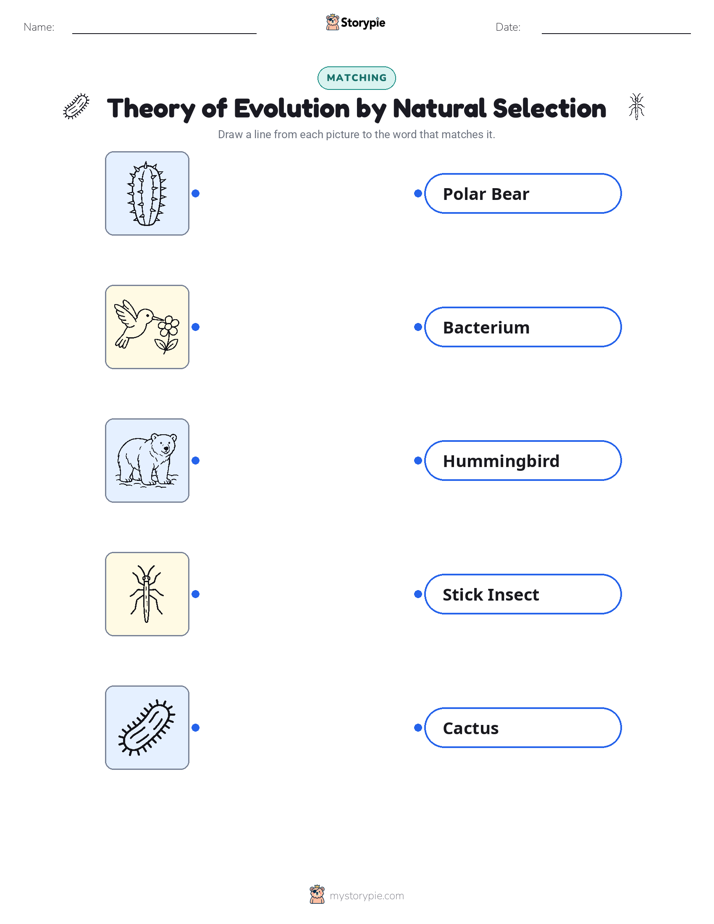
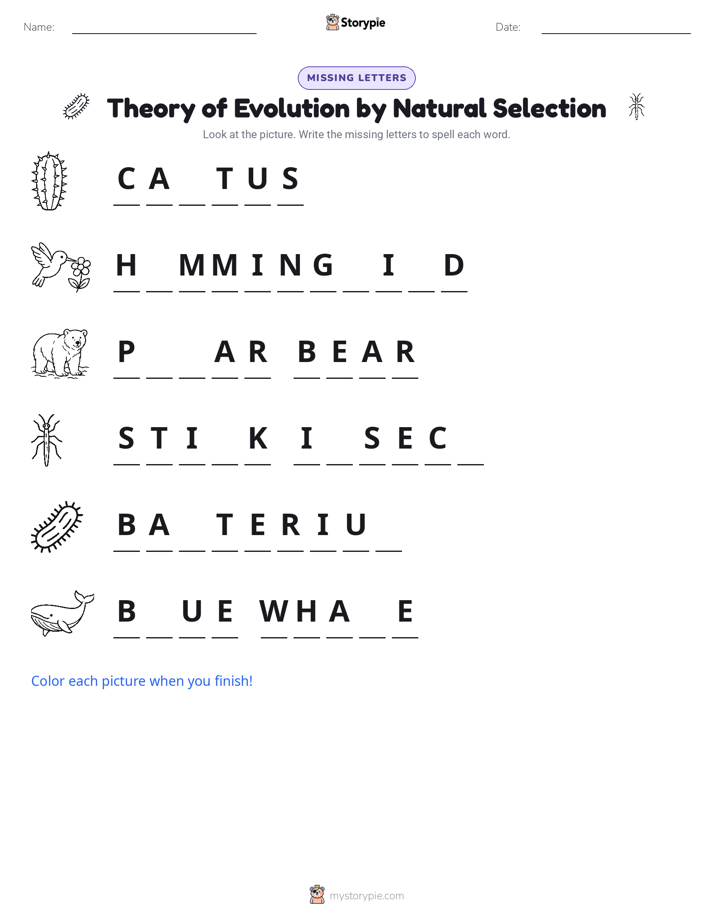
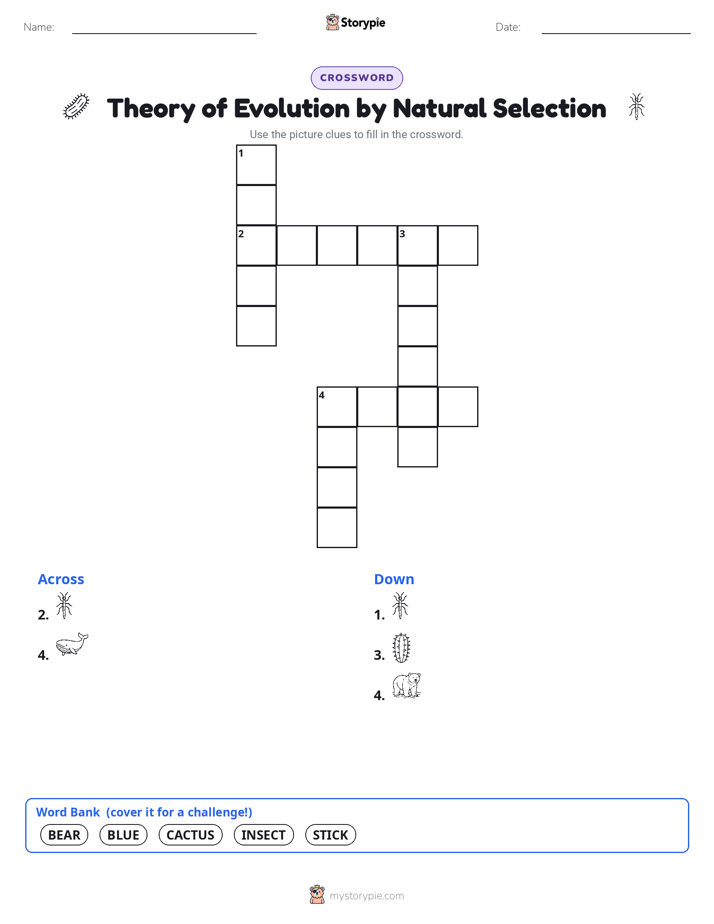
Have you ever wondered why a cactus is covered in sharp spines, or how a hummingbird can have a beak so perfectly long and thin it can sip nectar from deep inside a flower. Have you ever marveled at how a polar bear’s thick white fur makes it nearly invisible in the snow, or how a stick insect can vanish by looking exactly like a twig. I am the reason for these wonders. I am the invisible artist who has sculpted every living thing, from the most minuscule bacterium to the magnificent blue whale, over a canvas of billions of years. I am the quiet force that helps life adapt, survive, and flourish in every corner of the world. I don't work with a chisel or a paintbrush, but with time, chance, and the constant struggle for survival. My work is a slow and patient masterpiece, a story of life's incredible, branching journey. I am the family tree that connects you, right now, to the first speck of life that ever stirred on this planet. People call me Evolution.
For most of human history, my work was a deep mystery. People saw the world teeming with life but couldn't quite grasp the story I was telling. The first whispers of my existence were heard long ago. In the 6th century BCE, a Greek thinker named Anaximander gazed at the sea and wondered if life had first begun in the water. He even dared to imagine that humans might have descended from other types of animals. For centuries that followed, people unearthed strange stones shaped like shells, bones, and leaves of creatures no one had ever seen alive. These fossils were clues I had left behind, pages from my diary written in rock, but the language was still unknown. Much, much later, in 1809, a brilliant French scientist named Jean-Baptiste Lamarck took a bold step. He proposed that living things could change during their own lifetimes and pass those new features to their children. He famously imagined a giraffe stretching its neck to reach the highest, tastiest leaves, and that because of this effort, its babies would be born with slightly longer necks. His idea wasn't exactly correct, but he was one of the first great detectives on my case, asking the right questions and pointing the way for others.
I Am Evolution
Have you ever wondered why a cactus is covered in sharp spines, or how a hummingbird can have a beak so perfectly long and thin it can sip nectar from deep inside a flower. Have you ever marveled at how a polar bear’s thick white fur makes it nearly invisible in the snow, or how a stick insect can vanish by looking exactly like a twig. I am the reason for these wonders. I am the invisible artist who has sculpted every living thing, from the most minuscule bacterium to the magnificent blue whale, over a canvas of billions of years. I am the quiet force that helps life adapt, survive, and flourish in every corner of the world. I don't work with a chisel or a paintbrush, but with time, chance, and the constant struggle for survival. My work is a slow and patient masterpiece, a story of life's incredible, branching journey. I am the family tree that connects you, right now, to the first speck of life that ever stirred on this planet. People call me Evolution.
For most of human history, my work was a deep mystery. People saw the world teeming with life but couldn't quite grasp the story I was telling. The first whispers of my existence were heard long ago. In the 6th century BCE, a Greek thinker named Anaximander gazed at the sea and wondered if life had first begun in the water. He even dared to imagine that humans might have descended from other types of animals. For centuries that followed, people unearthed strange stones shaped like shells, bones, and leaves of creatures no one had ever seen alive. These fossils were clues I had left behind, pages from my diary written in rock, but the language was still unknown. Much, much later, in 1809, a brilliant French scientist named Jean-Baptiste Lamarck took a bold step. He proposed that living things could change during their own lifetimes and pass those new features to their children. He famously imagined a giraffe stretching its neck to reach the highest, tastiest leaves, and that because of this effort, its babies would be born with slightly longer necks. His idea wasn't exactly correct, but he was one of the first great detectives on my case, asking the right questions and pointing the way for others.
My full story began to unfold thanks to two remarkable naturalists who, though separated by thousands of miles, arrived at the very same revolutionary idea. The first was a young man named Charles Darwin. In 1831, he set sail on a ship called the HMS Beagle for a five-year voyage around the world. His journey was one of incredible observation. He saw mountains made of seashells and uncovered fossils of giant, extinct mammals. But it was on a small cluster of volcanic islands called the Galápagos that the pieces of my puzzle truly began to click into place. Darwin noticed that the finches on each island were slightly different. Some had thick, strong beaks for cracking tough nuts, while others had small, delicate beaks for eating insects. He realized that each beak was perfectly suited to the food available on its home island. He wondered, could they all have come from one original type of finch and slowly changed over time. At the exact same time, another brilliant adventurer, Alfred Russel Wallace, was exploring the jungles of the Malay Archipelago. Surrounded by vibrant birds, insects, and mammals, he also witnessed my work firsthand and developed the very same idea. They called it Natural Selection. The idea was simple yet powerful: in any group of living things, there are small, random variations. The individuals whose variations give them a slight advantage—helping them find food, escape predators, or attract a mate—are more likely to survive and have offspring. Over immense stretches of time, these helpful traits become more common, gradually shaping a species. On July 1st, 1858, their groundbreaking papers were presented together. A year later, on November 24th, 1859, Darwin published his book, 'On the Origin of Species,' and my story was finally told to the world.
Even with their brilliant theory of natural selection, Darwin and Wallace still had a major question they couldn't answer. They knew that favorable traits were passed down from parents to offspring, but they had no idea how. The mechanism of inheritance was a black box. Unbeknownst to them, the key was being discovered in a quiet monastery garden. During the 1860s, a monk named Gregor Mendel was meticulously studying pea plants. By cross-breeding them and tracking their traits, he figured out the fundamental rules of genetics, showing that traits are passed down through distinct units, which we now call genes. His work, however, went largely unnoticed for decades. The final, crucial piece of the puzzle was revealed almost a century later. In 1953, a team of scientists including the brilliant Rosalind Franklin, whose X-ray images were essential, and James Watson and Francis Crick, pieced together the structure of a remarkable molecule. They called it DNA. They had found my secret instruction manual, the double-helix code that contains all the information for building and operating a living thing. This code is copied and passed down through generations, and tiny, random changes in it, called mutations, provide the raw material—the variation—that natural selection can act upon.
My story is not just something that happened in the distant past; it is a story that is still being written every single day, all around you and even inside you. I am the reason doctors and scientists must develop new vaccines for the flu each year, because the flu virus is constantly evolving to evade our defenses. I am the reason conservationists work to protect the genetic diversity of endangered species, because that variety gives them a better chance to adapt to a changing world. Understanding me is like finding a map that shows how everything is connected. It reveals your own place in the vast, beautiful, and ever-changing tapestry of life on Earth. I am a reminder that life is resilient, creative, and always finding new ways to thrive. You are a part of this incredible, unbroken chain of life, a story four billion years in the making. And the story continues with you.
Wow facts
About
Evolution is the scientific theory explaining how living organisms change over generations through processes like natural selection, resulting in the diversity of life on Earth.
Take a Quiz
Question 1 of 5
What is the main idea of the book 'On the Origin of Species' by Charles Darwin, as described in the story?
Explore next


Want to do even more?
Go beyond exploring. Unlock tools that turn every story into real learning.

Storypie Plus for families
Full stories, quizzes, and printables. Nights and car rides, sorted.
- Unlimited audio stories
- Create Mode: your child stars in the story
- Offline downloads
- Printable worksheets & coloring pages

Why Storypie for Schools
Students engaged. Prep in seconds. Evenings back to you.
- Worksheets & Quizzes
- Classroom Management
- Formative Assessment
- Custom Curriculum & Lesson Plans
- 27 Languages

Why Storypie for Homeschool
Curriculum done. They'll ask for more. Hours back in your day.
- Worksheet Generator
- First-Person Audio Stories
- Built-in Comprehension Quizzes
- Custom Curriculum & Lesson Plans
- Print & Go Activities