English

Ukiyo-e
Ukiyo-e, meaning 'pictures of the floating world,' is a genre of Japanese art, particularly woodblock prints…
Reads at Grades 6–8 Listens at Grades 4–8
Print & create
Answer keys·No prep·Free with an account
28 worksheets · answer keys · full story · quiz · Ages 10-12 · CEFR B2
Plus adds 164,000+ more stories in 27 languages, audio for every one, and printables for all of them.
Just want Ukiyo-e?

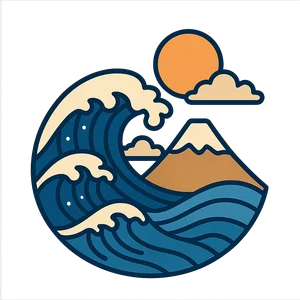
Imagine a flash of white makeup on an actor's face, his expression locked in a moment of intense drama on a kabuki stage. Picture a graceful woman, her hair held up with elegant pins, adjusting the sash of her silk kimono. See a towering, monstrous wave, its foamy claw about to crash down on tiny fishing boats, with a majestic mountain watching from the distance. I am all of these things. I am a window into a bustling, vibrant world of excitement, fashion, and breathtaking beauty. Before I came along, fine art was often reserved for wealthy lords and shoguns, hidden away in grand castles. But I was different. I was made for the everyday people living in the great city of Edo. I was like a celebrity poster, a fashion magazine, and a travel postcard all rolled into one. I captured the fleeting pleasures of city life. My name is Ukiyo-e, and my story is about the 'pictures of the floating world'.
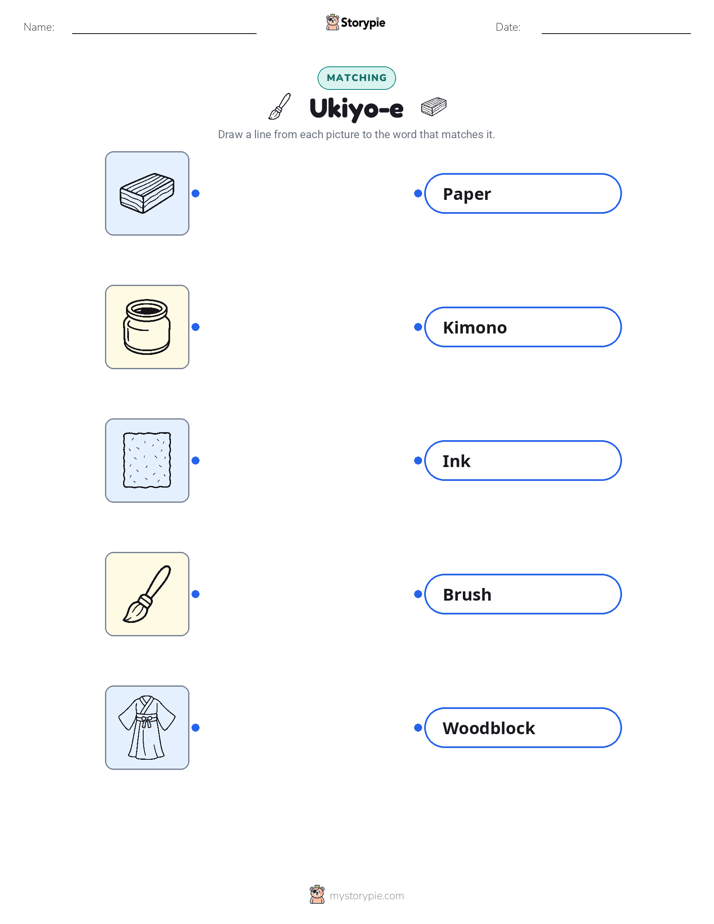
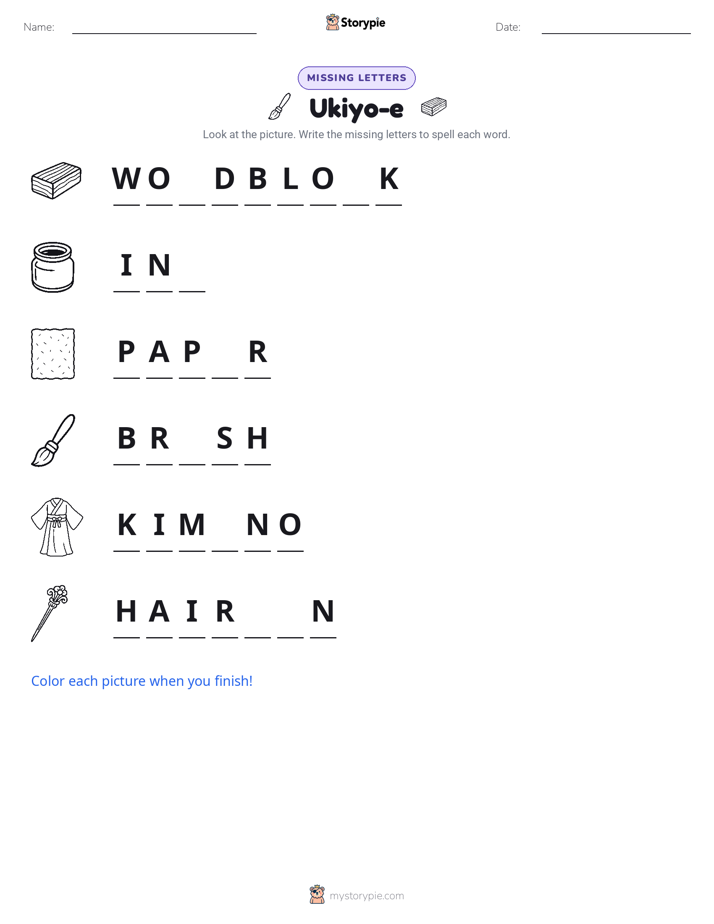
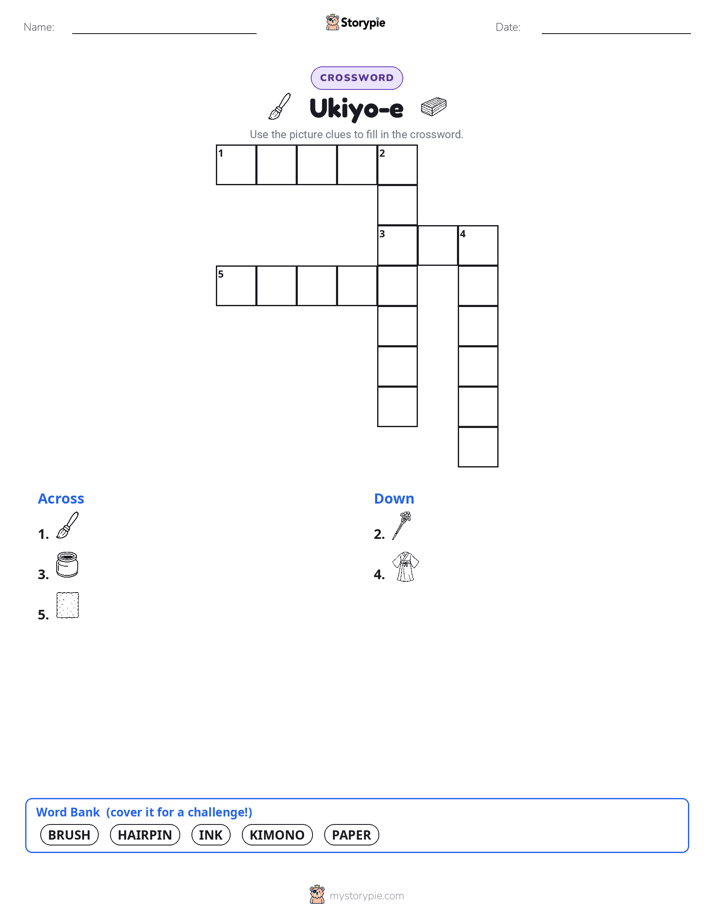
My life began during Japan's long and peaceful Edo Period, which started in the year 1603. For over two hundred years, the country was stable, and in big cities like Edo, which you now know as Tokyo, a new class of townspeople—merchants, artisans, and entertainers—began to thrive. They had money to spend and a taste for pleasure, flocking to the theater, following the latest fashions, and enjoying the beauty of the world around them. I was born to capture that world. In the 17th century, I started simply, as black-and-white ink drawings. An artist named Hishikawa Moronobu, around the 1670s, was one of the first to see my potential. He created single-sheet prints that were affordable enough for many people to own. Creating me was a true team effort. First, a publisher commissioned a design from an artist, who would paint a delicate ink drawing. Then, a master carver would paste the drawing onto a block of hard cherry wood and skillfully chisel away everything but the lines of the drawing. Finally, a printer would apply ink to the raised lines of the block, lay a sheet of paper on top, and rub it carefully to transfer the image. For many years, if you wanted color in your print, you had to brush it on by hand. But a revolution was coming, one that would fill my world with a symphony of color.
I am a Picture of the Floating World
Imagine a flash of white makeup on an actor's face, his expression locked in a moment of intense drama on a kabuki stage. Picture a graceful woman, her hair held up with elegant pins, adjusting the sash of her silk kimono. See a towering, monstrous wave, its foamy claw about to crash down on tiny fishing boats, with a majestic mountain watching from the distance. I am all of these things. I am a window into a bustling, vibrant world of excitement, fashion, and breathtaking beauty. Before I came along, fine art was often reserved for wealthy lords and shoguns, hidden away in grand castles. But I was different. I was made for the everyday people living in the great city of Edo. I was like a celebrity poster, a fashion magazine, and a travel postcard all rolled into one. I captured the fleeting pleasures of city life. My name is Ukiyo-e, and my story is about the 'pictures of the floating world'.
My life began during Japan's long and peaceful Edo Period, which started in the year 1603. For over two hundred years, the country was stable, and in big cities like Edo, which you now know as Tokyo, a new class of townspeople—merchants, artisans, and entertainers—began to thrive. They had money to spend and a taste for pleasure, flocking to the theater, following the latest fashions, and enjoying the beauty of the world around them. I was born to capture that world. In the 17th century, I started simply, as black-and-white ink drawings. An artist named Hishikawa Moronobu, around the 1670s, was one of the first to see my potential. He created single-sheet prints that were affordable enough for many people to own. Creating me was a true team effort. First, a publisher commissioned a design from an artist, who would paint a delicate ink drawing. Then, a master carver would paste the drawing onto a block of hard cherry wood and skillfully chisel away everything but the lines of the drawing. Finally, a printer would apply ink to the raised lines of the block, lay a sheet of paper on top, and rub it carefully to transfer the image. For many years, if you wanted color in your print, you had to brush it on by hand. But a revolution was coming, one that would fill my world with a symphony of color.
Everything changed around the year 1765. This was the beginning of my golden age. An artist named Suzuki Harunobu and his skilled printers perfected a technique for creating prints with many different colors. They called these brilliant new creations 'nishiki-e', which means 'brocade pictures', because their rich, overlapping colors were as dazzling as the most expensive woven silk. This was an incredibly complex process. To make a single nishiki-e print, a separate woodblock had to be carved for every single color. The printer had to line up the paper perfectly on each block, one after another, to ensure the colors all fit together without blurring. It was precision work, and the results were stunning. Artists who mastered my style became superstars. Kitagawa Utamaro was famous for his elegant portraits of beautiful women, capturing their quiet grace and inner thoughts. Toshusai Sharaku, in a brief and mysterious career, created powerful, exaggerated portraits of kabuki actors, full of dramatic energy. And a bit later, two of the greatest masters of all took me out of the city and into the countryside. Katsushika Hokusai showed the awesome power of nature in his series 'Thirty-six Views of Mount Fuji', which includes the world-famous 'The Great Wave off Kanagawa'. And Utagawa Hiroshige captured the quiet, poetic beauty of travel in his series 'The Fifty-three Stations of the Tōkaidō'.
For more than two centuries, Japan had very little contact with the rest of the world. But when its ports opened up to international trade in the 1850s, I finally got to travel. Sometimes I was used as wrapping paper for delicate pottery and other goods being shipped to Europe and America. When artists in Paris and London unwrapped these items, they were astonished by what they found. They had never seen anything like my bold, flat areas of color, my dramatic angles, and my focus on everyday life. An artistic craze they called Japonisme swept across Europe. Famous painters like Claude Monet, Edgar Degas, and Mary Cassatt began collecting my prints, studying them for inspiration. Vincent van Gogh was so moved by my beauty that he painted his own versions of prints by Hiroshige. I showed these artists a new way to see the world, to capture a fleeting moment not with perfect, realistic detail, but with feeling and design. Today, you can find my original prints in museums all over the globe, but my spirit lives on. You can see my influence in the dynamic lines of modern manga and the clean, powerful images of graphic design. I am a reminder that beauty can be found in the simplest moments, and that great art can belong to everyone.
Wow facts
About
Ukiyo-e, meaning 'pictures of the floating world,' is a genre of Japanese art, particularly woodblock prints, that flourished from the 17th to 19th centuries, depicting scenes of urban life, landscapes, and entertainment.
Take a Quiz
Question 1 of 5
Why were the multi-colored prints called 'nishiki-e', or 'brocade pictures'?
Want to do even more?
Go beyond exploring. Unlock tools that turn every story into real learning.

Storypie Plus for families
Full stories, quizzes, and printables. Nights and car rides, sorted.
- Unlimited audio stories
- Create Mode: your child stars in the story
- Offline downloads
- Printable worksheets & coloring pages

Why Storypie for Schools
Students engaged. Prep in seconds. Evenings back to you.
- Worksheets & Quizzes
- Classroom Management
- Formative Assessment
- Custom Curriculum & Lesson Plans
- 27 Languages

Why Storypie for Homeschool
Curriculum done. They'll ask for more. Hours back in your day.
- Worksheet Generator
- First-Person Audio Stories
- Built-in Comprehension Quizzes
- Custom Curriculum & Lesson Plans
- Print & Go Activities