English

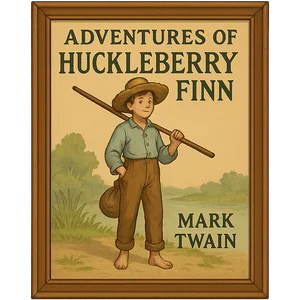
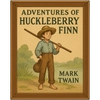
Adventures of Huckleberry Finn
A landmark American novel by Mark Twain…
Reads at Grades 6–8 Listens at Grades 4–8
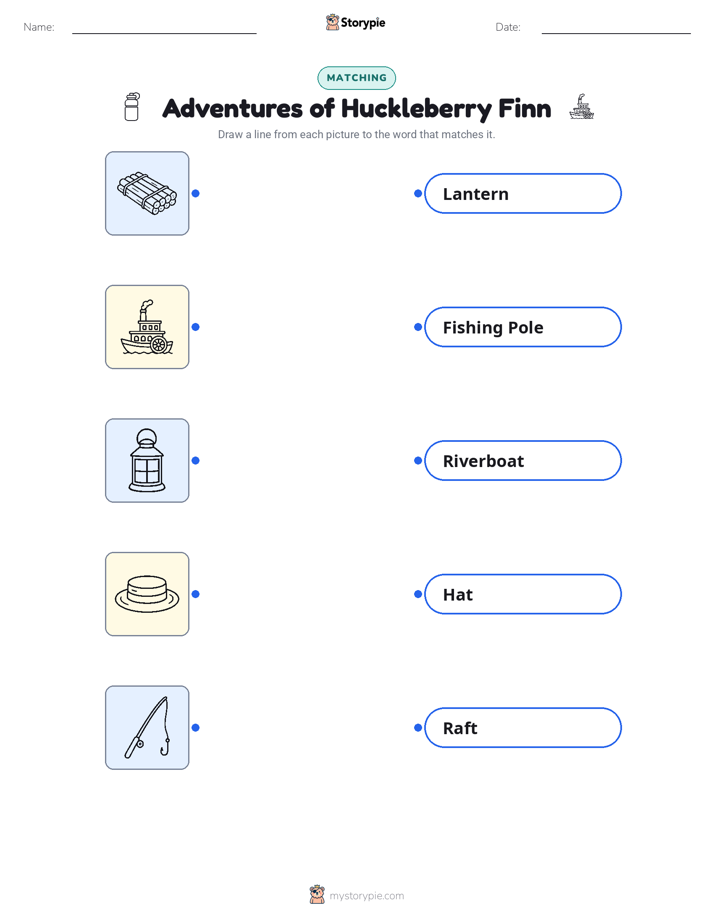
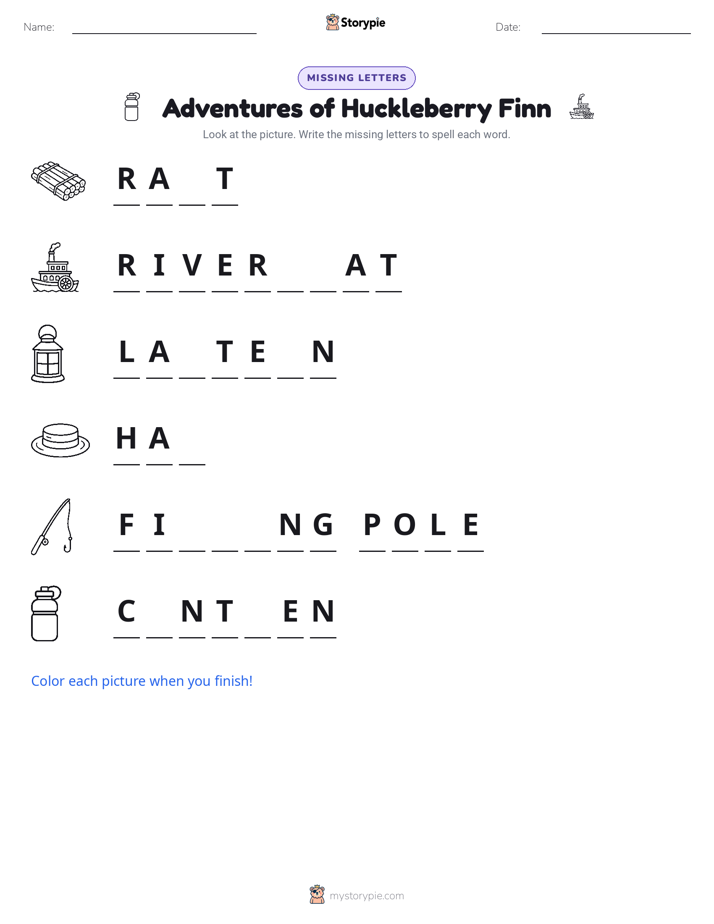
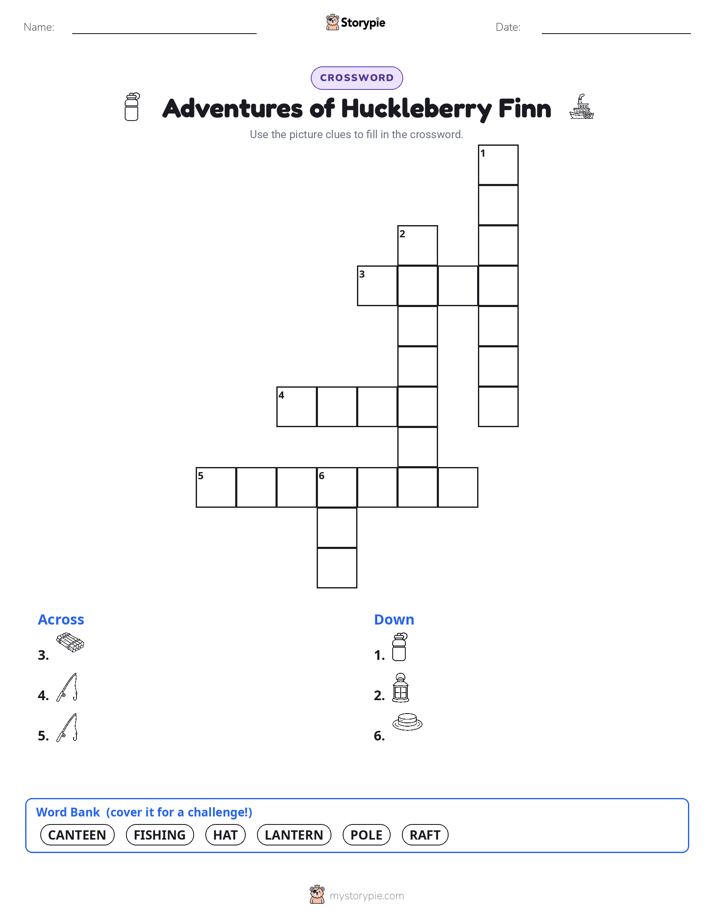
Print & create
Answer keys·No prep·Free with an account
28 worksheets · answer keys · full story · quiz · Ages 10-12 · CEFR B2
Plus adds 244,000+ more stories in 27 languages, audio for every one, and printables for all of them.
Just want Adventures of Huckleberry Finn?
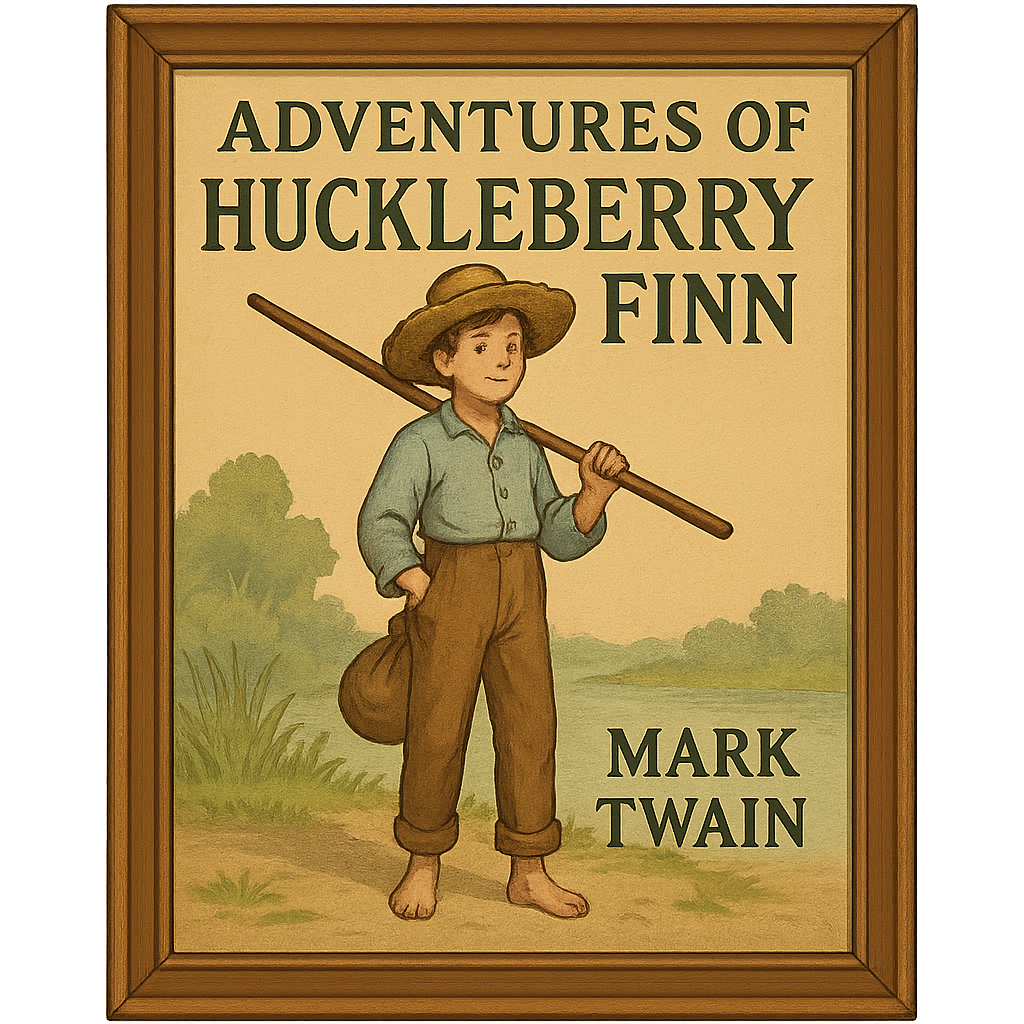
Imagine the feeling of cool, damp wood beneath you, the gentle sway of a raft on a wide, muddy river. Above you, the sky is a vast blanket of glittering stars, so close you feel you could touch them. The only sounds are the deep murmur of the water, the chirping of crickets, and the occasional croak of a bullfrog from the dark, shadowy banks. This is where my story lives, on the slow, powerful current of the Mississippi River. I am an idea, a journey, a feeling of running away from a world of rules to find something real and true. Before I was ever bound in leather and printed on paper, I was a whisper of an idea about freedom. I was a story of a friendship between two people who society, in its blindness, said should never be friends. My pages carry the scent of the river and the weight of a difficult choice. I am the Adventures of Huckleberry Finn.
My creator was a man with a wild tuft of white hair, a magnificent mustache, and an imagination as wide and deep as the river he loved. His name was Samuel Clemens, but the world came to know him by his pen name, Mark Twain. He knew the Mississippi River intimately, not just from looking at it, but from living on it. He spent his young adulthood as a steamboat pilot, learning every bend, sandbar, and hidden danger of its powerful currents. That experience flowed directly into his writing, giving my world its authentic feel. He first began to write my story in 1876, the same year he published a book about my main character’s best friend, 'The Adventures of Tom Sawyer'. But he knew that my hero, a poor boy named Huckleberry Finn, had a more serious and complicated story to tell. It was a story that took him years to get right. He would write for a while, then set me aside, always coming back to me. He finally finished my long journey on the page in 1883. His greatest challenge was making my voice sound true. He didn't want me to sound like a stuffy book; he wanted me to sound like a real, uneducated boy from Missouri, speaking in the dialect of his time and place. This choice was revolutionary and would change American literature forever.
Adventures of Huckleberry Finn: A River's Story
Imagine the feeling of cool, damp wood beneath you, the gentle sway of a raft on a wide, muddy river. Above you, the sky is a vast blanket of glittering stars, so close you feel you could touch them. The only sounds are the deep murmur of the water, the chirping of crickets, and the occasional croak of a bullfrog from the dark, shadowy banks. This is where my story lives, on the slow, powerful current of the Mississippi River. I am an idea, a journey, a feeling of running away from a world of rules to find something real and true. Before I was ever bound in leather and printed on paper, I was a whisper of an idea about freedom. I was a story of a friendship between two people who society, in its blindness, said should never be friends. My pages carry the scent of the river and the weight of a difficult choice. I am the Adventures of Huckleberry Finn.
My creator was a man with a wild tuft of white hair, a magnificent mustache, and an imagination as wide and deep as the river he loved. His name was Samuel Clemens, but the world came to know him by his pen name, Mark Twain. He knew the Mississippi River intimately, not just from looking at it, but from living on it. He spent his young adulthood as a steamboat pilot, learning every bend, sandbar, and hidden danger of its powerful currents. That experience flowed directly into his writing, giving my world its authentic feel. He first began to write my story in 1876, the same year he published a book about my main character’s best friend, 'The Adventures of Tom Sawyer'. But he knew that my hero, a poor boy named Huckleberry Finn, had a more serious and complicated story to tell. It was a story that took him years to get right. He would write for a while, then set me aside, always coming back to me. He finally finished my long journey on the page in 1883. His greatest challenge was making my voice sound true. He didn't want me to sound like a stuffy book; he wanted me to sound like a real, uneducated boy from Missouri, speaking in the dialect of his time and place. This choice was revolutionary and would change American literature forever.
When I was finally ready, I sailed out into the world, first published in the United Kingdom on December 10th, 1884, and then in the United States in February of 1885. From the very beginning, I caused a stir. My story is simple on the surface: Huck escapes his abusive father and the suffocating rules of “civilized” society. On his journey, he meets Jim, an enslaved man who has run away to avoid being sold and separated from his family. Together, they build a raft and float down the river, hoping to find freedom. Their growing friendship, loyalty, and care for one another is the beating heart of my story. But Mark Twain was not interested in telling a simple adventure tale. He used my voice to show the world as it truly was in the American South before the Civil War, including its deep-seated racism and cruelty. I used language and described situations that were common then but are deeply painful and offensive today. Because of this, many adults thought I was a bad influence. Libraries banned me, calling me “trash” and “suitable only for the slums.” They missed the point. My author wanted you, the reader, to feel Huck's moral dilemma: should he follow the rules of society and turn Jim in, or follow his own heart and help his friend? That question is what made me both dangerous and important.
For more than a century, my pages have carried readers on that same raft, facing that same moral choice alongside Huck and Jim. I have been called one of the first truly “Great American Novels” because I dared to capture the real voice, spirit, and contradictions of the country. I didn't present a romantic or polished version of America; I showed its beauty and its ugliness, its capacity for kindness and its terrible injustices. The questions I raise are the ones that never get old. What does it truly mean to be free? What defines a family? What is your duty when your conscience conflicts with the law? My journey down the Mississippi may have ended on the last page, but the adventure of thinking for yourself, of questioning what you are told, and of choosing compassion is a current that flows forever. I invite you to step onto the raft and see where the river takes you.
Wow facts
About
A landmark American novel by Mark Twain, published in the United Kingdom in December 1884 and in the United States in February 1885, about a boy's journey down the Mississippi River with an escaped slave, exploring themes of freedom, morality, and friendship.
Take a Quiz
Question 1 of 5
In your own words, describe the central journey Huck and Jim take and the main challenge they face together.
Explore next





Want to do even more?
Go beyond exploring. Unlock tools that turn every story into real learning.

Storypie Plus for families
Full stories, quizzes, and printables. Nights and car rides, sorted.
- Unlimited audio stories
- Create Mode: your child stars in the story
- Offline downloads
- Printable worksheets & coloring pages

Why Storypie for Schools
Students engaged. Prep in seconds. Evenings back to you.
- Worksheets & Quizzes
- Classroom Management
- Formative Assessment
- Custom Curriculum & Lesson Plans
- 27 Languages

Why Storypie for Homeschool
Curriculum done. They'll ask for more. Hours back in your day.
- Worksheet Generator
- First-Person Audio Stories
- Built-in Comprehension Quizzes
- Custom Curriculum & Lesson Plans
- Print & Go Activities