English

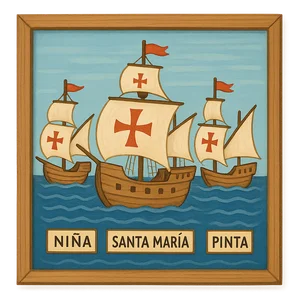
Santa María, Pinta, and Niña
The three Spanish ships, a nao and two caravels…
Reads at Grades 6–8 Listens at Grades 4–8
The Three Ships That Changed the World
We were born of wood and wind, our story beginning on the sun-drenched shores of Spain. The air around us hummed with the sounds of hammers and saws, and the sharp scent of pine and tar filled our newly formed frames. Though we were constructed in the late 15th century, we came together for a single, daring purpose. I am the Santa María, a strong, sturdy carrack, built larger than my sisters to lead the way and carry the bulk of our supplies. My two companions are the Pinta and the Niña. They are caravels, swifter and more nimble than I am, with special triangular sails designed to catch the wind from any direction, allowing them to dance across the waves. Our masts reached for the sky, and our wooden planks were sealed tight, ready for a journey unlike any the world had ever known. We didn't know it yet, but we were destined to carry a dream across the world's greatest ocean, connecting worlds that had never met.
The man whose vision gave our timbers purpose was an Italian mariner named Christopher Columbus. He possessed an audacious dream, one that many scholars and sailors of his time dismissed as impossible. He was convinced that the Earth was a sphere, and he believed he could reach the fabled riches of the East Indies—China, Japan, and India—by sailing west across the untraveled Atlantic Ocean. For nearly a decade, he petitioned the royal courts of Europe for support, facing rejection after rejection. Finally, in the year 1492, his persistence paid off. Queen Isabella I and King Ferdinand II of Spain, fresh from a major victory in their kingdom, agreed to finance his expedition. They saw the potential for immense reward: a new trade route that would bypass their rivals and bring unimaginable wealth, in the form of gold and spices, back to Spain. And so, we were chosen—three humble ships to carry Columbus and his crew of about 90 men into the vast, frightening unknown.
Our grand adventure began on the morning of August 3rd, 1492. The port of Palos de la Frontera was a whirlwind of activity. Sailors hoisted barrels and crates into our hulls, families gathered on the docks for tearful goodbyes, and a nervous energy filled the air. As our anchors were raised and our sails caught the morning breeze, we glided out of the harbor, leaving the familiar coastline of Spain behind. Soon, the land was just a faint line on the horizon, and then it was gone completely. For weeks upon weeks, our world was nothing but the deep blue of the sea and the endless arc of the sky. The crew grew anxious. They had never been out of sight of land for so long, and fear of sea monsters and falling off the edge of the world crept into their hearts. But Columbus remained steadfast. Using his compass, his knowledge of the stars, and his unshakeable belief, he urged them onward. The Pinta, being the fastest, often sailed ahead to scout, while the crew loved the smooth, steady ride of the Niña. As the flagship, I, the Santa María, bore the responsibility of command, the keeper of the mission's maps and its leader's unyielding hope.
After more than two months at sea, the crew’s hope had worn thin. Talk of mutiny rumbled across our decks. The sailors were exhausted and terrified, ready to turn us around and sail for home. Just as their despair reached its peak, the ocean began to offer clues. We sailed past floating sticks that looked carved by human hands, and then we saw flocks of birds flying purposefully, a sure sign that land was near. The mood on board shifted from desperation to eager anticipation. Then, in the dark, early hours of October 12th, 1492, a lookout perched high on the Pinta’s mast, a man named Rodrigo de Triana, broke the silence with a triumphant shout: '¡Tierra! ¡Tierra!'. Land. We had done it. We had crossed the great ocean. As the sun rose, we saw a beautiful green island, which Columbus would name San Salvador. It was an island in what we now call the Bahamas. On the shore stood people, the native Taíno, watching us with as much wonder as we watched them. In that moment, two separate halves of humanity, unaware of each other for millennia, were finally connected.
Our journey of discovery continued as we explored the islands of this new world. But my own story was destined for a sudden end. On the peaceful night of Christmas Day, 1492, while sailing along the coast of a large island called Hispaniola, a sleepy cabin boy was left at my helm. A strong current carried me onto a hidden sandbar, and with a terrible crunch, my hull was breached. The damage was too severe. I could not be saved. My journey across the ocean was over. But my purpose was not. Christopher Columbus ordered my crew to salvage my timbers, and with my own wood, they built a small fort they named La Navidad. It became the very first European settlement in the Americas. My sisters, the Niña and the Pinta, began the long, treacherous voyage back to Spain without me, battling fierce storms before finally arriving in March of 1493. They carried with them incredible news that would forever alter humanity's understanding of the planet—not of a new route to Asia, but of a 'New World' entirely.
Though our wooden bodies have long since vanished, reclaimed by the sea and the soil, our legacy sails on through the currents of time. We were not just three ships; we were the vessels of a world-changing idea. Our voyage across the Atlantic in 1492 sparked the Age of Exploration, creating a permanent link between the continents of Europe, Africa, and the Americas. This connection, often called the Columbian Exchange, led to the transfer of plants, animals, cultures, and ideas that reshaped civilizations across the globe. We stand as symbols of the courage it takes to venture into the unknown, of the relentless curiosity that drives discovery, and of the profound, and often complicated, consequences of bringing different worlds together. Our story is a timeless reminder that the map is never truly finished, and that great discoveries await those who are brave enough to sail beyond the horizon.
Wow facts
About
The three Spanish ships, a nao and two caravels, used by Christopher Columbus on his first voyage across the Atlantic Ocean in 1492, which led to the first documented European contact with the Americas since the Norse.
Take a Quiz
Question 1 of 5
Which of the following best summarizes the main purpose and outcome of the ships' journey?
Explore next
Want to do even more?
Go beyond exploring. Unlock tools that turn every story into real learning.

Storypie Plus for families
Full stories, quizzes, and printables. Nights and car rides, sorted.
- Unlimited audio stories
- Create Mode: your child stars in the story
- Offline downloads
- Printable worksheets & coloring pages

Why Storypie for Schools
Students engaged. Prep in seconds. Evenings back to you.
- Worksheets & Quizzes
- Classroom Management
- Formative Assessment
- Custom Curriculum & Lesson Plans
- 27 Languages

Why Storypie for Homeschool
Curriculum done. They'll ask for more. Hours back in your day.
- Worksheet Generator
- First-Person Audio Stories
- Built-in Comprehension Quizzes
- Custom Curriculum & Lesson Plans
- Print & Go Activities