English

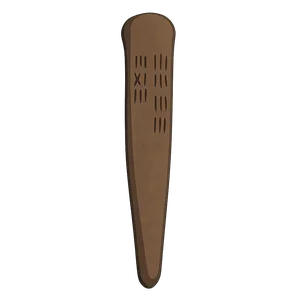
Ishango Bone
An ancient bone tool, discovered in the Democratic Republic of Congo…
Reads at Grades 6–8 Listens at Grades 4–8
Print & create
Answer keys·No prep·Free with an account
28 worksheets · answer keys · full story · quiz · Ages 10-12 · CEFR B2
Plus adds 244,000+ more stories in 27 languages, audio for every one, and printables for all of them.
Just want Ishango Bone?
Before you knew numbers, before you had calendars, I was there. I rested in the warm, clever hands of a person who lived beside a great lake teeming with fish, under a vast African sky. I am not made of stone or clay, but of something that was once alive—strong and dark brown. A sharp piece of quartz was used to scratch tiny marks into my surface, not randomly, but with purpose and thought. I could feel the care and concentration in each notch, each groove a deliberate act of a thinking mind. For thousands upon thousands of years, I held these secrets, a silent testament to an intellect that flourished in a world you would find completely unfamiliar. What am I? I am a mystery you can hold in your hand, a whisper from a time so distant it feels like a dream. I am the Ishango Bone.
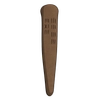
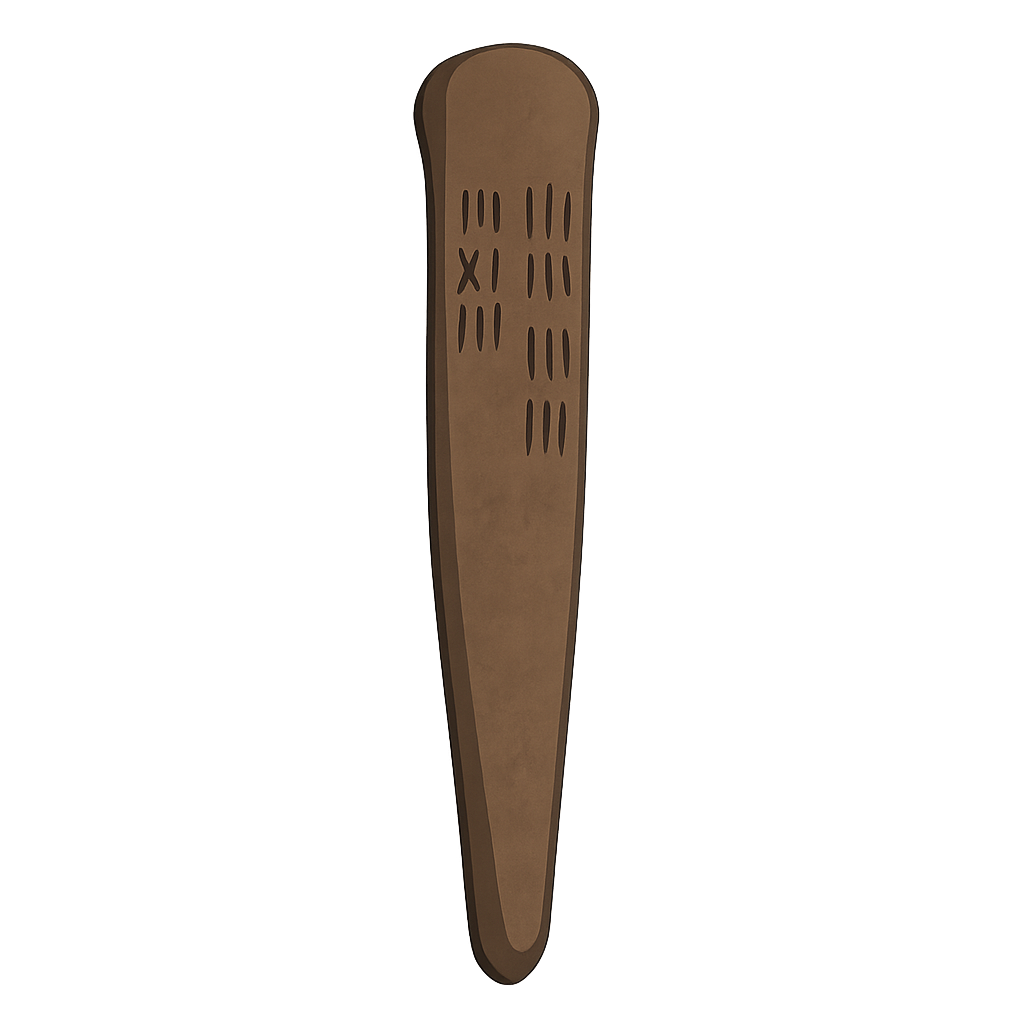
My creator, who lived sometime between 20,000 and 18,000 BCE, was an observer, a planner, and a member of a sophisticated community of fishers and gatherers near the headwaters of the Nile River. They shaped me from the fibula of a baboon, a strong and slender bone perfect for their purpose. They carved three distinct columns of marks onto my body, each one a puzzle for the future. Look closely at my form. One column contains groups of 11, 13, 17, and 19 notches—numbers that have no common divisor except one. You call them prime numbers. Another column seems to demonstrate a grasp of duplication or multiplication; it shows groups of 3 and 6, 4 and 8, and 5 and 10. The third column has markings that add up to 60, twice, which some believe corresponds to a six-month lunar calendar. Was I an arithmetic tool, a way to calculate and solve problems? Was I a calendar to track the phases of the moon and predict the seasons? The debate continues to this day. I do not give away my secrets easily, but my patterns clearly show a mind that was organized, intensely curious, and already beginning to understand the world through the language of mathematics.
The Ishango Bone's Story
Before you knew numbers, before you had calendars, I was there. I rested in the warm, clever hands of a person who lived beside a great lake teeming with fish, under a vast African sky. I am not made of stone or clay, but of something that was once alive—strong and dark brown. A sharp piece of quartz was used to scratch tiny marks into my surface, not randomly, but with purpose and thought. I could feel the care and concentration in each notch, each groove a deliberate act of a thinking mind. For thousands upon thousands of years, I held these secrets, a silent testament to an intellect that flourished in a world you would find completely unfamiliar. What am I? I am a mystery you can hold in your hand, a whisper from a time so distant it feels like a dream. I am the Ishango Bone.
My creator, who lived sometime between 20,000 and 18,000 BCE, was an observer, a planner, and a member of a sophisticated community of fishers and gatherers near the headwaters of the Nile River. They shaped me from the fibula of a baboon, a strong and slender bone perfect for their purpose. They carved three distinct columns of marks onto my body, each one a puzzle for the future. Look closely at my form. One column contains groups of 11, 13, 17, and 19 notches—numbers that have no common divisor except one. You call them prime numbers. Another column seems to demonstrate a grasp of duplication or multiplication; it shows groups of 3 and 6, 4 and 8, and 5 and 10. The third column has markings that add up to 60, twice, which some believe corresponds to a six-month lunar calendar. Was I an arithmetic tool, a way to calculate and solve problems? Was I a calendar to track the phases of the moon and predict the seasons? The debate continues to this day. I do not give away my secrets easily, but my patterns clearly show a mind that was organized, intensely curious, and already beginning to understand the world through the language of mathematics.
My time with my creator and their community was tragically cut short. A nearby volcano, a sleeping giant in the landscape, awoke with a furious roar, spewing ash and rock across the land. My owner, and their entire settlement, was buried. I was plunged into darkness, lost to the world for an almost unimaginable length of time. I slept for twenty thousand years, silent and still beneath the earth, while the ice ages ended, civilizations rose and fell, and the world transformed in ways my creator could never have envisioned. Languages, empires, and technologies were born and died while I waited. Then, one day in the year 1950, I felt the warmth of the sun again. A Belgian geologist named Jean de Heinzelin de Braucourt was excavating the area of Ishango, in what is now the Democratic Republic of Congo. He found me among other artifacts, carefully brushed the ancient volcanic dust from my markings, and immediately recognized that he had found something extraordinary. I was no longer just a forgotten tool; I was a vital clue to a long-lost chapter of human history, a key to understanding the deep origins of human intellect.
Today, I reside in the Royal Belgian Institute of Natural Sciences in Brussels, Belgium, where I am protected and studied. People from all over the world come to look at me, a small, unassuming bone that carries an immense story. I am one of the oldest mathematical objects ever discovered, and my very existence challenges the long-held belief that mathematics began with the ancient Egyptians or Greeks. I am proof that the story of mathematics began much earlier, in the very heart of Africa. Scientists, mathematicians, and historians continue to analyze my intricate notches, each proposing new theories about my exact function, trying to unlock the last of my secrets. I am a powerful reminder that curiosity, abstract thought, and the desire to find patterns in the universe are fundamental parts of what it means to be human. I am a bridge connecting your modern world to your most ancient ancestors, proving that a brilliant mind, a simple tool, and a bit of curiosity can leave a message that echoes for twenty thousand years.
Wow facts
About
An ancient bone tool, discovered in the Democratic Republic of Congo, featuring carved notches that are interpreted by some researchers as evidence of early mathematical thinking, though this idea is debated.
Take a Quiz
Question 1 of 5
What is the central message the Ishango Bone conveys about human history?
Explore next





Want to do even more?
Go beyond exploring. Unlock tools that turn every story into real learning.

Storypie Plus for families
Full stories, quizzes, and printables. Nights and car rides, sorted.
- Unlimited audio stories
- Create Mode: your child stars in the story
- Offline downloads
- Printable worksheets & coloring pages

Why Storypie for Schools
Students engaged. Prep in seconds. Evenings back to you.
- Worksheets & Quizzes
- Classroom Management
- Formative Assessment
- Custom Curriculum & Lesson Plans
- 27 Languages

Why Storypie for Homeschool
Curriculum done. They'll ask for more. Hours back in your day.
- Worksheet Generator
- First-Person Audio Stories
- Built-in Comprehension Quizzes
- Custom Curriculum & Lesson Plans
- Print & Go Activities