English

One Thousand and One Nights
A collection of Middle Eastern folk tales compiled in Arabic during the Islamic Golden Age…
Reads at Grades 3–5 Listens at Grades 1–5
The Story of the One Thousand and One Nights
Begin in a world of starry desert skies, bustling markets filled with the scent of spices, and the glimmer of hidden treasure. I am not a person or a place, but a collection of whispers, a river of stories that has flowed for centuries. My words have saved a life, enchanted kings, and carried listeners to magical lands on flying carpets. I was born from the clever mind of a brave young woman who knew that a good story, told at the right time, holds the greatest power of all. My voice is the rustle of ancient scrolls and the echo of tales told around a fire. I am the One Thousand and One Nights.
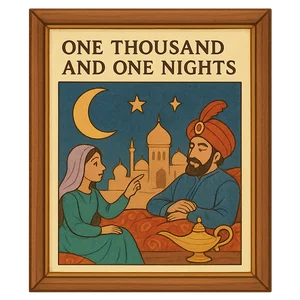
I wasn't written by a single person. I am a tapestry woven from threads of folklore from ancient Persia, India, and across the Arab world. Can you imagine stories traveling from person to person, changing a little bit each time, like a giant game of telephone that lasts for hundreds of years? Over many centuries, during a time of great learning and art called the Islamic Golden Age, from the 8th to the 14th centuries, storytellers and scribes gathered my tales together. They carefully wrote them down, making sure my magic wouldn't be lost. At my very heart is the story of a clever queen named Scheherazade and a powerful king, Shahryar. The king was heartbroken and angry, and he had made a terrible vow. To save herself and the other women of the kingdom, Scheherazade began telling the king a new story every evening, but she always stopped at the most exciting part, right at a cliffhanger. The king, desperate to know what happened next, would let her live another day just to hear the end of the tale. For one thousand and one nights, she spun tales of Sinbad the Sailor and his seven incredible voyages, of genies trapped in lamps, of ghouls and heroes, and of clever tricksters, until her stories softened the king's heart and reminded him of kindness and trust.
For a long time, my stories were shared mostly in the Middle East, carefully copied by hand in beautiful Arabic script. My pages were filled with elegant calligraphy, and only those who could read Arabic could unlock my secrets. But my biggest journey began in the early 18th century, when I traveled from my desert home to the bustling cities of Europe. A French scholar and diplomat named Antoine Galland heard whispers of me during his travels. He was fascinated and began to search for my words. Between the years 1704 and 1717, he translated my tales into French, publishing them in a series of books he called 'Les mille et une nuits'. His translation was a huge success. But he did something else, too. He met a storyteller from Syria who told him some tales that weren't in the old Arabic manuscripts. Galland added these new stories to his collection, including two you might know: 'Aladdin's Wonderful Lamp' and 'Ali Baba and the Forty Thieves.' Suddenly, my magic was unlocked for the whole world. I traveled across oceans and mountains, appearing in English, German, and many other languages, finding a home on the bookshelves of children and adults in faraway lands.
Today, my adventures continue. You can find my spirit in movies with soaring carpets, in books about daring adventurers, and in the dreams of anyone who wishes for a little bit of magic. I am more than just a collection of old tales; I am an invitation to imagine. I show that courage and cleverness can change the world, and that a story has the power to connect people across hundreds of years and thousands of miles. I became the symbol of storytelling itself, a reminder that words can build bridges, heal hearts, and create new worlds. So the next time you hear a tale of a genie in a bottle or a hidden cave of treasure, remember me. I am the proof that a good story never truly ends—it just waits for a new listener to bring it to life again.
Wow facts
About
A collection of Middle Eastern folk tales compiled in Arabic during the Islamic Golden Age, framed by the story of Scheherazade, who tells tales to her husband King Shahryar to delay her execution.
Take a Quiz
Question 1 of 5
Why did King Shahryar let Scheherazade live each day?
Explore next






Want to do even more?
Go beyond exploring. Unlock tools that turn every story into real learning.

Storypie Plus for families
Full stories, quizzes, and printables. Nights and car rides, sorted.
- Unlimited audio stories
- Create Mode: your child stars in the story
- Offline downloads
- Printable worksheets & coloring pages

Why Storypie for Schools
Students engaged. Prep in seconds. Evenings back to you.
- Worksheets & Quizzes
- Classroom Management
- Formative Assessment
- Custom Curriculum & Lesson Plans
- 27 Languages

Why Storypie for Homeschool
Curriculum done. They'll ask for more. Hours back in your day.
- Worksheet Generator
- First-Person Audio Stories
- Built-in Comprehension Quizzes
- Custom Curriculum & Lesson Plans
- Print & Go Activities