English

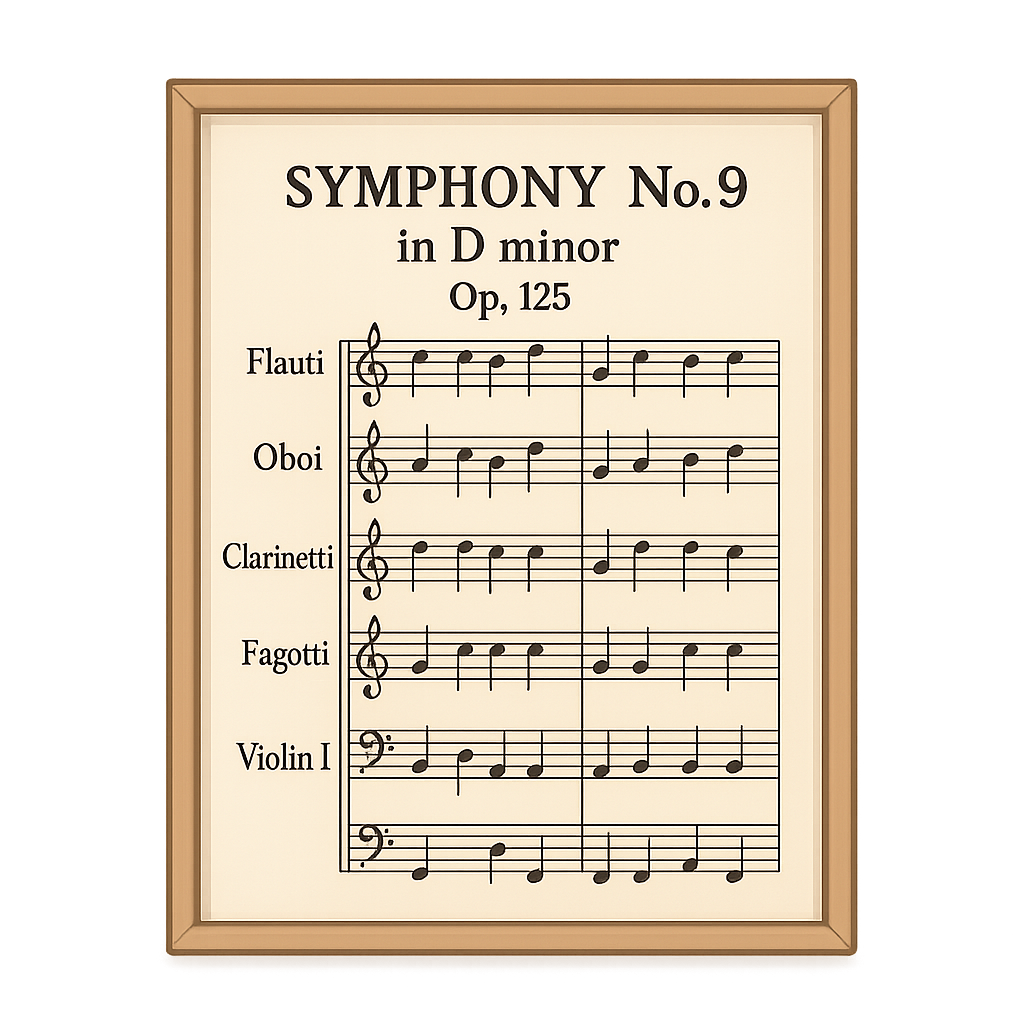
Symphony No. 9 in D minor, Op. 125
Ludwig van Beethoven's final complete symphony…
Reads at Grades 6–8 Listens at Grades 4–8
Print & create
Answer keys·No prep·Free with an account
28 worksheets · answer keys · full story · quiz · Ages 10-12 · CEFR B2
Plus adds 208,000+ more stories in 27 languages, audio for every one, and printables for all of them.
Just want Symphony No. 9 in D minor, Op. 125?
Before I was a river of sound, I was born from a sea of silence. Imagine a feeling, not a noise, gathering like a storm in the distance. First, a low rumble from the deepest strings, then quiet, searching whispers from the woodwinds. I took shape inside the mind of a great master, a man who could no longer hear the world around him but who held an entire universe of music within his soul. He didn't need his ears to know my power; he felt my vibrations through the floorboards and in the fierce beating of his own heart. He knew I would be vast and powerful, full of a deep, searching spirit that asked what it means to be human. My purpose was to speak for all of humanity, to give voice to its struggles and its ultimate capacity for joy. I am Symphony No. 9.
My creator was Ludwig van Beethoven, a man whose spirit was as wild, dramatic, and grand as my melodies. He lived and worked in Vienna, Austria, a city filled with music, but by the time he began composing me in earnest around the year 1822, his world had fallen almost completely quiet. Deafness had closed a door to the outside world, but it opened a new one within his mind, where he could hear me more clearly than any sound. He was a force of nature, pacing his rooms, stomping his feet to feel my rhythm, and shouting my melodies into the silent air. He didn't just write my notes; he wrestled them into existence. For decades, he had carried a dream: to unite the immense power of a full orchestra with the emotional beauty of the human voice. He had found the perfect words for this union long ago, in a poem written in 1785 by the great German writer Friedrich Schiller. It was called 'An die Freude,' or 'Ode to Joy,' and its message of universal brotherhood was the heart he wanted to give me.
A Song from Silence
Before I was a river of sound, I was born from a sea of silence. Imagine a feeling, not a noise, gathering like a storm in the distance. First, a low rumble from the deepest strings, then quiet, searching whispers from the woodwinds. I took shape inside the mind of a great master, a man who could no longer hear the world around him but who held an entire universe of music within his soul. He didn't need his ears to know my power; he felt my vibrations through the floorboards and in the fierce beating of his own heart. He knew I would be vast and powerful, full of a deep, searching spirit that asked what it means to be human. My purpose was to speak for all of humanity, to give voice to its struggles and its ultimate capacity for joy. I am Symphony No. 9.
My creator was Ludwig van Beethoven, a man whose spirit was as wild, dramatic, and grand as my melodies. He lived and worked in Vienna, Austria, a city filled with music, but by the time he began composing me in earnest around the year 1822, his world had fallen almost completely quiet. Deafness had closed a door to the outside world, but it opened a new one within his mind, where he could hear me more clearly than any sound. He was a force of nature, pacing his rooms, stomping his feet to feel my rhythm, and shouting my melodies into the silent air. He didn't just write my notes; he wrestled them into existence. For decades, he had carried a dream: to unite the immense power of a full orchestra with the emotional beauty of the human voice. He had found the perfect words for this union long ago, in a poem written in 1785 by the great German writer Friedrich Schiller. It was called 'An die Freude,' or 'Ode to Joy,' and its message of universal brotherhood was the heart he wanted to give me.
After two intense years of work, I was finally complete in the early months of 1824. My grand debut was set for the evening of May 7th, 1824, at Vienna's prestigious Theater am Kärntnertor. The air was electric with anticipation. For three movements, I surged and swelled, a powerful and complex journey of sound that pushed the boundaries of what a symphony could be. The audience was captivated. But then came my great, revolutionary surprise. In my fourth and final movement, something happened that no one had ever witnessed in a symphony before. Human voices burst forth. A full choir and four soloists joined the orchestra, singing Schiller's beautiful words about joy and the hope that all people will become brothers. The effect was astonishing. The audience was stunned, then completely overwhelmed with emotion. When my final, triumphant note faded, the theater erupted. People leaped to their feet with thunderous applause, but my dear Ludwig, who was on stage helping conduct, could not hear it. His back was to the crowd, and he remained still until one of the young singers, Caroline Unger, gently took his arm and turned him around. Only then did he see the five standing ovations, the waving handkerchiefs and hats, the silent roar of their appreciation.
From that day forward, I no longer belonged only to my creator. I became a gift to the world. My final theme, the simple and soaring melody of the 'Ode to Joy,' took on a life of its own, becoming an anthem for humanity itself. It has been played at moments of profound historical change, a soundtrack for hope. When the Berlin Wall, a barrier that divided a city and a nation, fell in 1989, I was performed in a triumphant Christmas Day concert to celebrate freedom and reunification. My 'Ode to Joy' melody was chosen as the official anthem of the European Union, representing the ideal of different nations coming together in peace. Today, you can hear my theme in movies, commercials, and played by aspiring musicians everywhere. I am more than just notes on a page or a performance in a concert hall; I am the sound of people finding connection, a timeless reminder that even from the deepest silence, a song of pure, unconquerable joy can rise up and fill the world.
Wow facts
About
Ludwig van Beethoven's final complete symphony, renowned for its grand scale and for being the first major symphony to incorporate a choir and vocal soloists, most famously in its final movement, 'Ode to Joy'.
Take a Quiz
Question 1 of 5
In your own words, retell the main events of the symphony's premiere on May 7th, 1824.
Explore next






Want to do even more?
Go beyond exploring. Unlock tools that turn every story into real learning.

Storypie Plus for families
Full stories, quizzes, and printables. Nights and car rides, sorted.
- Unlimited audio stories
- Create Mode: your child stars in the story
- Offline downloads
- Printable worksheets & coloring pages

Why Storypie for Schools
Students engaged. Prep in seconds. Evenings back to you.
- Worksheets & Quizzes
- Classroom Management
- Formative Assessment
- Custom Curriculum & Lesson Plans
- 27 Languages

Why Storypie for Homeschool
Curriculum done. They'll ask for more. Hours back in your day.
- Worksheet Generator
- First-Person Audio Stories
- Built-in Comprehension Quizzes
- Custom Curriculum & Lesson Plans
- Print & Go Activities