English

The Blue Marble
The Blue Marble is a famous photograph of Earth taken on December 7th, 1972…
Reads at Grades 6–8 Listens at Grades 4–8
Print & create
Answer keys·No prep·Free with an account
28 worksheets · answer keys · full story · quiz · Ages 10-12 · CEFR B2
Plus adds 244,000+ more stories in 27 languages, audio for every one, and printables for all of them.
Just want The Blue Marble?
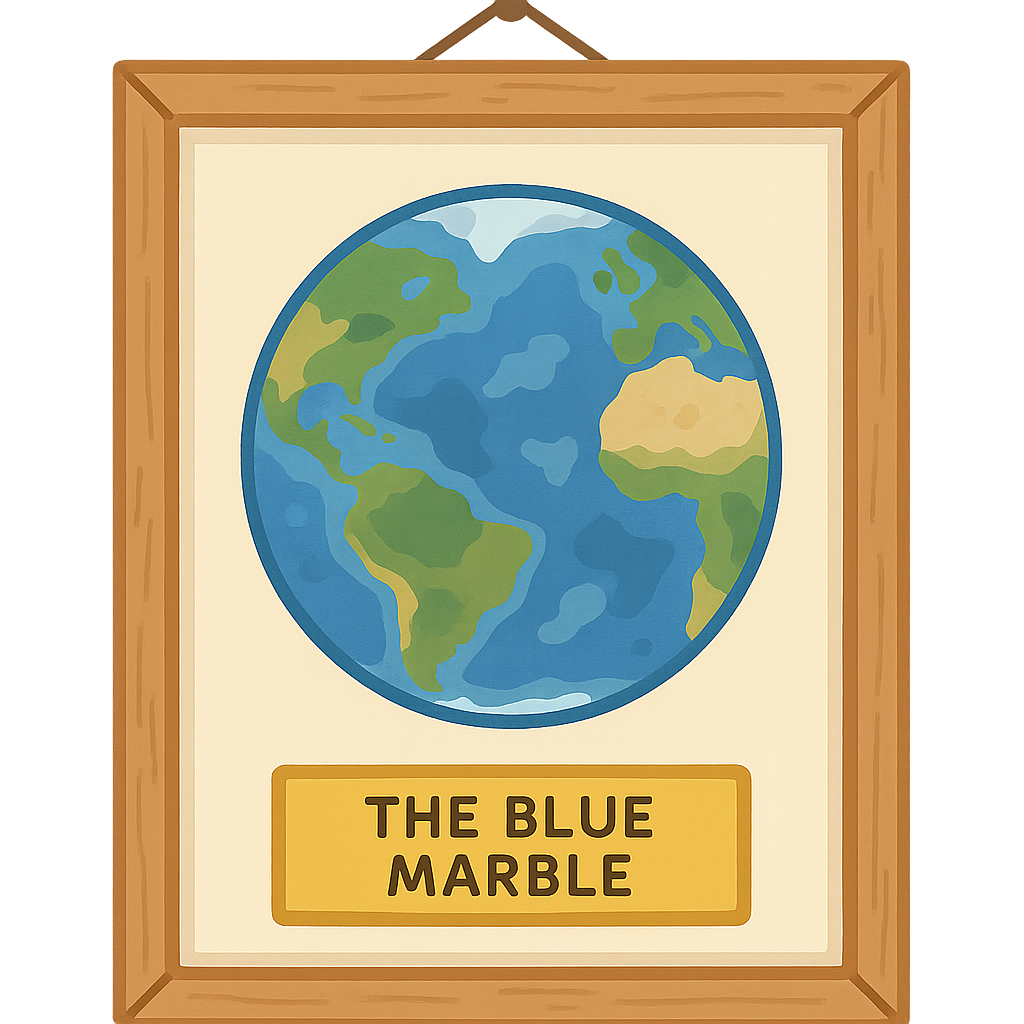
Imagine floating in the deepest, darkest silence you can think of, a quiet so complete it feels like the whole universe is holding its breath. Then, out of that blackness, a single, perfect sphere appears. It glows with an impossible swirl of deep, living blue, streaked with delicate wisps of brilliant white. Patches of rich green and earthy tan peek through the clouds, hinting at continents and coastlines. It hangs there, peaceful and radiant, a solitary jewel in the vastness of space. It looks like a planet, but I am not a planet. I am a picture of one. I am the first photograph of the whole, sunlit Earth, taken by a human hand on a journey far from home. My name is The Blue Marble.
My story begins on December 7th, 1972, a long way from the world I show. Three astronauts from a country called the United States—Eugene Cernan, Ronald Evans, and Harrison Schmitt—were sealed inside a spacecraft named Apollo 17. They were on their way to the Moon, the last mission of its kind. About five hours and six minutes after they had left Earth's orbit, their home planet was shrinking behind them. It was a moment of perfect cosmic alignment. The sun was directly behind their spacecraft, acting like a giant spotlight that illuminated the entire face of the Earth. From their window, the astronauts saw a view no human had ever seen in its entirety before. One of them, though historians are not completely sure which one, grabbed a special 70-millimeter Hasselblad camera with an 80-millimeter lens. Looking out the window of the command module, he aimed the camera and clicked the shutter. In that instant, I was born. I captured a breathtaking view, from the recognizable shape of the Mediterranean Sea all the way down to the vast, icy expanse of Antarctica at the South Pole. For the first time, a human being saw and captured the full, sun-drenched circle of life in a single frame.
The Blue Marble
Imagine floating in the deepest, darkest silence you can think of, a quiet so complete it feels like the whole universe is holding its breath. Then, out of that blackness, a single, perfect sphere appears. It glows with an impossible swirl of deep, living blue, streaked with delicate wisps of brilliant white. Patches of rich green and earthy tan peek through the clouds, hinting at continents and coastlines. It hangs there, peaceful and radiant, a solitary jewel in the vastness of space. It looks like a planet, but I am not a planet. I am a picture of one. I am the first photograph of the whole, sunlit Earth, taken by a human hand on a journey far from home. My name is The Blue Marble.
My story begins on December 7th, 1972, a long way from the world I show. Three astronauts from a country called the United States—Eugene Cernan, Ronald Evans, and Harrison Schmitt—were sealed inside a spacecraft named Apollo 17. They were on their way to the Moon, the last mission of its kind. About five hours and six minutes after they had left Earth's orbit, their home planet was shrinking behind them. It was a moment of perfect cosmic alignment. The sun was directly behind their spacecraft, acting like a giant spotlight that illuminated the entire face of the Earth. From their window, the astronauts saw a view no human had ever seen in its entirety before. One of them, though historians are not completely sure which one, grabbed a special 70-millimeter Hasselblad camera with an 80-millimeter lens. Looking out the window of the command module, he aimed the camera and clicked the shutter. In that instant, I was born. I captured a breathtaking view, from the recognizable shape of the Mediterranean Sea all the way down to the vast, icy expanse of Antarctica at the South Pole. For the first time, a human being saw and captured the full, sun-drenched circle of life in a single frame.
When I was brought back to Earth, carefully developed from a roll of film, I caused a sensation. Before my existence, photographs of Earth were mostly partial views—beautiful crescents or sections of the globe, often with parts hidden in shadow. Satellites had taken images, but they were often composites, stitched together from many pictures. I was different. I was a single, authentic portrait, taken by a person looking back at everyone and everything he had ever known. When NASA released me to the public on December 23rd, 1972, people were speechless. For the first time in history, humanity could see its home not as a collection of countries with lines drawn on a map, but as one single, interconnected organism. This new perspective was revolutionary. In the 1970s, a powerful environmental movement was gaining momentum, with people growing concerned about pollution and the health of the planet. I became their banner, their symbol. I showed a world without borders, a fragile and finite home that everyone shared. My image helped fuel the passion behind movements like Earth Day, reminding people that the oceans, the air, and the land are all connected. I wasn't just a picture; I was a call to action.
My legacy grew far beyond that moment. I became one of the most famous and widely reproduced photographs in all of history. My image has been printed on posters, in textbooks, on album covers, and seen on screens all over the world. Many people feel they have seen me even if they do not know my name or my story. But I am more than just an image; I am an idea. I am the visual proof that our home is a shared one, and that its fate rests in the hands of all who live upon it. I represent what some call the 'overview effect'—the profound shift in awareness that astronauts experience when they see Earth from a distance. It’s a feeling of awe for the planet and a sense of responsibility for its care. I am a memory of a time when humanity looked back at itself and saw something beautiful and whole. I live on as a reminder that we all share this one precious home, a beautiful blue marble spinning in the great, starry dark.
Wow facts
About
The Blue Marble is a famous photograph of Earth taken on December 7th, 1972, by the crew of the Apollo 17 spacecraft. It is one of the most widely reproduced images in history and became a symbol of the environmental movement.
Take a Quiz
Question 1 of 5
In your own words, summarize the key events that led to the creation of The Blue Marble photograph.
Explore next






Want to do even more?
Go beyond exploring. Unlock tools that turn every story into real learning.

Storypie Plus for families
Full stories, quizzes, and printables. Nights and car rides, sorted.
- Unlimited audio stories
- Create Mode: your child stars in the story
- Offline downloads
- Printable worksheets & coloring pages

Why Storypie for Schools
Students engaged. Prep in seconds. Evenings back to you.
- Worksheets & Quizzes
- Classroom Management
- Formative Assessment
- Custom Curriculum & Lesson Plans
- 27 Languages

Why Storypie for Homeschool
Curriculum done. They'll ask for more. Hours back in your day.
- Worksheet Generator
- First-Person Audio Stories
- Built-in Comprehension Quizzes
- Custom Curriculum & Lesson Plans
- Print & Go Activities