English

NASA
The National Aeronautics and Space Administration (NASA) is an independent agency of the U.S.
Reads at Grades 3–5 Listens at Grades 1–5
Print & create
Answer keys·No prep·Free with an account
28 worksheets · answer keys · full story · quiz · Ages 8-10 · CEFR B1
Plus adds 116,000+ more stories in 27 languages, audio for every one, and printables for all of them.
Just want NASA?
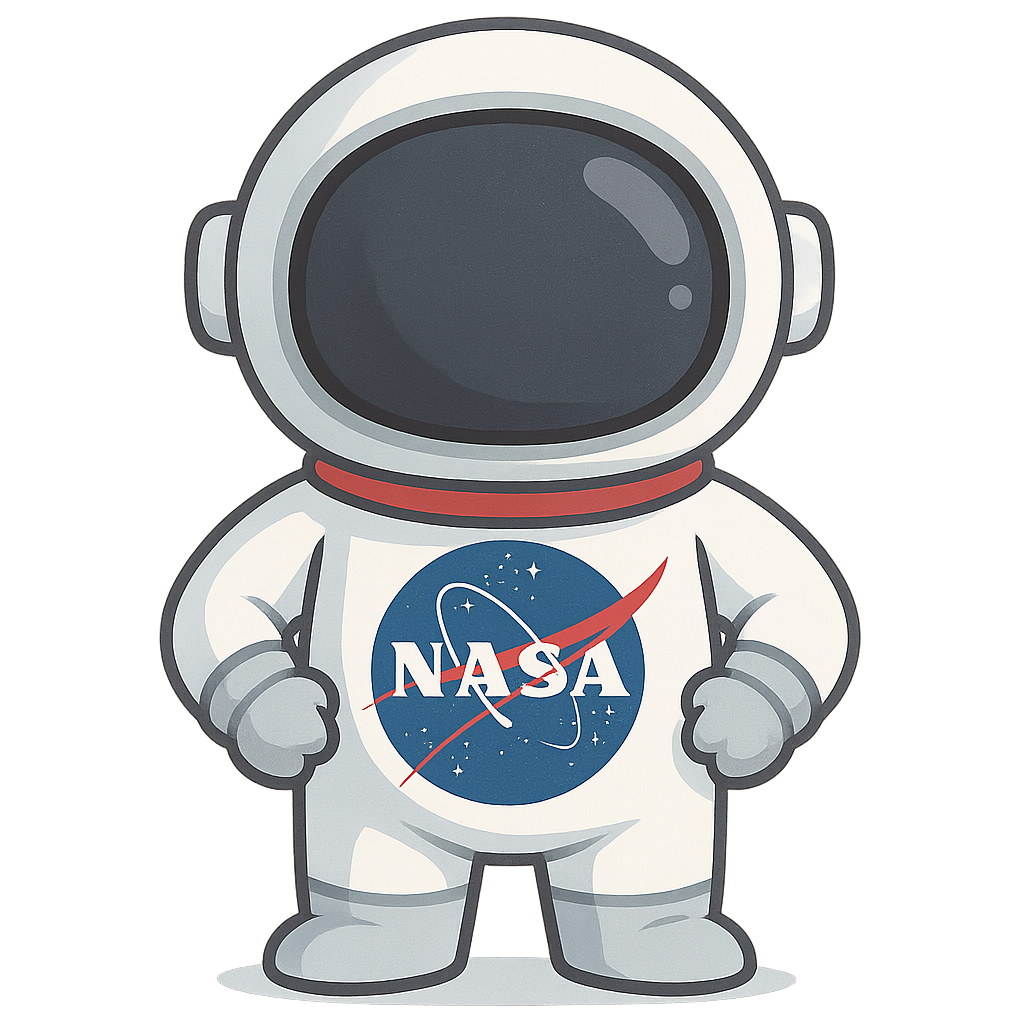
Hello! We are the National Aeronautics and Space Administration, but you probably know us by our nickname, NASA. We are an agency of the United States government, which means we work on behalf of the American people. Our journey began in 1958, when we were created with a very important job: to explore the vast universe around us. Our mission has three main parts. First, we explore space, venturing out to see what lies beyond our world. Second, we study our home planet, Earth, to understand it better. And third, we develop new technologies that can help us in our explorations and also improve life here on the ground. We use science to ask big questions about the Moon, the planets, and the distant stars, and we work hard to find the answers about the universe and our place within it.
When we were first formed, we set our sights on an incredible goal that seemed like science fiction at the time: sending human beings to the Moon. This was a huge challenge that required many careful steps. First, we started our Mercury and Gemini programs. In these early missions, our brave astronauts learned the basics of space travel. They practiced flying their small capsules, learned how to live and work in a weightless environment, and figured out how to connect two spacecraft together while in orbit. These projects were like our training wheels, preparing us for the main event: the Apollo program. After years of hard work and preparation, our Apollo 11 mission was ready. In 1969, we successfully landed on the Moon. Astronauts Neil Armstrong and Buzz Aldrin stepped out of their lunar module and became the first people to ever walk on the surface of another world. It was a moment watched by people all over the globe, a true giant leap for exploration.
A Story of NASA: Exploring Our Universe
Hello! We are the National Aeronautics and Space Administration, but you probably know us by our nickname, NASA. We are an agency of the United States government, which means we work on behalf of the American people. Our journey began in 1958, when we were created with a very important job: to explore the vast universe around us. Our mission has three main parts. First, we explore space, venturing out to see what lies beyond our world. Second, we study our home planet, Earth, to understand it better. And third, we develop new technologies that can help us in our explorations and also improve life here on the ground. We use science to ask big questions about the Moon, the planets, and the distant stars, and we work hard to find the answers about the universe and our place within it.
When we were first formed, we set our sights on an incredible goal that seemed like science fiction at the time: sending human beings to the Moon. This was a huge challenge that required many careful steps. First, we started our Mercury and Gemini programs. In these early missions, our brave astronauts learned the basics of space travel. They practiced flying their small capsules, learned how to live and work in a weightless environment, and figured out how to connect two spacecraft together while in orbit. These projects were like our training wheels, preparing us for the main event: the Apollo program. After years of hard work and preparation, our Apollo 11 mission was ready. In 1969, we successfully landed on the Moon. Astronauts Neil Armstrong and Buzz Aldrin stepped out of their lunar module and became the first people to ever walk on the surface of another world. It was a moment watched by people all over the globe, a true giant leap for exploration.
After the great success of the Apollo program, our human explorers stayed closer to home for a while, but our curiosity about the solar system only grew. To continue exploring, we turned to a new team of adventurers: our amazing robotic explorers. These spacecraft can travel to places that are too far or too dangerous for humans to go yet. For example, our two Viking landers touched down on the rusty red surface of Mars in the 1970s, studying its soil and weather. Around the same time, we launched our twin Voyager probes on an epic journey. They flew past the giant planets of Jupiter, Saturn, Uranus, and Neptune, sending back the very first close-up pictures of these mysterious worlds and their many moons. Today, decades later, the two Voyager spacecraft are still traveling. They have gone so far that they have left our solar system and are now exploring interstellar space, the empty area between the stars. They are the farthest human-made objects from Earth.
To make it easier for our astronauts to travel to space and back, we knew we needed a new kind of vehicle. This led us to develop the Space Shuttle, a remarkable spacecraft that looked like an airplane. Unlike the Apollo rockets, which could only be used once, the Space Shuttle was reusable. It could launch like a rocket, work in orbit like a spaceship, and land on a runway like a plane. For 30 years, our fleet of Space Shuttles carried astronauts and supplies into orbit. One of its most important jobs was to help us build our next home in space: the International Space Station, or ISS. The ISS is a huge laboratory that circles high above our planet. We didn't build it alone; it was a team effort with partners from many different countries. Astronauts from around the world live on the ISS for months at a time, conducting important scientific experiments in a unique zero-gravity environment that can’t be duplicated on Earth.
Our work of exploration is far from over. Today, we are peering deeper into space and further back in time than ever before with powerful new tools. One of these is the James Webb Space Telescope, which is designed to see the very first stars and galaxies that formed in the universe just after the Big Bang. At the same time, we are preparing to send humans on new journeys. With our Artemis program, we are planning to send astronauts back to the Moon. But this time, we aren't just going for a short visit. Our goal is to build a long-term base where astronauts can live and work. Everything we learn from living on the Moon will help us prepare for our next giant leap, which will be the most difficult journey in human history: sending the first astronauts to explore Mars.
Wow facts
About
The National Aeronautics and Space Administration (NASA) is an independent agency of the U.S. federal government responsible for the nation's civil space program and for aeronautics and aerospace research.
Take a Quiz
Question 1 of 5
According to the story, what was the main goal of NASA's Apollo program?
Explore next





Want to do even more?
Go beyond exploring. Unlock tools that turn every story into real learning.

Storypie Plus for families
Full stories, quizzes, and printables. Nights and car rides, sorted.
- Unlimited audio stories
- Create Mode: your child stars in the story
- Offline downloads
- Printable worksheets & coloring pages

Why Storypie for Schools
Students engaged. Prep in seconds. Evenings back to you.
- Worksheets & Quizzes
- Classroom Management
- Formative Assessment
- Custom Curriculum & Lesson Plans
- 27 Languages

Why Storypie for Homeschool
Curriculum done. They'll ask for more. Hours back in your day.
- Worksheet Generator
- First-Person Audio Stories
- Built-in Comprehension Quizzes
- Custom Curriculum & Lesson Plans
- Print & Go Activities