English

Apollo 11 Mission
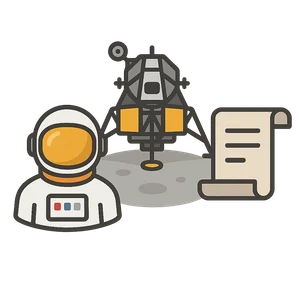
The historic 1969 spaceflight by the United States that first landed humans on the Moon…
Reads at Grades 6–8 Listens at Grades 4–8
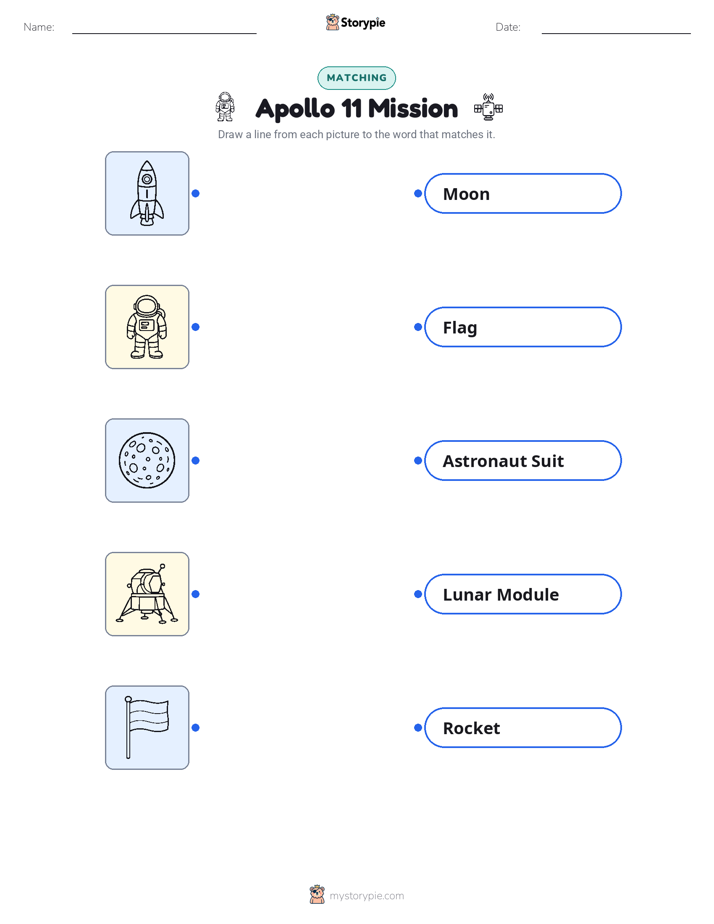
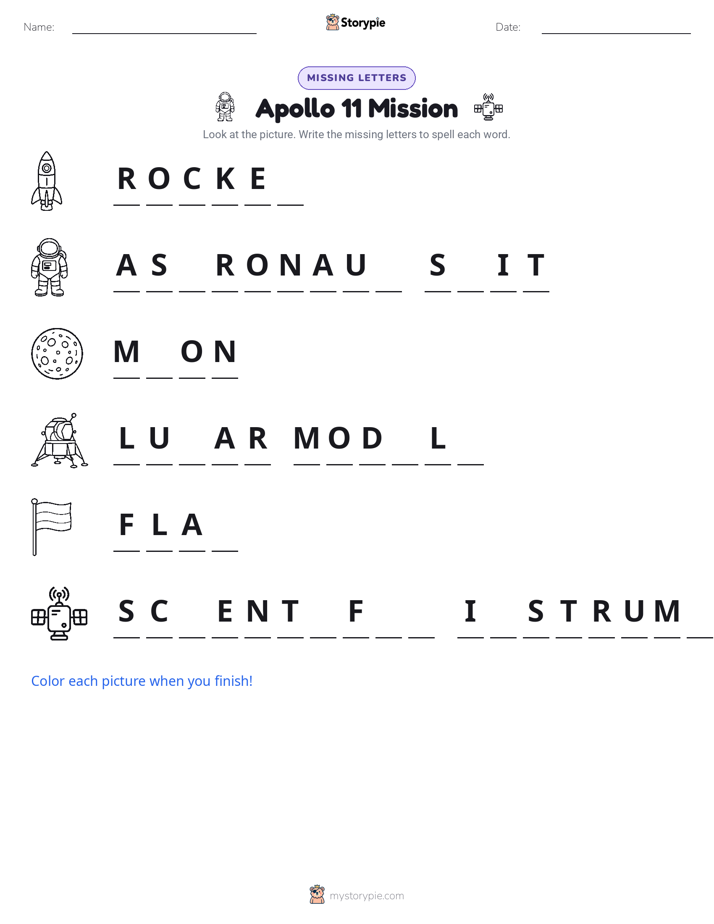
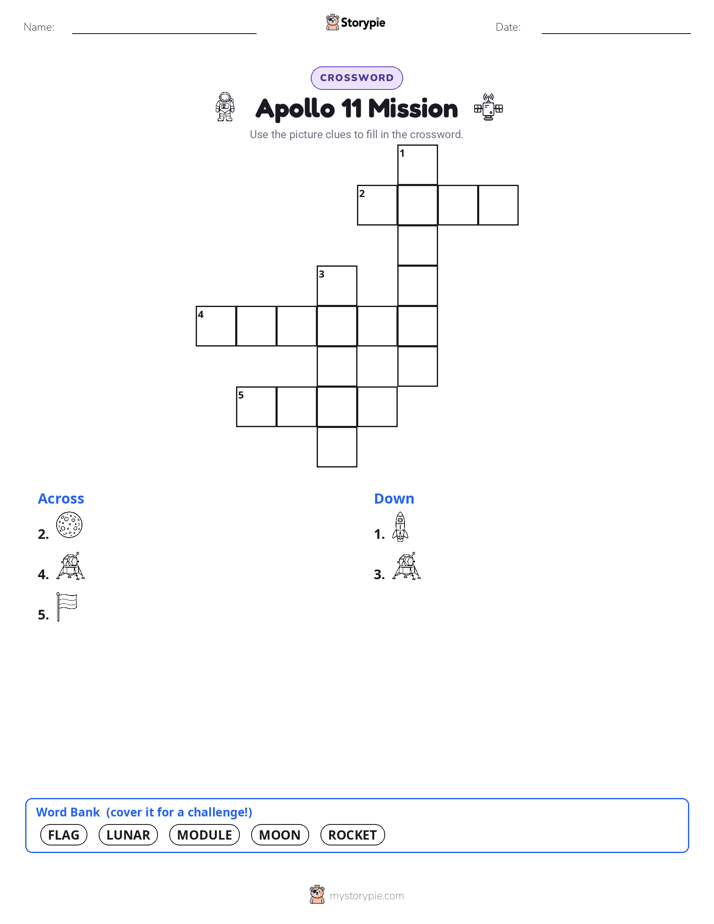
Print & create
Answer keys·No prep·Free with an account
28 worksheets · answer keys · full story · quiz · Ages 10-12 · CEFR B2
Plus adds 244,000+ more stories in 27 languages, audio for every one, and printables for all of them.
Just want Apollo 11 Mission?
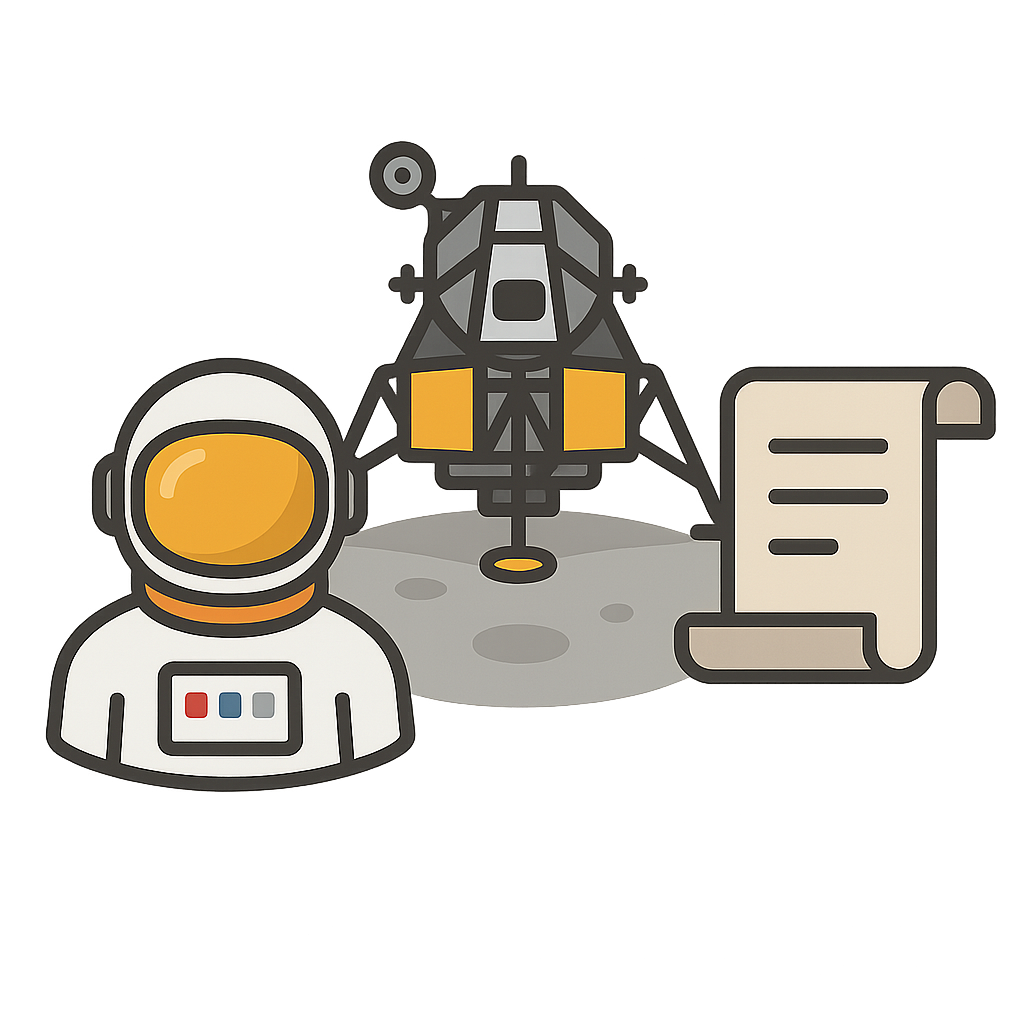
Hello there. My name is Neil Armstrong, and long before I ever dreamed of spaceships, I dreamed of flying. As a boy growing up in Ohio, I built model airplanes and read every book I could find about aviation. My first real airplane ride at age six sealed my fate; I knew my future was in the sky. As I grew up, the world changed. My country, the United States, and another powerful nation, the Soviet Union, were engaged in what became known as the Space Race. It wasn't a war fought with weapons, but a peaceful competition of science, engineering, and courage to see who could explore the cosmos first. The Soviets had achieved early successes, like launching the first satellite and sending the first man into orbit. This inspired America to aim for an even greater goal: landing a man on the Moon and returning him safely to Earth before the decade was out. I joined NASA as an astronaut in 1962, and the work was more intense than I could have imagined. Thousands of brilliant scientists, engineers, and technicians worked together, solving problems that had never been solved before. By 1969, we were ready. I was given the incredible honor of commanding the Apollo 11 mission. The responsibility was immense, but the sense of purpose and excitement was even greater. We were standing on the shoulders of giants, ready to take humanity's next great step.
On the morning of July 16th, 1969, my crewmates, Buzz Aldrin and Michael Collins, and I were strapped into our seats at the very top of the most powerful rocket ever built: the Saturn V. It was a machine of unbelievable complexity, a 36-story tower of fuel and metal pointed at the heavens. When the countdown reached zero, a rumble started deep below us. It grew into a bone-shaking roar that felt like the whole world was tearing apart. We were pushed back into our seats by forces many times the pull of Earth’s gravity as the rocket clawed its way into the sky. For the first few minutes, the ride was rough and deafening, a controlled explosion of immense power. Then, as the stages of the rocket fell away, the noise stopped, and we were suddenly weightless. It was silent. Looking out the window, I saw the most beautiful sight imaginable: our home, Planet Earth, a perfect blue and white marble hanging in the infinite blackness of space. As we traveled for three days across the 240,000 miles to the Moon, we watched Earth grow smaller and smaller. It was a humbling perspective, seeing our entire world in a single glance. Michael would orbit the Moon in our Command Module, 'Columbia,' while Buzz and I would make the final descent.
One Giant Leap: My Journey to the Moon
Hello there. My name is Neil Armstrong, and long before I ever dreamed of spaceships, I dreamed of flying. As a boy growing up in Ohio, I built model airplanes and read every book I could find about aviation. My first real airplane ride at age six sealed my fate; I knew my future was in the sky. As I grew up, the world changed. My country, the United States, and another powerful nation, the Soviet Union, were engaged in what became known as the Space Race. It wasn't a war fought with weapons, but a peaceful competition of science, engineering, and courage to see who could explore the cosmos first. The Soviets had achieved early successes, like launching the first satellite and sending the first man into orbit. This inspired America to aim for an even greater goal: landing a man on the Moon and returning him safely to Earth before the decade was out. I joined NASA as an astronaut in 1962, and the work was more intense than I could have imagined. Thousands of brilliant scientists, engineers, and technicians worked together, solving problems that had never been solved before. By 1969, we were ready. I was given the incredible honor of commanding the Apollo 11 mission. The responsibility was immense, but the sense of purpose and excitement was even greater. We were standing on the shoulders of giants, ready to take humanity's next great step.
On the morning of July 16th, 1969, my crewmates, Buzz Aldrin and Michael Collins, and I were strapped into our seats at the very top of the most powerful rocket ever built: the Saturn V. It was a machine of unbelievable complexity, a 36-story tower of fuel and metal pointed at the heavens. When the countdown reached zero, a rumble started deep below us. It grew into a bone-shaking roar that felt like the whole world was tearing apart. We were pushed back into our seats by forces many times the pull of Earth’s gravity as the rocket clawed its way into the sky. For the first few minutes, the ride was rough and deafening, a controlled explosion of immense power. Then, as the stages of the rocket fell away, the noise stopped, and we were suddenly weightless. It was silent. Looking out the window, I saw the most beautiful sight imaginable: our home, Planet Earth, a perfect blue and white marble hanging in the infinite blackness of space. As we traveled for three days across the 240,000 miles to the Moon, we watched Earth grow smaller and smaller. It was a humbling perspective, seeing our entire world in a single glance. Michael would orbit the Moon in our Command Module, 'Columbia,' while Buzz and I would make the final descent.
The most dangerous part of our entire journey came on July 20th, 1969. Buzz and I had separated from Columbia in our Lunar Module, which we had nicknamed the 'Eagle.' Our job was to fly it down to the surface. Everything was going according to our training until the final minutes of the descent. Suddenly, alarms began to blare inside our small cockpit. The guidance computer was overloaded with data, flashing codes we had never seen in our simulations. Mission Control back in Houston told us to press on, but I could see through my window that the computer was steering us toward a bad landing spot—the side of a large crater filled with massive boulders. There was no way we could land there safely. With my heart pounding, I took over manual control of the Eagle. My hands flew across the controls, guiding our fragile craft forward, skimming over the rocky terrain. Buzz was calling out our altitude and fuel levels. The numbers were dropping fast. '60 seconds,' he said, meaning we had only a minute of fuel left. Then '30 seconds.' The tension was immense. I finally found a clear, level spot and gently eased the Eagle down. With less than 25 seconds of fuel to spare, I felt a soft bump. The engine went silent. On the radio, I said the words the whole world was waiting to hear: 'Houston, Tranquility Base here. The Eagle has landed.'
For a moment, Buzz and I just looked at each other in the quiet stillness. We had done it. We were on the Moon. After checking all our systems, we prepared for the next historic moment. I slowly made my way down the ladder on the outside of the Eagle. As my boot touched the fine, powdery dust of the lunar surface, I spoke the first words from another world: 'That's one small step for a man, one giant leap for mankind.' I truly meant it. My single step was small, but it represented the combined effort and dreams of hundreds of thousands of people over many years. The surface was like nothing on Earth. I called it 'magnificent desolation.' It was beautiful in its stark, untouched emptiness. The sky was the blackest black I had ever seen, with no stars visible in the sun's glare. In the low gravity, which is only one-sixth of Earth's, every step felt like a slow, bouncing leap. Buzz soon joined me, and together we planted the American flag as a symbol of our nation's achievement. We spent about two and a half hours outside, collecting samples of moon rocks and soil, setting up scientific experiments, and taking photographs. But the most profound sight was looking up and seeing our home. Earth hung in the black sky like a precious, fragile jewel. From the Moon, there are no borders, no conflicts, just one beautiful planet. It was a perspective that changed me forever.
Our work on the surface complete, we climbed back into the Eagle, leaving behind our footprints and a plaque that read, 'We came in peace for all mankind.' We launched from the Moon's surface and rejoined Michael, who had been patiently orbiting above us in Columbia. The journey home was a time for reflection. After three more days of coasting through space, we prepared for our fiery return. Our capsule hit Earth's atmosphere at nearly 25,000 miles per hour, turning into a blazing fireball as the heat shield protected us. Finally, parachutes deployed, and we splashed down safely in the Pacific Ocean on July 24th, 1969, where a ship was waiting to recover us. The Apollo 11 mission was a success. But to me, its legacy was never about one country winning a race. It was a demonstration of what humanity can achieve when we unite with a common purpose, driven by curiosity and a desire to explore the unknown. It proved that even the most impossible dreams, like walking on the Moon, can be reached. My hope has always been that our journey would inspire future generations to keep asking questions, to work together, and to continue reaching for the stars.
Wow facts
About
The historic 1969 spaceflight by the United States that first landed humans on the Moon, with astronauts Neil Armstrong and Buzz Aldrin walking on the lunar surface.
Take a Quiz
Question 1 of 5
What was the main problem Neil Armstrong faced while trying to land the 'Eagle' on the Moon, and how did he solve it?
Explore next



Want to do even more?
Go beyond exploring. Unlock tools that turn every story into real learning.

Storypie Plus for families
Full stories, quizzes, and printables. Nights and car rides, sorted.
- Unlimited audio stories
- Create Mode: your child stars in the story
- Offline downloads
- Printable worksheets & coloring pages

Why Storypie for Schools
Students engaged. Prep in seconds. Evenings back to you.
- Worksheets & Quizzes
- Classroom Management
- Formative Assessment
- Custom Curriculum & Lesson Plans
- 27 Languages

Why Storypie for Homeschool
Curriculum done. They'll ask for more. Hours back in your day.
- Worksheet Generator
- First-Person Audio Stories
- Built-in Comprehension Quizzes
- Custom Curriculum & Lesson Plans
- Print & Go Activities