English


Cinco de Mayo
A holiday commemorating the Mexican army's unlikely victory over the French Empire at the Battle of Puebla on…
Reads at Grades 6–8 Listens at Grades 4–8
 Screen-free speaker. Built for your kids.
No card, no commitment. One email when there is real news, and one click to stop.
Print & create
Answer keys·No prep·Free with an account
28 worksheets · answer keys · full story · quiz · Ages 10-12 · CEFR B2
Plus adds 102,000+ more stories in 27 languages, audio for every one, and printables for all of them.
Just want Cinco de Mayo?

My name is Ignacio Zaragoza, and I served as a general in the army of Mexico. To tell you my story, I must take you back to a difficult time for my country, the early 1860s. For years, Mexico had been torn apart by internal conflicts, most recently a terrible civil struggle we called the Reform War. By 1861, our nation was exhausted and our treasury was empty. Our president, a wise and determined man named Benito Juárez, was forced to make a painful decision. He announced to the world that Mexico would have to temporarily suspend paying its debts to foreign countries, including Spain, Great Britain, and France. We simply did not have the money, but we promised to pay when we could. This decision was not well received. Soon, the naval fleets of all three European powers arrived off our coast, demanding payment. We were able to negotiate with Spain and Great Britain. They listened to our situation, made arrangements, and their ships sailed away. But France was a different story. Their emperor, Napoleon III, was ambitious. He saw our moment of weakness not as a problem to be solved, but as a golden opportunity. He didn't just want his money back; he dreamed of conquering Mexico and establishing a new empire loyal to him in the Americas. Before we knew it, a formidable French army had landed and begun its march toward our capital, Mexico City. They were considered the finest army in the world, undefeated for nearly fifty years. And President Juárez had given me the monumental task of stopping them. I looked at my soldiers, many of whom were volunteers with more courage than training, and I knew the weight of our nation's future rested on our shoulders.
The Day We Were Covered in Glory
My name is Ignacio Zaragoza, and I served as a general in the army of Mexico. To tell you my story, I must take you back to a difficult time for my country, the early 1860s. For years, Mexico had been torn apart by internal conflicts, most recently a terrible civil struggle we called the Reform War. By 1861, our nation was exhausted and our treasury was empty. Our president, a wise and determined man named Benito Juárez, was forced to make a painful decision. He announced to the world that Mexico would have to temporarily suspend paying its debts to foreign countries, including Spain, Great Britain, and France. We simply did not have the money, but we promised to pay when we could. This decision was not well received. Soon, the naval fleets of all three European powers arrived off our coast, demanding payment. We were able to negotiate with Spain and Great Britain. They listened to our situation, made arrangements, and their ships sailed away. But France was a different story. Their emperor, Napoleon III, was ambitious. He saw our moment of weakness not as a problem to be solved, but as a golden opportunity. He didn't just want his money back; he dreamed of conquering Mexico and establishing a new empire loyal to him in the Americas. Before we knew it, a formidable French army had landed and begun its march toward our capital, Mexico City. They were considered the finest army in the world, undefeated for nearly fifty years. And President Juárez had given me the monumental task of stopping them. I looked at my soldiers, many of whom were volunteers with more courage than training, and I knew the weight of our nation's future rested on our shoulders.
Our stand would be made at the city of Puebla. As the French army, led by the overly confident General Charles de Lorencez, approached, we prepared our defenses. The morning of May 5th, 1862, dawned cold and gray, with a persistent rain that turned the fields to thick mud. This, I thought, might be a small gift from fate. We were positioned on high ground, in and around two old forts named Loreto and Guadalupe that overlooked the main road. My army consisted of roughly 4,500 men, a mix of professional soldiers and civilian volunteers who loved their country enough to risk everything. We were poorly equipped compared to the enemy, but our hearts burned with a fierce patriotism. General de Lorencez commanded over 6,000 soldiers, all well-fed, well-trained, and armed with the best weapons of the time. He was so sure of an easy victory that he believed the sight of his soldiers' blue uniforms would be enough to make us flee. He decided on a direct, frontal assault up the slippery, muddy hill toward our forts. He thought we would crumble. The battle began with the roar of French cannons, but our own artillery answered back from the forts. Then, the French infantry began their charge. It was a terrifying sight, this wave of disciplined soldiers marching steadily up the slope, but my men held their ground. Our volleys of musket fire tore into their ranks, and the first charge faltered and fell back. They regrouped and charged a second time, with even more fury. Again, we repelled them. The fighting was intense, and I saw incredible bravery from my soldiers, especially a group of indigenous fighters from the nearby mountains who fought with unmatched ferocity. After a third, desperate assault failed, the French were in disarray. Their ammunition was running low, and their spirit was broken. Seeing my chance, I ordered my cavalry to attack their flanks while my infantry charged forward. The disciplined French army, the pride of Europe, turned and fled in a chaotic retreat. We had done the impossible.
In the moments after the French retreat, a stunned silence fell over the battlefield, quickly replaced by thunderous cheers. Cries of '¡Viva México!' echoed from the forts. We, the underdogs, had defeated the world's greatest army. My heart swelled with a pride I can hardly describe. I immediately sent a dispatch to President Juárez in Mexico City. I kept my message brief, wanting the facts to speak for themselves. 'Las armas nacionales se han cubierto de gloria,' I wrote. 'The national arms have been covered in glory.' Now, it is important to understand the truth of what happened next. Our victory at Puebla on May 5th was a glorious moment, but it did not end the war. The French were humiliated, and they sent a much larger army the following year, which eventually did capture Mexico City and occupy our country for a time. So why is this one battle remembered with such passion? Because on that day, we showed the world, and more importantly ourselves, that the spirit of the Mexican people would not be easily broken. We proved that a united nation fighting for its freedom and its home could stand against any power. The Battle of Puebla became a powerful symbol of our resilience and courage. And that is what is celebrated every Cinco de Mayo. It is not our independence day, but a day to honor the legacy of courage that was born in the mud and rain of Puebla, a day to remember that the fight for what you believe in is always worth it.
Wow facts
About
A holiday commemorating the Mexican army's unlikely victory over the French Empire at the Battle of Puebla on May 5th, 1862, under the leadership of General Ignacio Zaragoza.
Take a Quiz
Question 1 of 5
In your own words, summarize the main events of the Battle of Puebla as described by General Zaragoza.
Explore next





Want to do even more?
Go beyond exploring. Unlock tools that turn every story into real learning.

Storypie Plus for families
Full stories, quizzes, and printables. Nights and car rides, sorted.
- Unlimited audio stories
- Create Mode: your child stars in the story
- Offline downloads
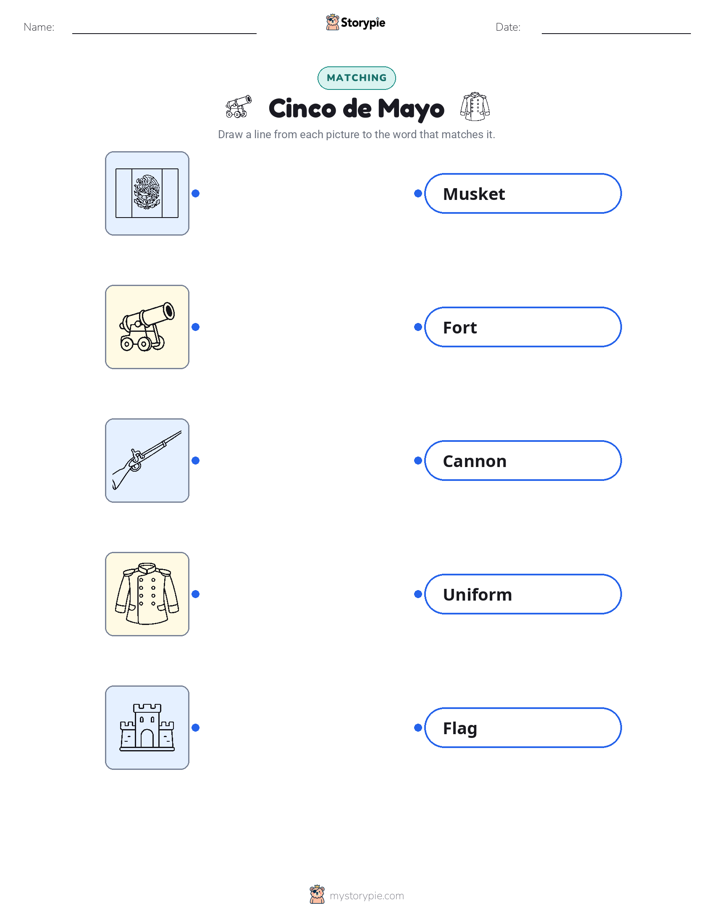
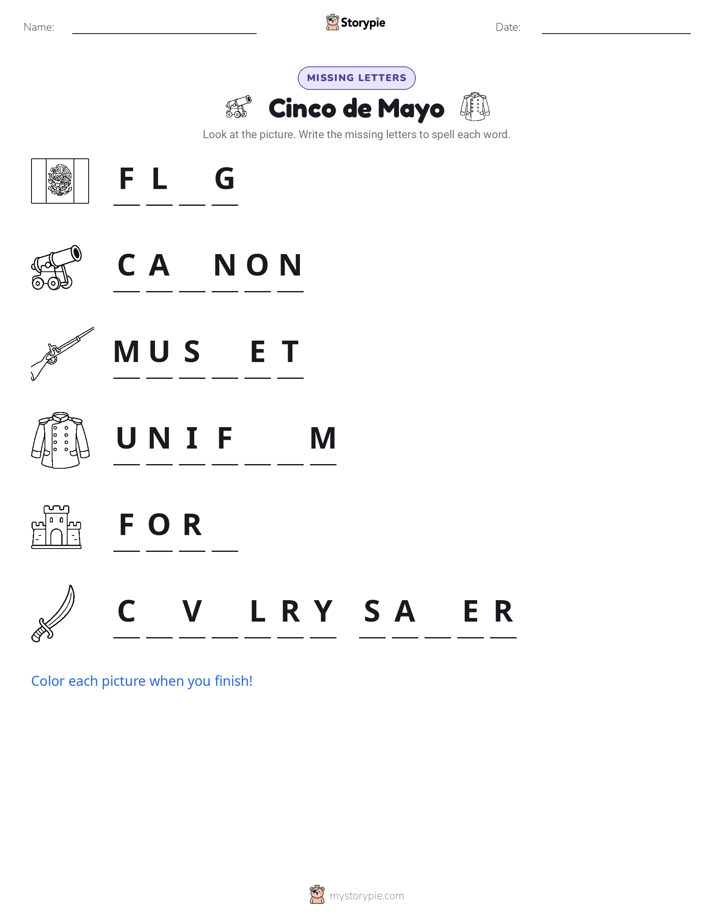
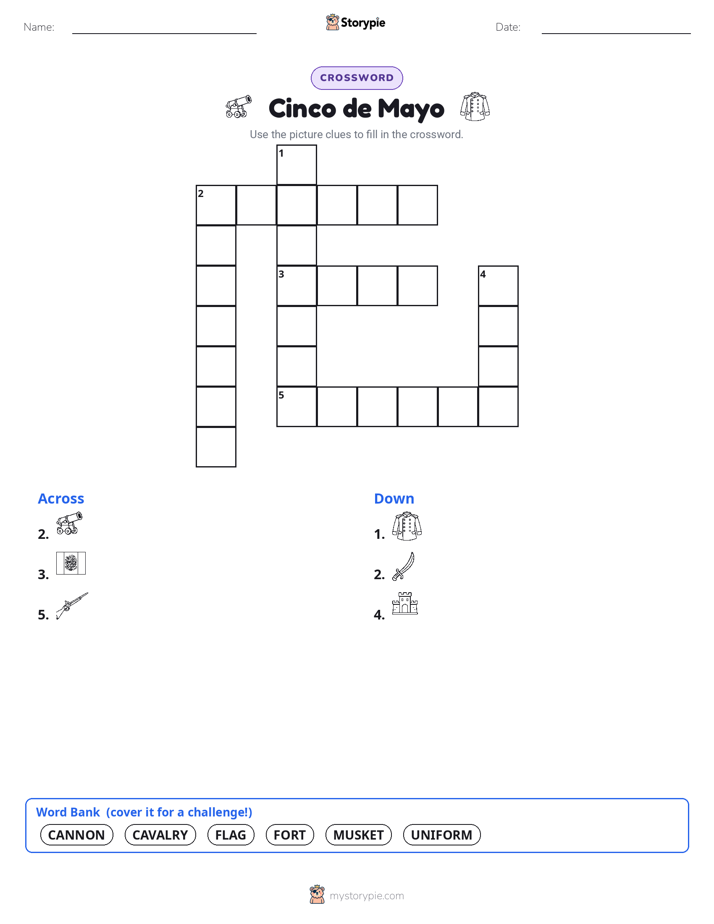
- Printable worksheets & coloring pages

Why Storypie for Schools
Students engaged. Prep in seconds. Evenings back to you.
- Worksheets & Quizzes
- Classroom Management
- Formative Assessment
- Custom Curriculum & Lesson Plans
- 27 Languages

Why Storypie for Homeschool
Curriculum done. They'll ask for more. Hours back in your day.
- Worksheet Generator
- First-Person Audio Stories
- Built-in Comprehension Quizzes
- Custom Curriculum & Lesson Plans
- Print & Go Activities