English

Cold War
A period of intense geopolitical tension from 1947 to 1991 between the United States and the Soviet Union and…
Reads at Grades 3–5 Listens at Grades 1–5
Print & create
Answer keys·No prep·Free with an account
28 worksheets · answer keys · full story · quiz · Ages 8-10 · CEFR B1
Plus adds 102,000+ more stories in 27 languages, audio for every one, and printables for all of them.
Just want Cold War?
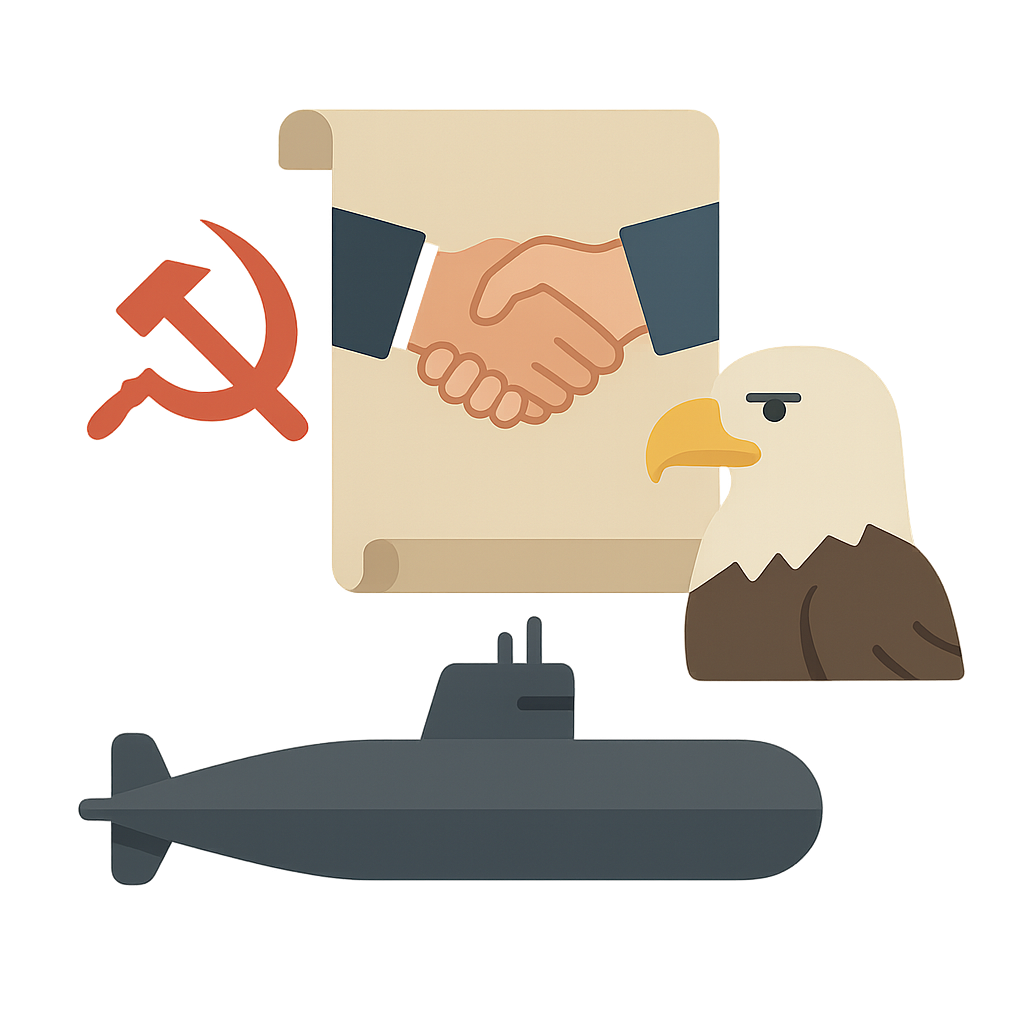
Hello there. My name is John F. Kennedy, and I had the great honor of serving as the 35th President of the United States. I want to tell you about a very unusual time in history that happened when I was president. It was called the Cold War. After a huge war called World War II ended, the world was left with two very strong countries, which some people called 'superpowers'. One was my country, the United States, and the other was the Soviet Union. Now, this wasn't a war with soldiers and battles in the way you might think. It was a long, tense competition of ideas. It was like having two teams on a playground with completely different rulebooks for how to play the game of life. We in the United States believed in democracy, which means people get to choose their own leaders and have many freedoms. The Soviet Union believed in an idea called communism, where the government controlled almost everything. This disagreement was so strong that it felt like a line had been drawn across the world, dividing everyone. Some called this invisible line the 'Iron Curtain', because it separated families and countries with different beliefs so completely.
During my time as president, this great competition had some very serious and some very hopeful moments. One of the saddest days was August 13th, 1961. On that day, a huge wall began to be built right through the middle of a city in Germany called Berlin. The Berlin Wall wasn't just made of bricks and wire; it was a symbol of the world's division. It split families apart, separating parents from children and friends from friends, just because they lived on different sides of the street. It was a concrete sign of the 'Iron Curtain' I mentioned. Then, in October of 1962, the world held its breath during something called the Cuban Missile Crisis. For thirteen days, it felt like the world was on the edge of a serious conflict. It was a very scary time, but it taught us that leaders had to be very brave and talk carefully to solve problems and keep the peace. But the competition wasn't all scary. There was also an exciting and hopeful part: the Space Race. Instead of competing with weapons, we decided to compete to see who could explore the stars. I challenged our nation to do something that seemed impossible: to send a man to the Moon and bring him home safely before the decade was over. I believed this was a positive way to compete, a challenge that would push all of humanity to be its very best.
John F. Kennedy and the Great Competition
Hello there. My name is John F. Kennedy, and I had the great honor of serving as the 35th President of the United States. I want to tell you about a very unusual time in history that happened when I was president. It was called the Cold War. After a huge war called World War II ended, the world was left with two very strong countries, which some people called 'superpowers'. One was my country, the United States, and the other was the Soviet Union. Now, this wasn't a war with soldiers and battles in the way you might think. It was a long, tense competition of ideas. It was like having two teams on a playground with completely different rulebooks for how to play the game of life. We in the United States believed in democracy, which means people get to choose their own leaders and have many freedoms. The Soviet Union believed in an idea called communism, where the government controlled almost everything. This disagreement was so strong that it felt like a line had been drawn across the world, dividing everyone. Some called this invisible line the 'Iron Curtain', because it separated families and countries with different beliefs so completely.
During my time as president, this great competition had some very serious and some very hopeful moments. One of the saddest days was August 13th, 1961. On that day, a huge wall began to be built right through the middle of a city in Germany called Berlin. The Berlin Wall wasn't just made of bricks and wire; it was a symbol of the world's division. It split families apart, separating parents from children and friends from friends, just because they lived on different sides of the street. It was a concrete sign of the 'Iron Curtain' I mentioned. Then, in October of 1962, the world held its breath during something called the Cuban Missile Crisis. For thirteen days, it felt like the world was on the edge of a serious conflict. It was a very scary time, but it taught us that leaders had to be very brave and talk carefully to solve problems and keep the peace. But the competition wasn't all scary. There was also an exciting and hopeful part: the Space Race. Instead of competing with weapons, we decided to compete to see who could explore the stars. I challenged our nation to do something that seemed impossible: to send a man to the Moon and bring him home safely before the decade was over. I believed this was a positive way to compete, a challenge that would push all of humanity to be its very best.
I believe in setting big goals, what I called a 'New Frontier'. Even though I did not live long enough to see it myself, that big goal of reaching the Moon was achieved. On July 20th, 1969, an American astronaut named Neil Armstrong took the first steps on the lunar surface. When he did, he said it was 'one small step for man, one giant leap for mankind'. He didn't say it was just a victory for America, but for everyone. That moment showed the whole world what people can accomplish when they are inspired by a great challenge. Looking back, the difficult times of the Cold War taught us an important lesson: that talking and understanding each other is always more powerful than building walls or fighting. And the hopeful times, like the race to space, showed that aiming for the stars can bring out the best in all of us and unite people in a shared sense of wonder and achievement. It is my hope that we always choose to explore new frontiers together.
Wow facts
About
A period of intense geopolitical tension from 1947 to 1991 between the United States and the Soviet Union and their respective allies. It was characterized by an arms race, a space race, and ideological conflict rather than direct large-scale fighting between the two superpowers.
Take a Quiz
Question 1 of 5
In the story, I describe the Cold War as being like 'two teams on a playground with very different rulebooks.' What does this comparison mean?
Explore next




Want to do even more?
Go beyond exploring. Unlock tools that turn every story into real learning.

Storypie Plus for families
Full stories, quizzes, and printables. Nights and car rides, sorted.
- Unlimited audio stories
- Create Mode: your child stars in the story
- Offline downloads
- Printable worksheets & coloring pages

Why Storypie for Schools
Students engaged. Prep in seconds. Evenings back to you.
- Worksheets & Quizzes
- Classroom Management
- Formative Assessment
- Custom Curriculum & Lesson Plans
- 27 Languages

Why Storypie for Homeschool
Curriculum done. They'll ask for more. Hours back in your day.
- Worksheet Generator
- First-Person Audio Stories
- Built-in Comprehension Quizzes
- Custom Curriculum & Lesson Plans
- Print & Go Activities