English

D-Day Landings
The D-Day Landings on June 6th, 1944, were the largest seaborne invasion in history…
Reads at Grades 6–8 Listens at Grades 4–8
Print & create
Answer keys·No prep·Free with an account
28 worksheets · answer keys · full story · quiz · Ages 10-12 · CEFR B2
Plus adds 102,000+ more stories in 27 languages, audio for every one, and printables for all of them.
Just want D-Day Landings?
My name is Dwight D. Eisenhower, and during the most difficult years of the Second World War, I served as the Supreme Commander of the Allied Expeditionary Force in Europe. It was my job to lead a great alliance of nations in the fight for freedom. By the early summer of 1944, our world had been at war for nearly five years. Much of Europe was under the control of Nazi Germany, and we knew that to free the continent, we had to launch the largest invasion in history. We called it Operation Overlord. For more than a year, we planned every single detail. We gathered a force of over 150,000 brave young soldiers from America, Britain, Canada, and other allied nations. We assembled thousands of ships and airplanes, all hidden along the coast of southern England, waiting for the right moment. The weight of it all was immense. Every night, I thought about those soldiers. They were sons, brothers, and husbands who had put their trust in my leadership. The final decision to send them into battle was mine and mine alone.
The invasion was set for June 5th, 1944. But as the day approached, a terrible storm began to brew in the English Channel. Our meteorologists brought me grim news: high winds and rough seas would make a landing nearly impossible. Our paratroopers wouldn't be able to see their targets, and our landing craft would be swamped by massive waves. My commanders and I gathered in our headquarters, a building called Southwick House. The air was thick with tension as we looked at the weather charts. Postponing was a huge risk. The enemy might discover our secret plan, and we would lose the element of surprise. But sending our men into that storm would be a disaster. With a heavy heart, I made the call to delay the attack by 24 hours. The next day, on June 5th, the weather was still poor, but our chief meteorologist predicted a small window of calmer weather opening up for June 6th. It was a gamble. If we waited any longer, we'd have to postpone for weeks, and our secret would surely be out. I looked at the faces of my commanders. They were ready. I knew the soldiers were ready. I took a deep breath and said the words, “Okay, let’s go.” In that moment, the fate of millions rested on a forecast and a flicker of hope.
My D-Day Decision: A General's Story
My name is Dwight D. Eisenhower, and during the most difficult years of the Second World War, I served as the Supreme Commander of the Allied Expeditionary Force in Europe. It was my job to lead a great alliance of nations in the fight for freedom. By the early summer of 1944, our world had been at war for nearly five years. Much of Europe was under the control of Nazi Germany, and we knew that to free the continent, we had to launch the largest invasion in history. We called it Operation Overlord. For more than a year, we planned every single detail. We gathered a force of over 150,000 brave young soldiers from America, Britain, Canada, and other allied nations. We assembled thousands of ships and airplanes, all hidden along the coast of southern England, waiting for the right moment. The weight of it all was immense. Every night, I thought about those soldiers. They were sons, brothers, and husbands who had put their trust in my leadership. The final decision to send them into battle was mine and mine alone.
The invasion was set for June 5th, 1944. But as the day approached, a terrible storm began to brew in the English Channel. Our meteorologists brought me grim news: high winds and rough seas would make a landing nearly impossible. Our paratroopers wouldn't be able to see their targets, and our landing craft would be swamped by massive waves. My commanders and I gathered in our headquarters, a building called Southwick House. The air was thick with tension as we looked at the weather charts. Postponing was a huge risk. The enemy might discover our secret plan, and we would lose the element of surprise. But sending our men into that storm would be a disaster. With a heavy heart, I made the call to delay the attack by 24 hours. The next day, on June 5th, the weather was still poor, but our chief meteorologist predicted a small window of calmer weather opening up for June 6th. It was a gamble. If we waited any longer, we'd have to postpone for weeks, and our secret would surely be out. I looked at the faces of my commanders. They were ready. I knew the soldiers were ready. I took a deep breath and said the words, “Okay, let’s go.” In that moment, the fate of millions rested on a forecast and a flicker of hope.
The hours that followed were the longest of my life. In the pre-dawn darkness of June 6th, 1944, our operation began. I stayed at my headquarters, pacing as the first reports trickled in. Thousands of paratroopers from the American 82nd and 101st Airborne Divisions, along with British airborne forces, dropped from the sky deep inside enemy territory in France. Their mission was to disrupt communications and capture key bridges to protect our soldiers who would soon land on the beaches. As the sun began to rise, the largest fleet the world had ever seen—nearly 7,000 vessels—steamed across the choppy English Channel towards the coast of Normandy. It was a city on the sea, carrying our hopes and the future of freedom. The naval guns began to roar, pounding the German defenses along a fifty-mile stretch of coastline.
The invasion was focused on five beaches, each with a codename. The landings at Utah, Gold, Juno, and Sword beaches were incredibly difficult, but our soldiers fought with tremendous courage and pushed through the enemy defenses. But the reports from Omaha Beach were terrifying. There, the American soldiers faced a heavily fortified cliff with experienced German defenders. The naval bombardment hadn't been as effective as we had hoped. Our men were pinned down on the sand by blistering machine-gun fire, and for a few hours, it seemed our entire plan might fail right there. I listened to these reports with a knot in my stomach, feeling both helpless and immensely proud. I couldn't be there with them, but I trusted their training, their officers, and their sheer determination. Slowly, through acts of incredible bravery, small groups of soldiers began to climb the bluffs. They broke through the German lines, creating a path for others to follow. By the end of that long, brutal day, they had taken the beach. It was a testament to the human spirit and the unbreakable will of soldiers fighting for a cause greater than themselves.
By the time night fell on June 6th, the Allies had done it. We had secured a foothold in Normandy. It was not a total victory, but it was the crucial first step—the beginning of the end. That narrow strip of coastline we had won was a lifeline. It allowed us to pour in hundreds of thousands more troops and an endless stream of tanks, trucks, and supplies needed to push eastward across France. The success of D-Day opened the door to the rest of Europe. Less than three months later, in August 1944, our troops marched into Paris, liberating the city from four years of occupation. The road ahead was still long and hard, but the momentum had shifted in our favor for good. The war in Europe would finally come to an end in May of 1945.
Looking back, I am filled with pride for what we accomplished together. D-Day was a victory not for one nation, but for all the nations that stood together against tyranny. It showed the world that when free people unite with a common purpose, there is no challenge they cannot overcome. The legacy of that day belongs to the young men who stormed those beaches, who faced down their fears, and who fought for a world where future generations could live in peace. Their courage and sacrifice must never be forgotten, for it is on the foundation of their bravery that much of our modern world was built.
Wow facts
About
The D-Day Landings on June 6th, 1944, were the largest seaborne invasion in history, where Allied forces landed on the beaches of Normandy, France, during World War II, beginning the liberation of Western Europe.
Take a Quiz
Question 1 of 5
In your own words, describe the main challenges General Eisenhower faced in the days leading up to June 6th, 1944.
Explore next




Want to do even more?
Go beyond exploring. Unlock tools that turn every story into real learning.

Storypie Plus for families
Full stories, quizzes, and printables. Nights and car rides, sorted.
- Unlimited audio stories
- Create Mode: your child stars in the story
- Offline downloads
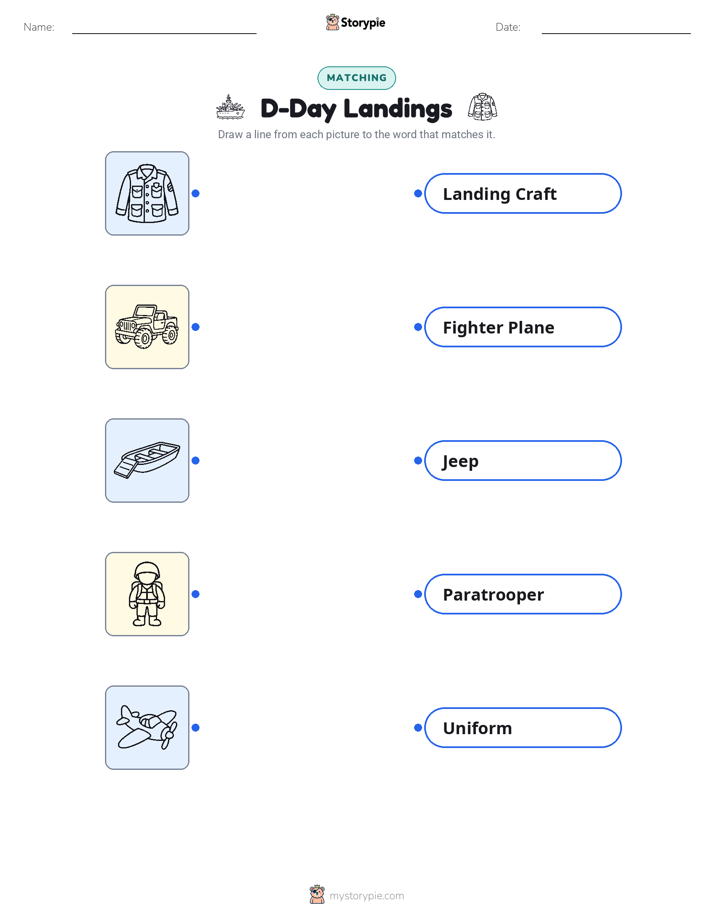
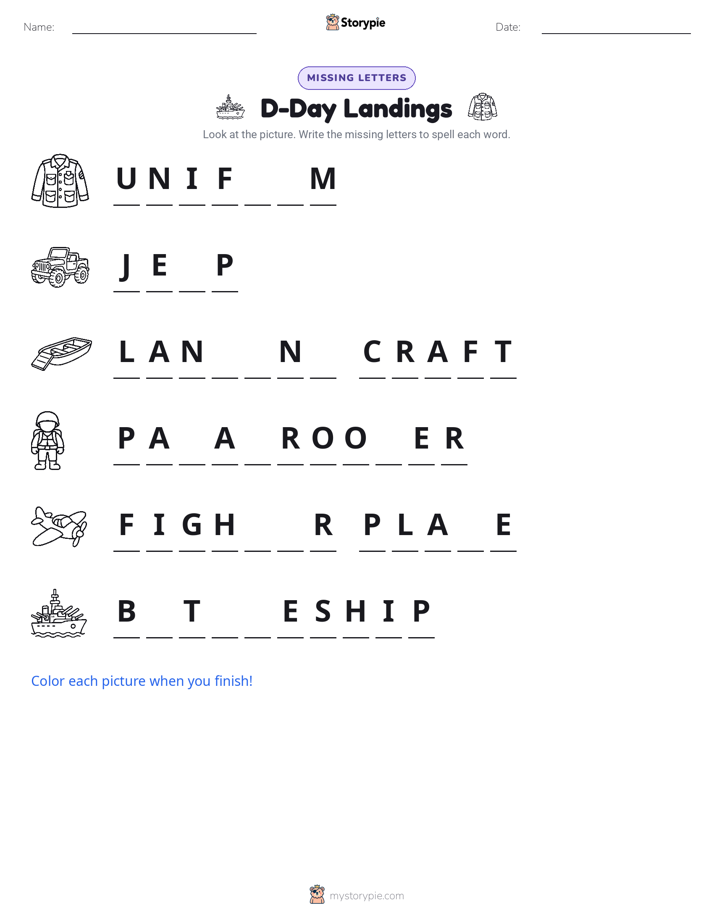
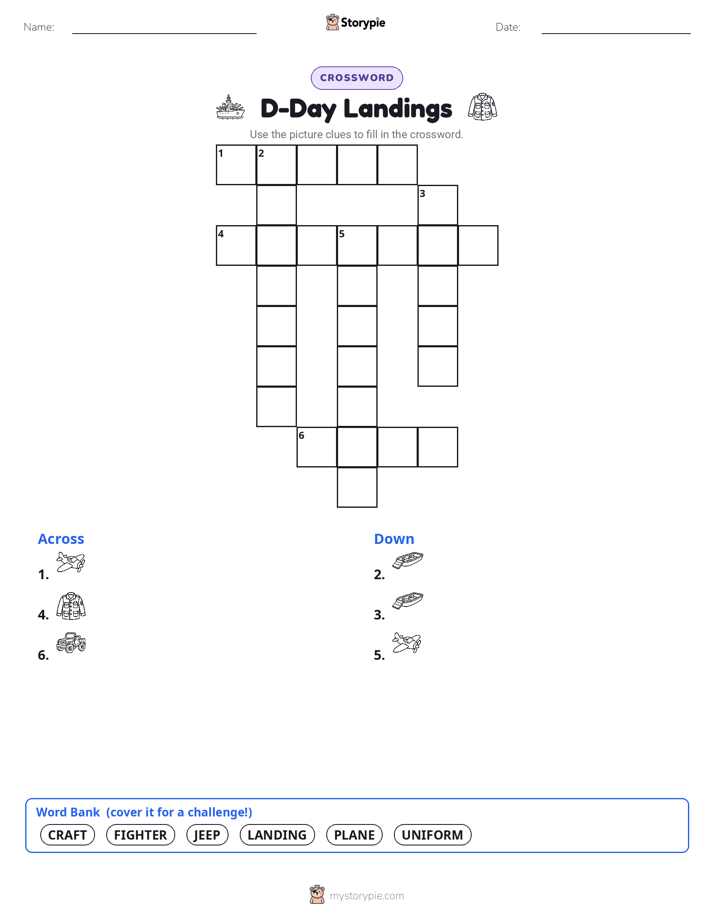
- Printable worksheets & coloring pages

Why Storypie for Schools
Students engaged. Prep in seconds. Evenings back to you.
- Worksheets & Quizzes
- Classroom Management
- Formative Assessment
- Custom Curriculum & Lesson Plans
- 27 Languages

Why Storypie for Homeschool
Curriculum done. They'll ask for more. Hours back in your day.
- Worksheet Generator
- First-Person Audio Stories
- Built-in Comprehension Quizzes
- Custom Curriculum & Lesson Plans
- Print & Go Activities