

 English

The Soldier and the Secret Stone
Hello. My name is Pierre-François Bouchard, and I was a soldier from France. A long, long time ago, in the summer of 1799, my journey took me far from home to a hot, sandy country called Egypt. The sun was a giant, warm blanket in the sky, making the sand sparkle like a million tiny jewels. My friends and I were part of an army led by our general, Napoleon Bonaparte. He gave us a very important job. Near a town called Rosetta, there was an old fort that was falling apart. Our job was to rebuild it and make it strong again. It was hard work under the hot sun. We spent our days digging in the dirt and moving heavy stones. I thought it was just another ordinary day of being a soldier, a day of dust and sweat. I had absolutely no idea that I was about to find a treasure that would change history forever and unlock secrets from thousands of years ago.
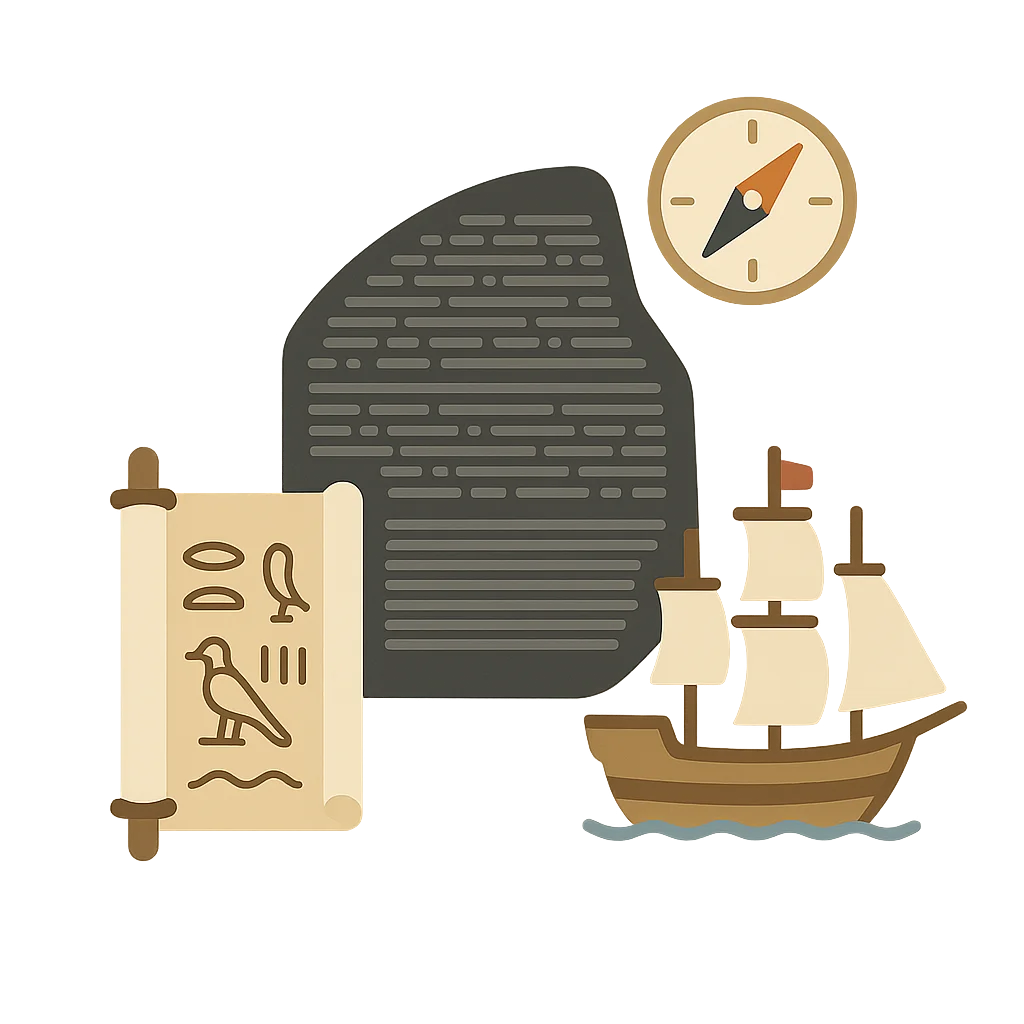
It was on July 19th, 1799, a day I will never forget. I was digging with my shovel, just like any other day. Clank. My shovel hit something hard. It was not just another rock. I knelt down and started brushing away the dust and sand with my hands. Buried in the old wall we were tearing down was a huge, flat slab of dark, shiny stone. It was completely different from all the other building blocks. My heart started to beat a little faster, like a drum. As I cleaned it more, my eyes grew wide with surprise. The stone was covered in writing. But it was not just one kind of writing. I could see three different types of beautiful, mysterious marks carved perfectly into its surface. The top part looked like tiny pictures of birds, eyes, and people. The middle part looked like swirly, curvy letters I had never seen before. And the last one, at the bottom, looked familiar. It was an ancient language called Greek. I knew, right in my heart, that this was something incredibly important. “Stop.” I shouted. “Everyone, come look at this.” I called for my commander, and soon, all the other soldiers gathered around, staring in wonder at the amazing stone I had found.
You might be wondering why a stone with writing on it was such a big deal. Well, this was not just any stone. It was a key. For thousands of years, people had seen the picture-writing of the ancient Egyptians, called hieroglyphs, on their temples and tombs, but nobody knew how to read them. It was a complete mystery. Our special stone had the same message written in all three scripts. It had the mysterious hieroglyphs at the top, another Egyptian script called Demotic in the middle, and Ancient Greek at the bottom. Since smart people, called scholars, could still read Ancient Greek, they could use it as a guide. It was like having a secret decoder ring. They could look at the Greek words and match them to the hieroglyphs to figure out what the pictures meant. It was not easy, though. It took more than twenty years and a very clever man from my country, named Jean-François Champollion, to finally crack the code. He solved the world's most exciting puzzle and could finally read the stories the Egyptians wrote so long ago.
Because of the stone I found, which everyone started calling the Rosetta Stone, we could finally understand the ancient Egyptians. We could read their stories about kings and queens, their poems, and their letters. It was like they could finally speak to us from across thousands of years. We learned so much about their lives, all thanks to that one lucky discovery. It makes me smile to think that my ordinary day of work as a soldier led to unlocking a whole secret world from the past. My discovery shows that you never know when you might stumble upon something amazing. The greatest treasures are not always gold or jewels. Sometimes, they are the ones that teach us something new about our world and the people who lived in it long before us.
Activities
Take a Quiz
Test what you learned with a fun quiz!
Get creative with colors!
Print a coloring book page of this topic.













 Free for Educators