English

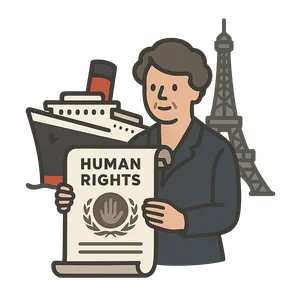
Adoption of the Universal Declaration of Human Rights
The 1948 adoption of the Universal Declaration of Human Rights by the United Nations General Assembly…
Reads at Grades 6–8 Listens at Grades 4–8
Print & create
Answer keys·No prep·Free with an account
28 worksheets · answer keys · full story · quiz · Ages 10-12 · CEFR B2
Plus adds 102,000+ more stories in 27 languages, audio for every one, and printables for all of them.
Just want Adoption of the Universal Declaration of Human Rights?
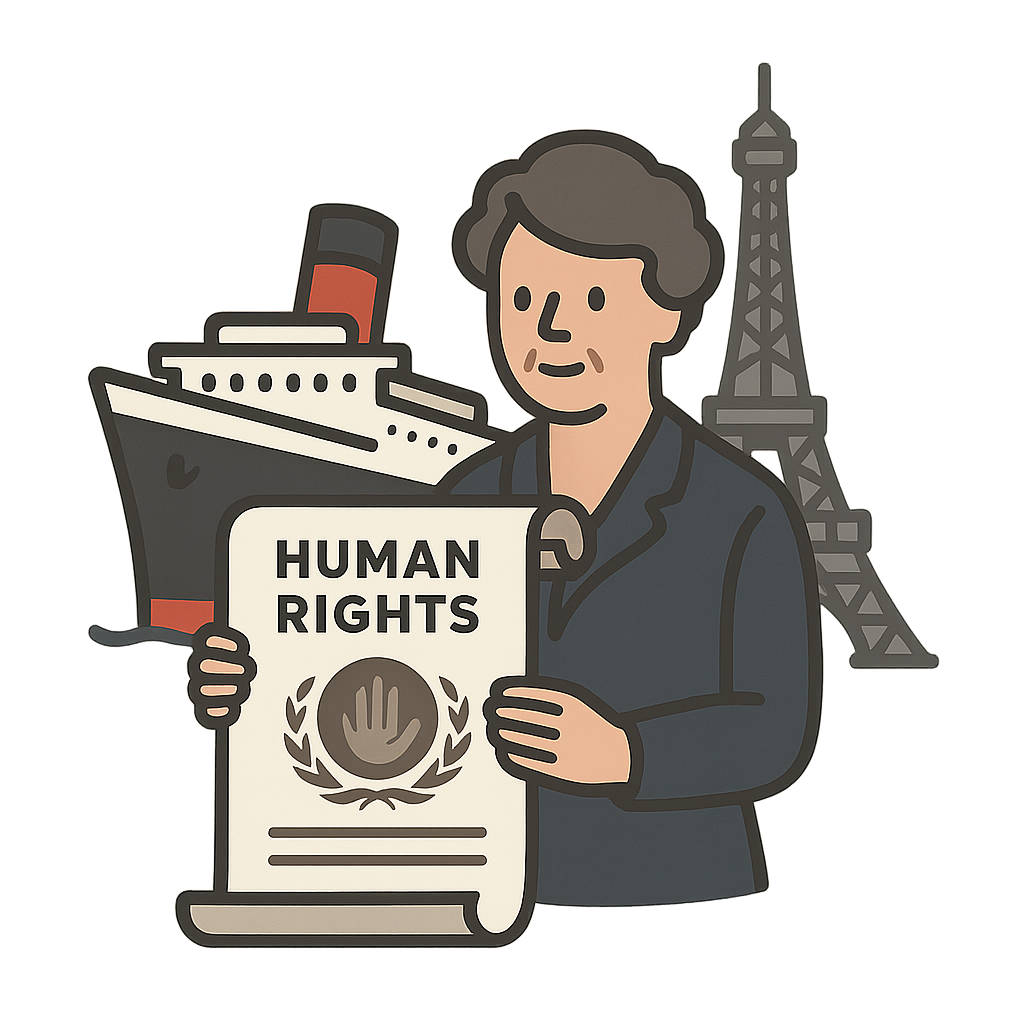
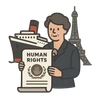
My name is Eleanor Roosevelt, and my story begins in a world that was trying to heal. The year was 1945, and the most terrible war in history, World War II, had finally ended. Cities lay in ruins, families were broken, and a deep sadness hung over the entire globe. We had seen the worst of what human beings could do to one another, and we all shared a desperate hope that it would never happen again. To make that hope a reality, leaders from fifty countries gathered in San Francisco and created a new organization called the United Nations. Its goal was simple but enormous: to keep peace and encourage friendship among all nations. My husband, President Franklin Delano Roosevelt, had believed so strongly in this idea, but he had passed away just before the war ended. I thought my time in public service was over. So you can imagine my surprise when the new president, Harry S. Truman, called me. He asked me to serve as a delegate for the United States at the very first meeting of the United Nations in London. I felt a great weight of responsibility settle on my shoulders. I was not a diplomat or a politician, but I knew I could not refuse. I had to help build the kinder, safer world we all dreamed of.
My new task was bigger than I could have ever imagined. In 1946, I was chosen to be the chairperson of the United Nations' Human Rights Commission. Our job was to write a document that would define the basic rights and freedoms that every single person on Earth should have. It sounded straightforward, but think about it. My committee was made up of eighteen people from all corners of the world. There was Dr. Charles Malik from Lebanon, a thoughtful philosopher; Dr. Peng Chun Chang from China, who was an expert in Confucian teachings; and René Cassin from France, a brilliant lawyer whose family had suffered terribly in the war. We came from different cultures, spoke different languages, and had very different ideas about the world. Getting everyone to agree on the meaning of a single word, like 'freedom' or 'dignity,' could take weeks. We met for long hours, day after day, in rooms filled with passionate debate. Sometimes our discussions grew heated. I remember one debate where we argued for hours over whether we should mention a 'Creator,' as some delegates felt it was important to acknowledge a divine source for our rights, while others believed the document must be universal and not tied to any single religion. To find a solution, we chose words that spoke of rights being 'inherent,' meaning you are born with them. It was a slow, difficult process of listening, arguing, and compromising, but we all knew how important our work was. We were building a foundation for a better world.
A Declaration of Hope
My name is Eleanor Roosevelt, and my story begins in a world that was trying to heal. The year was 1945, and the most terrible war in history, World War II, had finally ended. Cities lay in ruins, families were broken, and a deep sadness hung over the entire globe. We had seen the worst of what human beings could do to one another, and we all shared a desperate hope that it would never happen again. To make that hope a reality, leaders from fifty countries gathered in San Francisco and created a new organization called the United Nations. Its goal was simple but enormous: to keep peace and encourage friendship among all nations. My husband, President Franklin Delano Roosevelt, had believed so strongly in this idea, but he had passed away just before the war ended. I thought my time in public service was over. So you can imagine my surprise when the new president, Harry S. Truman, called me. He asked me to serve as a delegate for the United States at the very first meeting of the United Nations in London. I felt a great weight of responsibility settle on my shoulders. I was not a diplomat or a politician, but I knew I could not refuse. I had to help build the kinder, safer world we all dreamed of.
My new task was bigger than I could have ever imagined. In 1946, I was chosen to be the chairperson of the United Nations' Human Rights Commission. Our job was to write a document that would define the basic rights and freedoms that every single person on Earth should have. It sounded straightforward, but think about it. My committee was made up of eighteen people from all corners of the world. There was Dr. Charles Malik from Lebanon, a thoughtful philosopher; Dr. Peng Chun Chang from China, who was an expert in Confucian teachings; and René Cassin from France, a brilliant lawyer whose family had suffered terribly in the war. We came from different cultures, spoke different languages, and had very different ideas about the world. Getting everyone to agree on the meaning of a single word, like 'freedom' or 'dignity,' could take weeks. We met for long hours, day after day, in rooms filled with passionate debate. Sometimes our discussions grew heated. I remember one debate where we argued for hours over whether we should mention a 'Creator,' as some delegates felt it was important to acknowledge a divine source for our rights, while others believed the document must be universal and not tied to any single religion. To find a solution, we chose words that spoke of rights being 'inherent,' meaning you are born with them. It was a slow, difficult process of listening, arguing, and compromising, but we all knew how important our work was. We were building a foundation for a better world.
For two long years, we worked. Our goal was to create a list of promises that every country could agree to uphold. We called it the Universal Declaration of Human Rights. We wrote about the most fundamental ideas. We declared that no one should be held in slavery. We insisted that everyone has the right to their own thoughts and beliefs. We included the right to an education, so that every child could learn and grow. We wrote that everyone should be considered innocent until proven guilty in a fair trial. Each article was a building block for a world where people were treated with respect. Our Canadian colleague, John Humphrey, created the first draft, and then our committee debated and revised every single line. Finally, in the autumn of 1948, our work was done. We traveled to Paris, France, to present the final document to the entire UN General Assembly. On the evening of December 10th, 1948, I stood before the delegates at the Palais de Chaillot. The room was filled with a nervous energy. After all the destruction of the war, this felt like a turning point. I held the document in my hands and spoke from my heart, hoping that the nations of the world were ready to make this promise together.
The vote was called late that night. One by one, the nations gave their answer. My heart pounded as I listened. When the final tally was announced, the Universal Declaration of Human Rights had been adopted with forty-eight countries in favor and none against, though eight countries chose to abstain. A wave of relief and pure joy washed over me as the entire assembly rose to their feet in a long, heartfelt standing ovation. We had done it. This declaration was not a law that could be enforced with armies or police. Instead, it was something more powerful: a promise. It was a common standard for all people and all nations, a yardstick to measure how we treat one another. I later called it a 'Magna Carta for all mankind,' a document that would inspire people for generations to come. It has been used by activists fighting for justice, by citizens demanding fairness from their governments, and by everyday people standing up for their neighbors. My part in its creation is one of the greatest honors of my life, but I want you to remember that human rights are not just for grand assemblies. They begin in small places, close to home—in your school, on your street, in your own backyard. They live in the way you treat your friends and family with kindness, fairness, and respect.
Wow facts
About
The 1948 adoption of the Universal Declaration of Human Rights by the United Nations General Assembly, establishing a common standard of fundamental rights and freedoms for all people and all nations.
Take a Quiz
Question 1 of 5
In your own words, summarize the main steps Eleanor Roosevelt and the commission took to create the Universal Declaration of Human Rights.
Explore next





Want to do even more?
Go beyond exploring. Unlock tools that turn every story into real learning.

Storypie Plus for families
Full stories, quizzes, and printables. Nights and car rides, sorted.
- Unlimited audio stories
- Create Mode: your child stars in the story
- Offline downloads
- Printable worksheets & coloring pages

Why Storypie for Schools
Students engaged. Prep in seconds. Evenings back to you.
- Worksheets & Quizzes
- Classroom Management
- Formative Assessment
- Custom Curriculum & Lesson Plans
- 27 Languages

Why Storypie for Homeschool
Curriculum done. They'll ask for more. Hours back in your day.
- Worksheet Generator
- First-Person Audio Stories
- Built-in Comprehension Quizzes
- Custom Curriculum & Lesson Plans
- Print & Go Activities