English

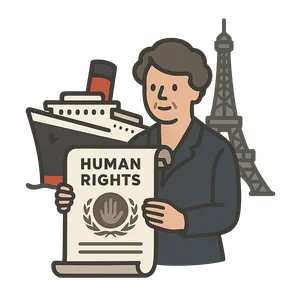
Adoption of the Universal Declaration of Human Rights
The 1948 adoption of the Universal Declaration of Human Rights by the United Nations General Assembly…
Reads at Grades 3–5 Listens at Grades 1–5
Print & create
Answer keys·No prep·Free with an account
28 worksheets · answer keys · full story · quiz · Ages 8-10 · CEFR B1
Plus adds 102,000+ more stories in 27 languages, audio for every one, and printables for all of them.
Just want Adoption of the Universal Declaration of Human Rights?
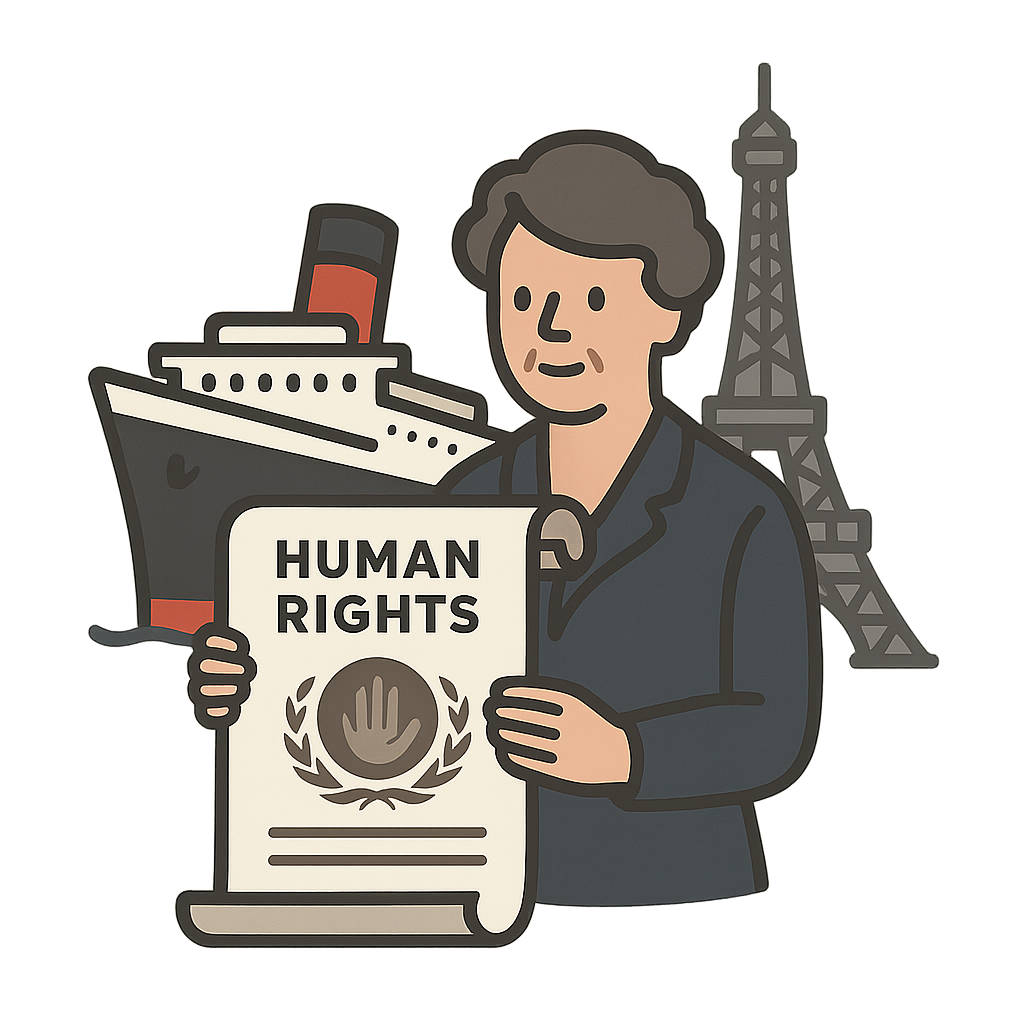
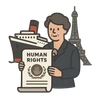
Hello there. My name is Eleanor Roosevelt. My story begins after a very sad time in world history. The year was 1945, and a terrible conflict called World War II had just ended. The whole world seemed to let out a long, tired sigh. Cities were in ruins, families were broken, and people everywhere felt a deep sense of loss. We all knew one thing for certain: we could never let something so awful happen again. From this feeling, a new idea was born. Leaders from countries all over the globe came together to create an organization called the United Nations. Its purpose was simple but powerful: to provide a place where countries could talk through their problems instead of fighting. I was surprised when the President of the United States, Harry S. Truman, asked me to be one of the first delegates to represent our country. I felt a great responsibility. Soon after I arrived, I was given a very special job. I was asked to lead a committee that would write a list of promises, a document that would declare the rights and freedoms that every single person on Earth should have, no matter who they are or where they live.
Our work on this special document, which we called the Universal Declaration of Human Rights, began in 1947. Our committee was a small group, but we came from all corners of the world. There was Dr. P.C. Chang from China, Dr. Charles Malik from Lebanon, René Cassin from France, and many others. We met for months, sometimes working late into the night in a room in Lake Success, New York. Trying to get everyone to agree was our biggest challenge. It was like we were all trying to build one big, beautiful house together. But the person from France wanted large, sunny windows, the person from Lebanon wanted a strong, stone foundation, and the delegate from Chile wanted every room to be welcoming. We all wanted a safe and sturdy house, but we had different ideas about the best way to build it. We would spend hours, even days, debating a single word. What does 'dignity' truly mean? How do we define 'freedom'? We listened carefully to one another, we argued respectfully, and we learned to compromise. We knew that for this document to work, it had to belong to everyone in the world, not just one country or one culture. Over nearly two years, we wrote and rewrote many drafts until we finally had a document we all felt proud of, one that we believed could be a guiding light for humanity.
Eleanor Roosevelt and a Promise for the World
Hello there. My name is Eleanor Roosevelt. My story begins after a very sad time in world history. The year was 1945, and a terrible conflict called World War II had just ended. The whole world seemed to let out a long, tired sigh. Cities were in ruins, families were broken, and people everywhere felt a deep sense of loss. We all knew one thing for certain: we could never let something so awful happen again. From this feeling, a new idea was born. Leaders from countries all over the globe came together to create an organization called the United Nations. Its purpose was simple but powerful: to provide a place where countries could talk through their problems instead of fighting. I was surprised when the President of the United States, Harry S. Truman, asked me to be one of the first delegates to represent our country. I felt a great responsibility. Soon after I arrived, I was given a very special job. I was asked to lead a committee that would write a list of promises, a document that would declare the rights and freedoms that every single person on Earth should have, no matter who they are or where they live.
Our work on this special document, which we called the Universal Declaration of Human Rights, began in 1947. Our committee was a small group, but we came from all corners of the world. There was Dr. P.C. Chang from China, Dr. Charles Malik from Lebanon, René Cassin from France, and many others. We met for months, sometimes working late into the night in a room in Lake Success, New York. Trying to get everyone to agree was our biggest challenge. It was like we were all trying to build one big, beautiful house together. But the person from France wanted large, sunny windows, the person from Lebanon wanted a strong, stone foundation, and the delegate from Chile wanted every room to be welcoming. We all wanted a safe and sturdy house, but we had different ideas about the best way to build it. We would spend hours, even days, debating a single word. What does 'dignity' truly mean? How do we define 'freedom'? We listened carefully to one another, we argued respectfully, and we learned to compromise. We knew that for this document to work, it had to belong to everyone in the world, not just one country or one culture. Over nearly two years, we wrote and rewrote many drafts until we finally had a document we all felt proud of, one that we believed could be a guiding light for humanity.
Our journey came to its most important moment on the night of December 10th, 1948. We were all gathered in a grand hall in Paris, France, for a meeting of the United Nations General Assembly. I sat with my fellow delegates, my heart pounding with a mix of hope and nervousness. After all our hard work, would the nations of the world accept our promise? One by one, the countries were called to cast their votes. I listened as country after country voted 'yes'. When the final tally was announced, and the Declaration was officially adopted, a wave of relief and joy washed over me. The room filled with applause. We had done it. We had created a shared standard of hope for all people. The Declaration’s first article says it all: 'All human beings are born free and equal in dignity and rights.' It is a simple sentence, but it holds a powerful promise. Looking back, I see that our work was not an ending, but a beginning. The Declaration is not just a piece of paper; it is a challenge to every person, including you, to treat others with fairness, kindness, and respect, and to be a light for those rights in your own community.
Wow facts
About
The 1948 adoption of the Universal Declaration of Human Rights by the United Nations General Assembly, establishing a common standard of fundamental rights and freedoms for all people and all nations.
Take a Quiz
Question 1 of 5
Why did Eleanor Roosevelt compare writing the Declaration to 'building a house where everyone has a different idea for the rooms'?
Explore next





Want to do even more?
Go beyond exploring. Unlock tools that turn every story into real learning.

Storypie Plus for families
Full stories, quizzes, and printables. Nights and car rides, sorted.
- Unlimited audio stories
- Create Mode: your child stars in the story
- Offline downloads
- Printable worksheets & coloring pages

Why Storypie for Schools
Students engaged. Prep in seconds. Evenings back to you.
- Worksheets & Quizzes
- Classroom Management
- Formative Assessment
- Custom Curriculum & Lesson Plans
- 27 Languages

Why Storypie for Homeschool
Curriculum done. They'll ask for more. Hours back in your day.
- Worksheet Generator
- First-Person Audio Stories
- Built-in Comprehension Quizzes
- Custom Curriculum & Lesson Plans
- Print & Go Activities