English

Bastille Day - French
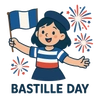
Bastille Day is the national day of France, celebrated on July 14th each year.
Reads at Grades 6–8 Listens at Grades 4–8
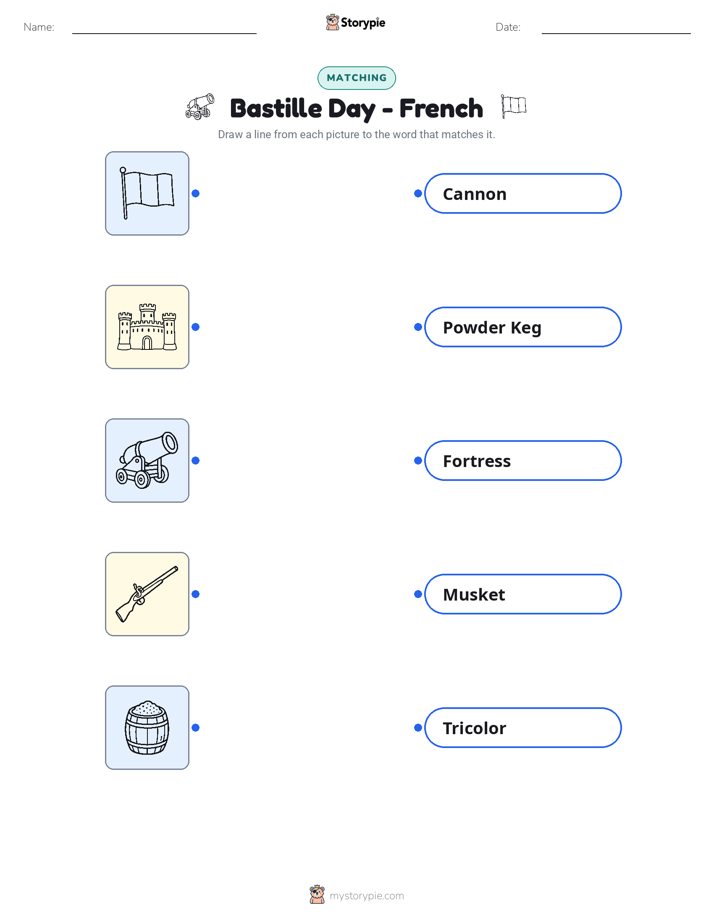
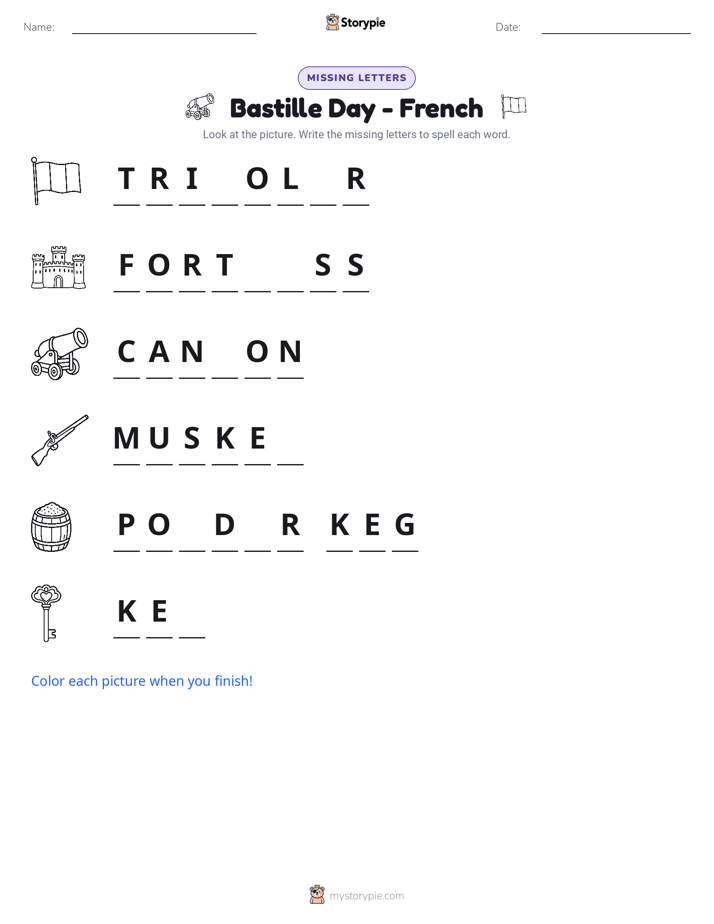
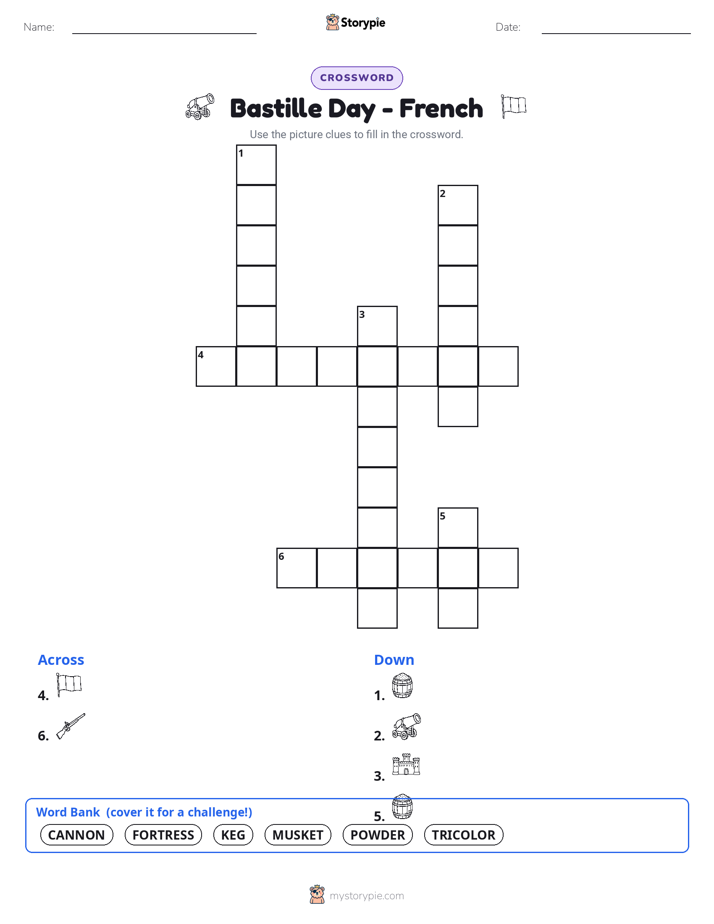
Print & create
Answer keys·No prep·Free with an account
28 worksheets · answer keys · full story · quiz · Ages 10-12 · CEFR B2
Plus adds 279,000+ more stories in 27 languages, audio for every one, and printables for all of them.
Just want Bastille Day - French?
Hello, I am the national day of France. You might know me by my English name, Bastille Day, but in France, people call me La Fête Nationale, which means The National Celebration, or simply Le 14 Juillet, The 14th of July. Every year on that date, I arrive to help the people of France celebrate their nation and its founding values. These powerful ideals are known as Liberté, Égalité, Fraternité—or Liberty, Equality, and Fraternity. My purpose is to serve as an annual reminder of the country's journey toward becoming a republic and the principles that guide it.
My story begins with a dramatic and historic event that unfolded on July 14th, 1789. This was the era of the French Revolution, a time of immense social and political upheaval. In the heart of Paris stood the Bastille, a massive, grim medieval fortress used as a state prison. To the common people, who were struggling under the absolute power of the monarchy, the Bastille was a terrifying symbol of the king's oppressive rule. It represented a system where a person could be imprisoned without a fair trial. On that hot summer day, a determined crowd of revolutionaries, seeking weapons and gunpowder, attacked the fortress. After a fierce battle, they captured it. The fall of the Bastille was not just a military victory; it was a symbolic earthquake. It sent a clear message across France that the power of the monarchy could be challenged by the will of the people, marking a pivotal moment in the revolution.
While my date is tied to that moment of conflict, it also commemorates an occasion of peace and national harmony. Exactly one year later, on July 14th, 1790, a massive celebration called the Fête de la Fédération, or the Festival of the Federation, took place in Paris. This event was designed to be the opposite of the violence from the year before. It was a grand spectacle of unity, bringing together people from every region of France. They gathered on the Champ de Mars, the same field where the Eiffel Tower now stands, to celebrate the new constitutional government and the idea of a single, united French nation. It was a day filled with hope and optimism for a future where citizens and their government could work together in peace.
I Am Bastille Day
Hello, I am the national day of France. You might know me by my English name, Bastille Day, but in France, people call me La Fête Nationale, which means The National Celebration, or simply Le 14 Juillet, The 14th of July. Every year on that date, I arrive to help the people of France celebrate their nation and its founding values. These powerful ideals are known as Liberté, Égalité, Fraternité—or Liberty, Equality, and Fraternity. My purpose is to serve as an annual reminder of the country's journey toward becoming a republic and the principles that guide it.
My story begins with a dramatic and historic event that unfolded on July 14th, 1789. This was the era of the French Revolution, a time of immense social and political upheaval. In the heart of Paris stood the Bastille, a massive, grim medieval fortress used as a state prison. To the common people, who were struggling under the absolute power of the monarchy, the Bastille was a terrifying symbol of the king's oppressive rule. It represented a system where a person could be imprisoned without a fair trial. On that hot summer day, a determined crowd of revolutionaries, seeking weapons and gunpowder, attacked the fortress. After a fierce battle, they captured it. The fall of the Bastille was not just a military victory; it was a symbolic earthquake. It sent a clear message across France that the power of the monarchy could be challenged by the will of the people, marking a pivotal moment in the revolution.
While my date is tied to that moment of conflict, it also commemorates an occasion of peace and national harmony. Exactly one year later, on July 14th, 1790, a massive celebration called the Fête de la Fédération, or the Festival of the Federation, took place in Paris. This event was designed to be the opposite of the violence from the year before. It was a grand spectacle of unity, bringing together people from every region of France. They gathered on the Champ de Mars, the same field where the Eiffel Tower now stands, to celebrate the new constitutional government and the idea of a single, united French nation. It was a day filled with hope and optimism for a future where citizens and their government could work together in peace.
Despite the significance of these 18th-century events, it took nearly a century for me to become the official national holiday of France. After many changes in government, the country established its Third Republic. In 1880, its leaders decided it was time to create a national day that could unite all citizens. They chose my date, July 14th, for a very specific and thoughtful reason. They understood that my date held a dual meaning. It represented the revolutionary spirit of the people who stormed the Bastille in 1789, a powerful reminder of the fight for freedom. It also honored the peaceful celebration of national unity from the Fête de la Fédération in 1790. This perfect balance allowed me to represent both the birth of the republic through struggle and its foundation in the ideal of a unified people.
Today, people across France observe me with patriotism and joy, and my most famous event takes place in the capital, Paris. Every year on the morning of July 14th, a grand military parade proceeds down the famous Champs-Élysées avenue. This is the oldest and largest regular military parade in Europe, a tradition that has been a central part of my observance for over a century. The President of France presides over the event, watching as thousands of soldiers, sailors, and aviators march with precision and pride. Tanks roll down the avenue, and jets fly overhead, often leaving trails of red, white, and blue smoke—the colors of the French flag. It is a formal and impressive display meant to showcase the nation's strength and honor its armed forces.
However, my celebrations are not confined to the formal atmosphere of Paris. My spirit is felt in every corner of the country, from the smallest villages to the largest cities. As day turns to night, the sky across France comes alive with spectacular fireworks displays. The most famous of these is the breathtaking show at the Eiffel Tower, which draws huge crowds. But communities everywhere have their own pyrotechnic shows, lighting up local castles, monuments, and town squares. Beyond the fireworks, many towns also host festive public dances. A beloved tradition is the bal des pompiers, or fireman’s ball, where local fire stations open their courtyards to the public for a joyful night of music, dancing, and community celebration. These gatherings capture the spirit of fraternity, bringing people together to celebrate their shared national identity in a relaxed and happy atmosphere.
Wow facts
About
Bastille Day is the national day of France, celebrated on July 14th each year. It commemorates the Storming of the Bastille in 1789, a key event in the French Revolution, as well as the Fête de la Fédération in 1790.
Take a Quiz
Question 1 of 5
Why did the leaders of the French Third Republic in 1880 choose July 14th as the national holiday?
Want to do even more?
Go beyond exploring. Unlock tools that turn every story into real learning.

Storypie Plus for families
Full stories, quizzes, and printables. Nights and car rides, sorted.
- Unlimited audio stories
- Create Mode: your child stars in the story
- Offline downloads
- Printable worksheets & coloring pages

Why Storypie for Schools
Students engaged. Prep in seconds. Evenings back to you.
- Worksheets & Quizzes
- Classroom Management
- Formative Assessment
- Custom Curriculum & Lesson Plans
- 27 Languages

Why Storypie for Homeschool
Curriculum done. They'll ask for more. Hours back in your day.
- Worksheet Generator
- First-Person Audio Stories
- Built-in Comprehension Quizzes
- Custom Curriculum & Lesson Plans
- Print & Go Activities