English

Christmas Markets - German
German Christmas markets, or 'Weihnachtsmärkte…
Reads at Grades 6–8 Listens at Grades 4–8
Print & create
Answer keys·No prep·Free with an account
28 worksheets · answer keys · full story · quiz · Ages 10-12 · CEFR B2
Plus adds 279,000+ more stories in 27 languages, audio for every one, and printables for all of them.
Just want Christmas Markets - German?
I am the German Christmas Market, a tradition known in German-speaking lands as a Weihnachtsmarkt or a Christkindlmarkt. My story unfolds during the four weeks of Advent, the period leading up to Christmas. People created me to bring a sense of community, light, and warmth to town squares during the darkest and coldest time of the year. My purpose is to be a special place where people can gather to enjoy festive sights, tastes, and smells, and find unique handmade crafts and gifts that capture the spirit of the season.
My story begins many centuries ago, in the German-speaking parts of Europe during a time historians call the Late Middle Ages. Long before I was associated with twinkling lights and festive treats, I served a much more practical purpose. I was a simple winter market, a place where people living in towns and the surrounding countryside could gather to buy essential provisions for the cold months ahead. They would stock up on meat and other supplies to ensure their families had enough to eat throughout the winter. While many such markets existed, the first one that historians consider my direct ancestor was held in the city of Dresden in 1434. This market was called the Striezelmarkt. It was authorized to be open for just a single day, specifically so that the city’s residents could purchase everything they needed for their Christmas feast. This event was a key step in my journey from a general winter market to a holiday-specific tradition.
Over the following centuries, I began to change, evolving from a practical market for food into a true Christmas celebration. A very important figure in this transformation was a 16th-century Protestant reformer named Martin Luther. He had new ideas about how people should observe Christmas. He suggested that instead of giving gifts on other saints' days, families should exchange presents on Christmas to celebrate the birth of Jesus, whom he referred to as the 'Christkind,' or the Christ child. This new focus on gift-giving had a major impact on me. It encouraged craftspeople, woodworkers, and toymakers to bring their goods to my stalls. Soon, I was filled with not just food, but also beautiful handmade toys and other special gifts. This shift turned me from a place of necessity into a place of festive joy and wonder, shaping my identity for generations to come.
The Story of the German Christmas Market
I am the German Christmas Market, a tradition known in German-speaking lands as a Weihnachtsmarkt or a Christkindlmarkt. My story unfolds during the four weeks of Advent, the period leading up to Christmas. People created me to bring a sense of community, light, and warmth to town squares during the darkest and coldest time of the year. My purpose is to be a special place where people can gather to enjoy festive sights, tastes, and smells, and find unique handmade crafts and gifts that capture the spirit of the season.
My story begins many centuries ago, in the German-speaking parts of Europe during a time historians call the Late Middle Ages. Long before I was associated with twinkling lights and festive treats, I served a much more practical purpose. I was a simple winter market, a place where people living in towns and the surrounding countryside could gather to buy essential provisions for the cold months ahead. They would stock up on meat and other supplies to ensure their families had enough to eat throughout the winter. While many such markets existed, the first one that historians consider my direct ancestor was held in the city of Dresden in 1434. This market was called the Striezelmarkt. It was authorized to be open for just a single day, specifically so that the city’s residents could purchase everything they needed for their Christmas feast. This event was a key step in my journey from a general winter market to a holiday-specific tradition.
Over the following centuries, I began to change, evolving from a practical market for food into a true Christmas celebration. A very important figure in this transformation was a 16th-century Protestant reformer named Martin Luther. He had new ideas about how people should observe Christmas. He suggested that instead of giving gifts on other saints' days, families should exchange presents on Christmas to celebrate the birth of Jesus, whom he referred to as the 'Christkind,' or the Christ child. This new focus on gift-giving had a major impact on me. It encouraged craftspeople, woodworkers, and toymakers to bring their goods to my stalls. Soon, I was filled with not just food, but also beautiful handmade toys and other special gifts. This shift turned me from a place of necessity into a place of festive joy and wonder, shaping my identity for generations to come.
Because of my long and varied history, people call me by different names that reflect the traditions of their specific region. In many parts of Germany, my most common name is 'Weihnachtsmarkt,' which translates simply to 'Christmas Market.' It’s a straightforward name that describes my main purpose. However, in southern Germany and in the neighboring country of Austria, I am often called a 'Christkindlmarkt.' This name, meaning 'Christ child market,' directly reflects the gift-giving tradition that Martin Luther promoted in the 16th century. It serves as a historical reminder of how the focus on the Christkind as the bringer of gifts helped transform me into the festive event people know today. So, while my names may differ, they each tell a part of my story.
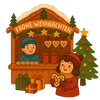
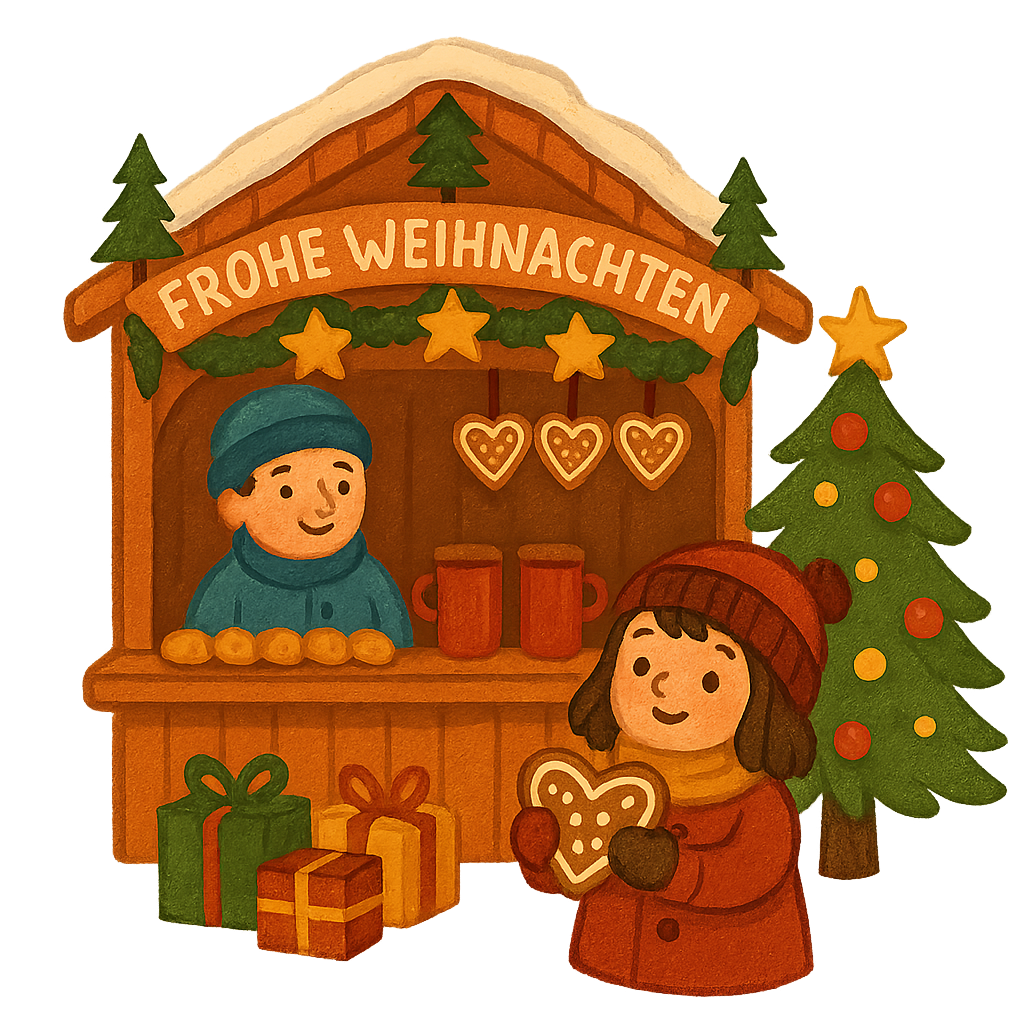
When people visit me, they step into a world designed to delight the senses. My setting is often a historic town square, surrounded by old buildings that add to the magical atmosphere. The square is filled with rows of charming wooden stalls, each one brightly lit and decorated. In the center, a huge, decorated Christmas tree often stands as a focal point, its lights shining against the dark winter sky. Many times, there is also a nativity scene, which is a display of figures representing the birth of Jesus. The air itself is alive with sound. Visitors hear the beautiful melodies of Christmas carols, the powerful and festive music of brass bands, and the happy, cheerful chatter of all the people strolling through my lanes, creating a warm and lively soundscape.
My atmosphere is also rich with distinctive and memorable smells that are central to the experience. As visitors walk among the stalls, they can smell the sweet and nutty aroma of almonds being roasted with sugar and cinnamon. The spicy scent of gingerbread cookies, known as Lebkuchen, fills the air, a fragrance many people associate with Christmas. There is also the savory smell of grilled sausages called Bratwurst, a popular and hearty snack. One of my most famous treats is Stollen, a dense fruit bread dusted with powdered sugar, which first originated in Dresden, the city where my story began. For adults, a traditional beverage is Glühwein, a type of warm, spiced mulled wine. The combined smells of these foods and drinks create an unforgettable holiday scent.
My stalls are famous for the traditional and often handmade goods that craftspeople sell. These items are a key part of my identity, showcasing skills passed down through generations. Visitors looking for decorations can find delicate glass ornaments, hand-blown and painted with intricate designs to hang on their Christmas trees. Another popular item is the hand-carved wooden nutcracker, often shaped like a soldier or a king. People also find incense-burning figures called Räuchermännchen, or 'little smoking men,' which release fragrant smoke from their mouths. Perhaps one of the most unique items is the Weihnachtspyramide, or Christmas pyramid. This is a multi-tiered wooden decoration, like a carousel, with figures on each level. The heat from candles at its base causes a fan at the top to spin, making the tiers slowly rotate.
Today, I continue to be a beloved tradition. I am celebrated not just in towns and cities across Germany, but all over the world. Many cities in other countries have adopted my style, creating their own versions of a German Christmas Market for people to enjoy. While I remain deeply connected to my history, I have also adapted to modern times. Visitors will always find the traditional food, warm drinks, and classic handmade crafts that define me. However, some of my modern versions have grown to include new attractions. It is not uncommon to find large ice-skating rinks or even amusement park rides alongside the classic wooden stalls. In this way, I continue to evolve, blending the old with the new and bringing festive cheer to people everywhere.
Wow facts
About
German Christmas markets, or 'Weihnachtsmärkte,' are traditional street markets held during the four weeks of Advent. They feature festive stalls selling food, drinks, and seasonal items, and are a cherished part of German Christmas traditions.
Take a Quiz
Question 1 of 5
What was the original purpose of the markets that evolved into the German Christmas Markets?
Want to do even more?
Go beyond exploring. Unlock tools that turn every story into real learning.

Storypie Plus for families
Full stories, quizzes, and printables. Nights and car rides, sorted.
- Unlimited audio stories
- Create Mode: your child stars in the story
- Offline downloads
- Printable worksheets & coloring pages

Why Storypie for Schools
Students engaged. Prep in seconds. Evenings back to you.
- Worksheets & Quizzes
- Classroom Management
- Formative Assessment
- Custom Curriculum & Lesson Plans
- 27 Languages

Why Storypie for Homeschool
Curriculum done. They'll ask for more. Hours back in your day.
- Worksheet Generator
- First-Person Audio Stories
- Built-in Comprehension Quizzes
- Custom Curriculum & Lesson Plans
- Print & Go Activities