English

Kupala Night - Ukrainian
Kupala Night is a traditional Ukrainian festival celebrated on the night of July 6th to 7th…
Reads at Grades 6–8 Listens at Grades 4–8
Print & create
Answer keys·No prep·Free with an account
28 worksheets · answer keys · full story · quiz · Ages 10-12 · CEFR B2
Plus adds 279,000+ more stories in 27 languages, audio for every one, and printables for all of them.
Just want Kupala Night - Ukrainian?
I am Kupala Night, an ancient and vibrant summer festival celebrated in Ukraine. People observe me on the night of July 6th, which flows into the morning of July 7th. My timing is deeply connected to the rhythm of the Earth, as my celebration marks the summer solstice. This is the time of year in the Northern Hemisphere when the sun reaches its highest point in the sky, resulting in the longest day and the shortest night. For centuries, my observance has been a way for people to honor this peak of summer. My traditions are rich with symbolism, creating powerful connections between participants and the fundamental elements of nature, especially fire and water. These customs, passed down through generations, are filled with meaning and a sense of magic that comes alive during the midsummer twilight.
My story begins long ago, rooted in the pre-Christian, pagan traditions of the Eastern Slavic peoples who lived in the lands that are now Ukraine. In those ancient times, I was known as a festival of fertility. This didn't just mean human fertility, but the fertility of the land itself—the abundance of crops, the health of livestock, and the life-giving power of the natural world. My celebration was a way to honor the sun, whose energy was at its strongest, and to recognize the immense power of nature at its peak. It was a time of deep spiritual significance. People believed that during my observance, the ordinary boundaries that separated the human world from the world of spirits became thin and permeable. This belief filled the night with a sense of wonder, possibility, and mystery, suggesting that magic was close at hand and that the natural world held secrets waiting to be discovered.
The Story of Kupala Night
I am Kupala Night, an ancient and vibrant summer festival celebrated in Ukraine. People observe me on the night of July 6th, which flows into the morning of July 7th. My timing is deeply connected to the rhythm of the Earth, as my celebration marks the summer solstice. This is the time of year in the Northern Hemisphere when the sun reaches its highest point in the sky, resulting in the longest day and the shortest night. For centuries, my observance has been a way for people to honor this peak of summer. My traditions are rich with symbolism, creating powerful connections between participants and the fundamental elements of nature, especially fire and water. These customs, passed down through generations, are filled with meaning and a sense of magic that comes alive during the midsummer twilight.
My story begins long ago, rooted in the pre-Christian, pagan traditions of the Eastern Slavic peoples who lived in the lands that are now Ukraine. In those ancient times, I was known as a festival of fertility. This didn't just mean human fertility, but the fertility of the land itself—the abundance of crops, the health of livestock, and the life-giving power of the natural world. My celebration was a way to honor the sun, whose energy was at its strongest, and to recognize the immense power of nature at its peak. It was a time of deep spiritual significance. People believed that during my observance, the ordinary boundaries that separated the human world from the world of spirits became thin and permeable. This belief filled the night with a sense of wonder, possibility, and mystery, suggesting that magic was close at hand and that the natural world held secrets waiting to be discovered.
Over time, as history unfolded, my identity began to change. When Christianity spread through the region known as Kievan Rus' around the 10th century, my ancient pagan customs encountered new religious beliefs. Instead of disappearing, my old traditions began to merge and blend with new ones. This process, known as syncretism, allowed many of my core elements to survive by adapting. My celebration became formally linked with a significant date in the Christian calendar: the feast day honoring the birth of Saint John the Baptist. In the local Slavic languages, the name 'John' is 'Ivan.' Because of this connection, my name evolved, and many people began to call me Ivana Kupala. This new name reflects my dual heritage, carrying the echoes of my pagan past while being woven into the fabric of a new cultural and religious landscape. It shows how cultures adapt, preserving parts of their history while embracing new influences.
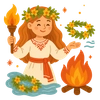
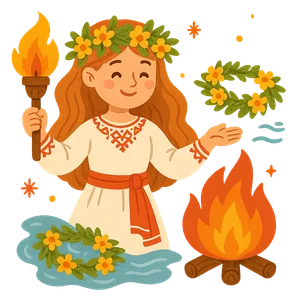
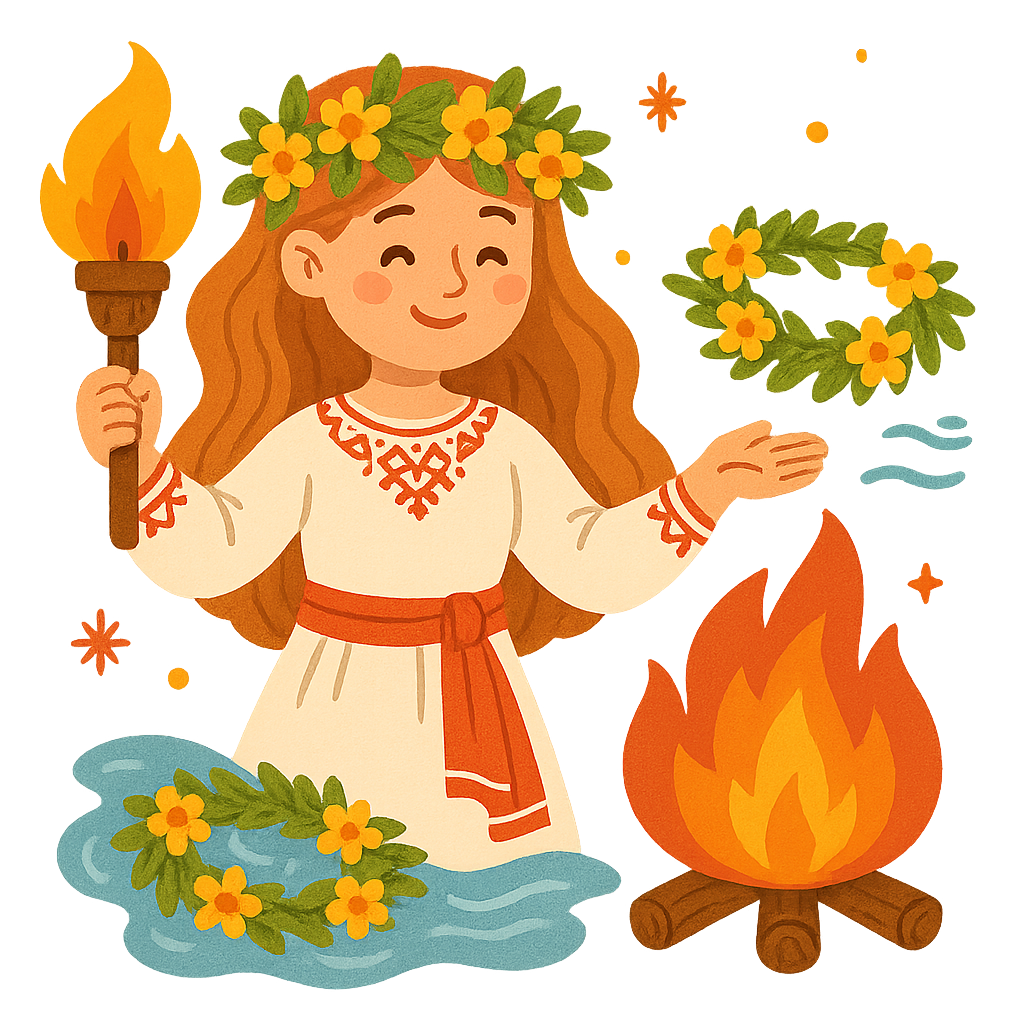
One of my most iconic and visually striking traditions is the lighting of enormous bonfires. As dusk settles on July 6th, communities gather to build a large fire that is kept burning brightly all through the short night. The bonfire becomes the heart of the celebration, a glowing center of warmth and light. People gather around the flames to sing traditional folk songs that tell stories of love, nature, and ancient myths. They join in lively circle dances, their movements illuminated by the flickering firelight. A particularly famous and exciting custom is practiced by young couples. Holding hands tightly, they take a running start and leap together over the flames. This act is more than just a display of bravery; it is a ritual believed to hold symbolic power. According to tradition, if the couple can make the jump without letting go of each other's hands, it is a sign that their bond is strong and that they will have a future filled with good fortune and happiness.
Just as fire is central to my identity, so is water. During my observance, rivers, lakes, and streams are seen as possessing special, purifying qualities. Many people participate in ritual bathing, swimming in the cool, dark waters under the midsummer sky. This act is believed to cleanse a person not only of physical dirt but also of bad luck, illness, and spiritual impurities, offering a sense of renewal and a fresh start. Another beautiful water-based tradition is practiced by young, unmarried women. They venture into meadows and forests to gather a variety of wildflowers and fragrant herbs. From these, they carefully weave intricate wreaths, known as 'vinoks.' As night falls, they attach a small candle to each wreath, light it, and gently release their creations onto the surface of a river or lake. The women then watch intently as the current carries the glowing wreaths away. The movement of the wreath is thought to predict their romantic future. If it floats steadily, a happy relationship is expected, but if it sinks or washes ashore, it might signal disappointment.
My celebration is also filled with folklore, and no legend is more famous than the tale of the magical fern flower. According to this ancient story, deep within the darkest part of the forest, a mythical fern is said to produce a single, brilliant flower. This event is incredibly rare, as the flower is believed to bloom for only a fleeting moment precisely at the stroke of midnight on Kupala Night. The legend says that finding this glowing flower is a perilous task, often guarded by forest spirits. However, the reward is extraordinary. The person who is brave and clever enough to find and pick the fern flower is said to gain amazing supernatural powers. These abilities might include understanding the language of birds and animals, seeing hidden treasures buried deep within the earth, or gaining wisdom and knowledge beyond that of ordinary people. This legend adds a layer of adventure and enchantment to my observance, inspiring a sense of wonder about the hidden magic within the natural world.
Today, I continue to be a cherished and joyful occasion for Ukrainians and people of Ukrainian heritage around the world. Though some of the ancient beliefs may be viewed more as folklore now, my traditions are celebrated with great enthusiasm. Large festivals are often organized in both rural villages and modern cities. These events are vibrant showcases of Ukrainian culture, featuring live folk music, energetic dancing, and markets selling traditional crafts. Many participants dress in beautiful embroidered clothing, called 'vyshyvanka.' The old customs are often reenacted, with communities lighting bonfires, floating wreaths, and celebrating the spirit of the holiday. I have become more than just a marking of the solstice; I am a powerful way for people to connect with their history, celebrate the beauty of nature, and express their enduring cultural identity. My flames and flowing waters continue to link the present to a deep and magical past.
Wow facts
About
Kupala Night is a traditional Ukrainian festival celebrated on the night of July 6th to 7th, according to the Julian calendar. It blends ancient pagan rituals with Christian traditions and is celebrated with bonfires, water purification, and folklore.
Take a Quiz
Question 1 of 5
What is the main idea of the section explaining how Kupala Night became 'Ivana Kupala'?
Want to do even more?
Go beyond exploring. Unlock tools that turn every story into real learning.

Storypie Plus for families
Full stories, quizzes, and printables. Nights and car rides, sorted.
- Unlimited audio stories
- Create Mode: your child stars in the story
- Offline downloads
- Printable worksheets & coloring pages

Why Storypie for Schools
Students engaged. Prep in seconds. Evenings back to you.
- Worksheets & Quizzes
- Classroom Management
- Formative Assessment
- Custom Curriculum & Lesson Plans
- 27 Languages

Why Storypie for Homeschool
Curriculum done. They'll ask for more. Hours back in your day.
- Worksheet Generator
- First-Person Audio Stories
- Built-in Comprehension Quizzes
- Custom Curriculum & Lesson Plans
- Print & Go Activities