English

Martin Luther King Jr. Day - American
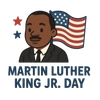
An American federal holiday marking the birthday of civil rights leader Martin Luther King Jr.
Reads at Grades 6–8 Listens at Grades 4–8
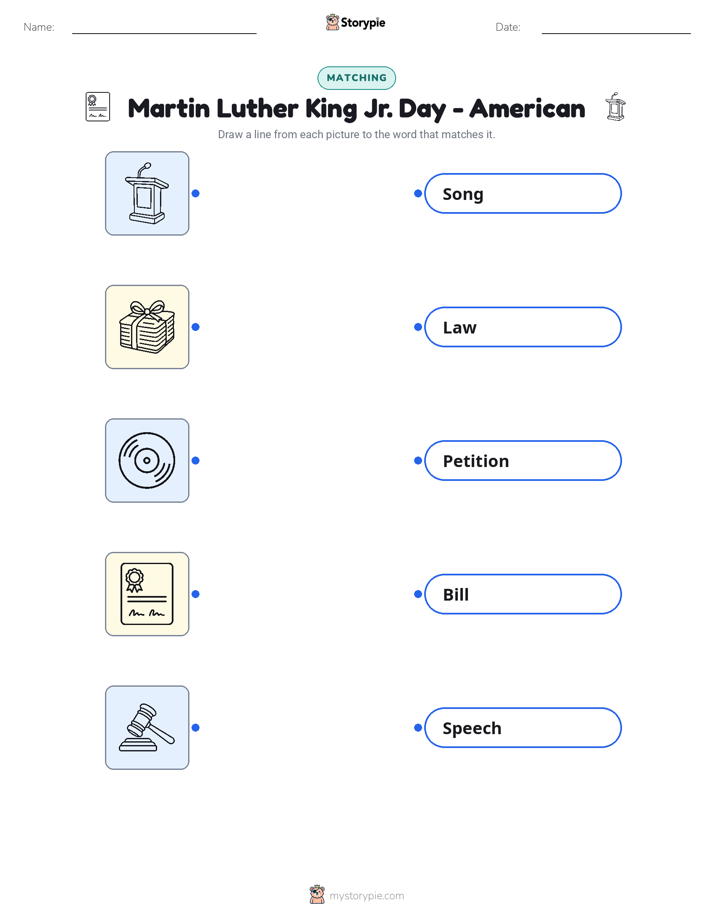
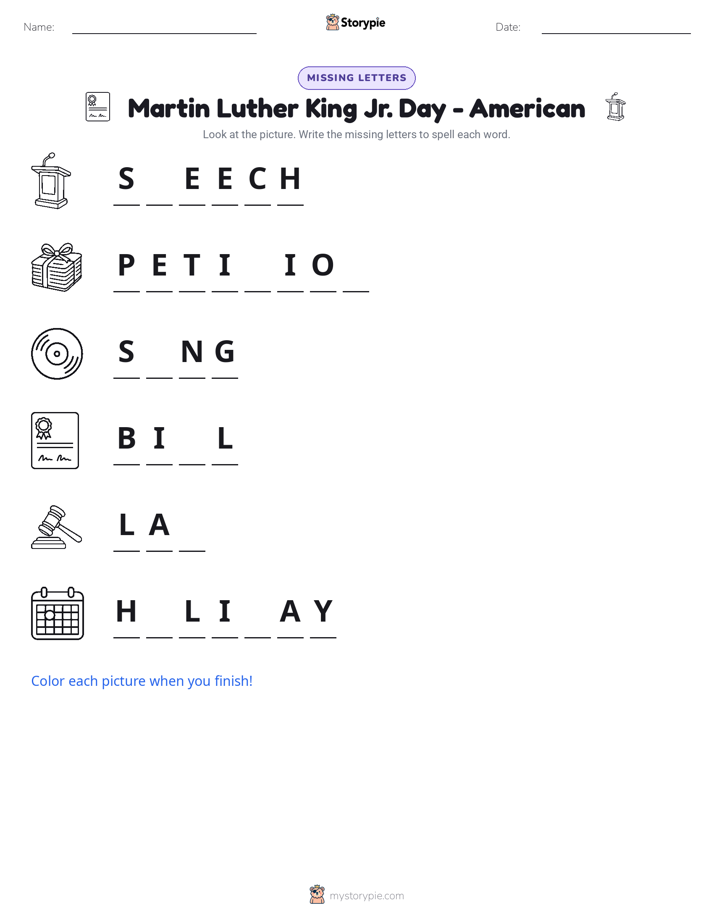
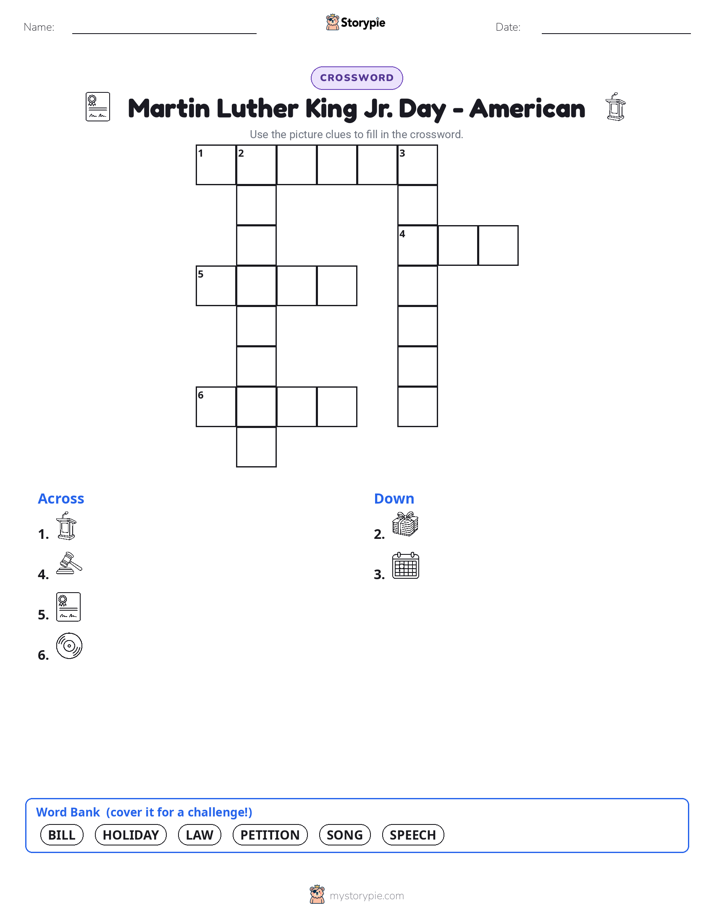
Print & create
Answer keys·No prep·Free with an account
28 worksheets · answer keys · full story · quiz · Ages 10-12 · CEFR B2
Plus adds 279,000+ more stories in 27 languages, audio for every one, and printables for all of them.
Just want Martin Luther King Jr. Day - American?
I am Martin Luther King Jr. Day, an American federal holiday. My purpose is to honor the life and lasting legacy of Dr. Martin Luther King Jr. He was a monumental leader in the Civil Rights Movement, a period of profound change in the United States. Dr. King championed the powerful idea of nonviolent protest as a means to fight for equality and justice for all people, particularly African Americans who faced systemic discrimination. His work was guided by a dream of a nation where individuals would be judged not by the color of their skin, but by the content of their character. To ensure this remembrance falls near his actual birthday of January 15th, people across the United States observe me each year on the third Monday of January. My date shifts, but my purpose remains constant: to reflect on his contributions to civil rights and the ongoing work for a more just society.
My journey into existence was not simple or swift; it was a long and challenging road that reflected the very struggles Dr. King himself faced. The call for a national day of honor came with incredible speed, a testament to the impact of his life and the shock of his death. Just four days after his assassination on April 4th, 1968, a proposal was introduced in the United States Congress to create a federal holiday in his name. However, that initial proposal was not successful. What followed was a persistent and arduous 15-year campaign. This effort required the unwavering dedication of activists, the support of key politicians, and the passionate voices of everyday citizens. They had to overcome significant political and social opposition from those who did not believe Dr. King deserved such an honor. This long fight demonstrated that creating a national holiday to recognize an African American leader was, in itself, an act of the Civil Rights Movement.
Martin Luther King Jr. Day: A Day of Service and Remembrance
I am Martin Luther King Jr. Day, an American federal holiday. My purpose is to honor the life and lasting legacy of Dr. Martin Luther King Jr. He was a monumental leader in the Civil Rights Movement, a period of profound change in the United States. Dr. King championed the powerful idea of nonviolent protest as a means to fight for equality and justice for all people, particularly African Americans who faced systemic discrimination. His work was guided by a dream of a nation where individuals would be judged not by the color of their skin, but by the content of their character. To ensure this remembrance falls near his actual birthday of January 15th, people across the United States observe me each year on the third Monday of January. My date shifts, but my purpose remains constant: to reflect on his contributions to civil rights and the ongoing work for a more just society.
My journey into existence was not simple or swift; it was a long and challenging road that reflected the very struggles Dr. King himself faced. The call for a national day of honor came with incredible speed, a testament to the impact of his life and the shock of his death. Just four days after his assassination on April 4th, 1968, a proposal was introduced in the United States Congress to create a federal holiday in his name. However, that initial proposal was not successful. What followed was a persistent and arduous 15-year campaign. This effort required the unwavering dedication of activists, the support of key politicians, and the passionate voices of everyday citizens. They had to overcome significant political and social opposition from those who did not believe Dr. King deserved such an honor. This long fight demonstrated that creating a national holiday to recognize an African American leader was, in itself, an act of the Civil Rights Movement.
Many determined and influential people worked tirelessly to make me a reality, building a coalition that crossed lines of race, politics, and profession. At the forefront of this movement was Dr. King's widow, Coretta Scott King. She was a powerful advocate who established the Martin Luther King, Jr. Center for Nonviolent Social Change in Atlanta to continue his work. She dedicated years of her life to the cause, testifying before Congress on numerous occasions and speaking across the country to gather support. Her leadership provided a crucial, guiding force for the campaign. Alongside her political efforts, a cultural movement was growing. The celebrated musician Stevie Wonder became one of my most prominent champions. In 1980, he released the song 'Happy Birthday,' an upbeat and heartfelt tribute that was written specifically to promote the campaign. The song became an international hit and served as a joyful anthem for the movement, bringing the cause into the hearts and homes of millions. Wonder also helped organize large-scale rallies and concerts that drew massive crowds and put public pressure on lawmakers.
This combination of political lobbying and popular cultural appeal created a powerful force for change. The public campaign for my establishment grew into one of the largest grassroots movements of its time. Its peak came when a petition, bearing the signatures of more than six million American citizens, was formally delivered to the leaders of Congress. This overwhelming display of public will was impossible for lawmakers to ignore. The debate in Washington had been long and often contentious, but the tide had turned. After years of discussion and stalled attempts, a bill to establish me as a national holiday finally passed through both the House of Representatives and the Senate. The journey reached its historic conclusion on November 2nd, 1983. In a special ceremony held in the Rose Garden of the White House, President Ronald Reagan signed the bill into law, officially creating the first federal holiday to honor an African American individual.
My first official observance as a federal holiday took place on January 20th, 1986. That day, communities across the country held parades, concerts, and educational events to mark the occasion. However, my adoption was not yet universal. While I was a federal holiday, individual states still had to pass their own laws to formally recognize me. Some states were resistant, and it took several more years of activism and legislative action to ensure I was honored everywhere. This process continued through the late 1980s and 1990s, with states gradually adopting me one by one. The year 2000 marked a major milestone in my history: it was the first time that I was officially observed in all 50 states. This final, nationwide recognition completed the long journey that had begun more than three decades earlier, solidifying my place as a day of national importance for all Americans.
Over the years, my meaning has continued to evolve and deepen. In 1994, Congress passed the King Holiday and Service Act, a piece of legislation that significantly expanded my purpose. This law was designed to transform me from a simple day of remembrance into a day of active citizenship. It formally encouraged Americans to view me as a 'day on, not a day off.' This powerful phrase captures the idea that the best way to honor Dr. King is not simply to rest, but to engage in work that helps others and builds a stronger, more equitable society. The act called on people to participate in community service projects, volunteer their time, and find ways to work together to solve local problems. This legislation connected my observance directly to Dr. King's core beliefs in service, community action, and the creation of what he called the 'Beloved Community.'
Today, people observe me in a multitude of ways that reflect Dr. King's enduring values of peace, justice, and service. In many towns and cities across the nation, people gather for commemorative parades and marches, often tracing the routes of historic civil rights protests. Leaders and community members give speeches that reflect on Dr. King's teachings and their relevance to contemporary issues. Schools, libraries, and community centers hold educational events that teach younger generations about the history of the Civil Rights Movement and the importance of Dr. King’s nonviolent philosophy. True to the spirit of the 'day on, not a day off,' countless Americans spend the day volunteering. They might serve meals at a food bank, participate in neighborhood clean-up projects, mentor young people, or help their elderly neighbors. Through these acts of service, they carry forward Dr. King's profound commitment to improving the lives of others and building a better world.
Wow facts
About
An American federal holiday marking the birthday of civil rights leader Martin Luther King Jr. It is observed on the third Monday of January each year, near Dr. King's actual birthday on January 15, and is often a day for community service and reflection on civil rights.
Take a Quiz
Question 1 of 5
Why do you think the author used the phrase 'a long and challenging road' to describe the creation of Martin Luther King Jr. Day?
Want to do even more?
Go beyond exploring. Unlock tools that turn every story into real learning.

Storypie Plus for families
Full stories, quizzes, and printables. Nights and car rides, sorted.
- Unlimited audio stories
- Create Mode: your child stars in the story
- Offline downloads
- Printable worksheets & coloring pages

Why Storypie for Schools
Students engaged. Prep in seconds. Evenings back to you.
- Worksheets & Quizzes
- Classroom Management
- Formative Assessment
- Custom Curriculum & Lesson Plans
- 27 Languages

Why Storypie for Homeschool
Curriculum done. They'll ask for more. Hours back in your day.
- Worksheet Generator
- First-Person Audio Stories
- Built-in Comprehension Quizzes
- Custom Curriculum & Lesson Plans
- Print & Go Activities