English

Vesak
Vesak is the most sacred and important festival for Buddhists around the world, commemorating the birth…
Reads at Grades 6–8 Listens at Grades 4–8
Print & create
Answer keys·No prep·Free with an account
28 worksheets · answer keys · full story · quiz · Ages 10-12 · CEFR B2
Plus adds 279,000+ more stories in 27 languages, audio for every one, and printables for all of them.
Just want Vesak?
Hello, I am Vesak, a day that holds deep meaning for millions of Buddhists all over the world. While many people know me as Vesak, I am also called Buddha Purnima in some places and simply Buddha Day in others. Whatever my name, my purpose is the same: I am the most sacred day in the Buddhist tradition, set aside to honor the three most significant events in the life of Siddhartha Gautama. He was the man whose profound journey of discovery led him to become known as the Buddha, or the “Enlightened One.” On the day of my observance, people reflect on his birth in Lumbini, his attainment of enlightenment under the Bodhi tree, and his passing into what is known as Parinirvana.
My date is not fixed on the same day each year in the commonly used Gregorian calendar. Instead, I follow a lunisolar calendar, a system of timekeeping that is guided by the cycles of both the moon and the sun. People observe me on the day of the full moon during the month of Vaisakha. This lunar month usually overlaps with April or May. Because different countries and Buddhist communities may follow slightly different calendars, the specific day people celebrate me can vary from one region to another. This means that while my spirit is shared globally, my observance can happen on different dates depending on where you are in the world.
Although the teachings and practices that people associate with me are ancient, my form as a single, unified holiday is more recent. The traditions themselves developed over many centuries following the life of the Buddha, which is understood to have been around the 5th century BCE. For a very long time, the key events of his life were honored separately. The idea of celebrating his birth, enlightenment, and passing all on the same day came much later. In the year 1950, a historic meeting of the World Fellowship of Buddhists was held in Sri Lanka. At this conference, delegates from many countries agreed that I should be formally observed on the full moon day in May to honor the Buddha’s life and legacy in a unified way.
The Story of Vesak
Hello, I am Vesak, a day that holds deep meaning for millions of Buddhists all over the world. While many people know me as Vesak, I am also called Buddha Purnima in some places and simply Buddha Day in others. Whatever my name, my purpose is the same: I am the most sacred day in the Buddhist tradition, set aside to honor the three most significant events in the life of Siddhartha Gautama. He was the man whose profound journey of discovery led him to become known as the Buddha, or the “Enlightened One.” On the day of my observance, people reflect on his birth in Lumbini, his attainment of enlightenment under the Bodhi tree, and his passing into what is known as Parinirvana.
My date is not fixed on the same day each year in the commonly used Gregorian calendar. Instead, I follow a lunisolar calendar, a system of timekeeping that is guided by the cycles of both the moon and the sun. People observe me on the day of the full moon during the month of Vaisakha. This lunar month usually overlaps with April or May. Because different countries and Buddhist communities may follow slightly different calendars, the specific day people celebrate me can vary from one region to another. This means that while my spirit is shared globally, my observance can happen on different dates depending on where you are in the world.
Although the teachings and practices that people associate with me are ancient, my form as a single, unified holiday is more recent. The traditions themselves developed over many centuries following the life of the Buddha, which is understood to have been around the 5th century BCE. For a very long time, the key events of his life were honored separately. The idea of celebrating his birth, enlightenment, and passing all on the same day came much later. In the year 1950, a historic meeting of the World Fellowship of Buddhists was held in Sri Lanka. At this conference, delegates from many countries agreed that I should be formally observed on the full moon day in May to honor the Buddha’s life and legacy in a unified way.
At my very core, I am a day dedicated to remembering and practicing the teachings of the Buddha. For those who observe me, it is a time to focus on the essential principles of peace, compassion for all living things, and kindness toward others. A central part of the day is performing good deeds, an act known as “making merit.” This concept encourages people to generate positive energy through generous actions. This can take many forms, from donating to charities that support monks and monasteries to actively helping people in the community who are in need. It is a day for putting spiritual principles into practice through thoughtful and helpful actions.
On the morning of my observance, many Buddhists visit their local temples. The atmosphere is often serene and reflective. They might arrive at dawn to witness the raising of the Buddhist flag, a symbol of faith and unity. Inside the temple, the air may be filled with the sound of monks chanting sacred texts from ancient scriptures. People come bearing offerings, each with its own special meaning. They bring beautiful flowers, which will eventually wilt; candles, which will burn down; and incense, which will burn to ash. These offerings are carefully placed at the feet of statues of the Buddha. They are not just gifts, but powerful reminders of a core Buddhist teaching: that all things in life are temporary, or impermanent.
One of the most visually distinctive ceremonies that takes place during my observance is the ritual known as “bathing the Buddha.” For this ceremony, a small statue of the Buddha as an infant, with one hand pointing to the sky and the other to the earth, is placed in a basin filled with clean, scented water. People then approach the statue one by one and pour scoops of the fragrant water over its shoulders. This gentle act is rich with symbolism. It is not about cleaning a physical object; rather, it represents the purification of one's own mind. Participants perform the ritual as a reminder to cleanse their thoughts and actions of greed, hatred, and ignorance, and to commit to a path of goodness and clarity.
In many countries, my arrival transforms towns and cities into a festival of light. Homes, streets, and temples are decorated with countless lanterns, creating a breathtaking sight. These can be simple paper lanterns, traditional oil lamps, or modern strings of electric lights. This tradition is deeply symbolic, representing the moment of the Buddha's enlightenment. It is believed that when he achieved this ultimate understanding, he found a truth that illuminated the world, chasing away the darkness of ignorance. The lights that shine during my observance are a physical representation of that spiritual light. In some places, the celebration includes beautiful lantern processions in the evening, where people walk together through the streets, filling the night with a warm, peaceful glow.
My observance is also a profound expression of compassion for all living beings. This principle is put into action in several ways. Many Buddhists choose to eat only vegetarian food on this day, as a way to avoid causing harm to animals. Another powerful tradition is known as “releasing life.” For this practice, people will purchase animals, birds, or fish that were destined to be sold for food or kept in captivity. They then take them to a safe, natural environment and set them free. This act is a symbol of giving freedom and life, reinforcing the deep respect for all living creatures that is a cornerstone of the Buddha's teachings. Through these customs, people honor the interconnectedness of all life.
Wow facts
About
Vesak is the most sacred and important festival for Buddhists around the world, commemorating the birth, enlightenment, and passing away (Parinirvana) of Siddhartha Gautama, the Buddha.
Take a Quiz
Question 1 of 5
Which sentence best summarizes the primary purpose of Vesak?
Want to do even more?
Go beyond exploring. Unlock tools that turn every story into real learning.

Storypie Plus for families
Full stories, quizzes, and printables. Nights and car rides, sorted.
- Unlimited audio stories
- Create Mode: your child stars in the story
- Offline downloads
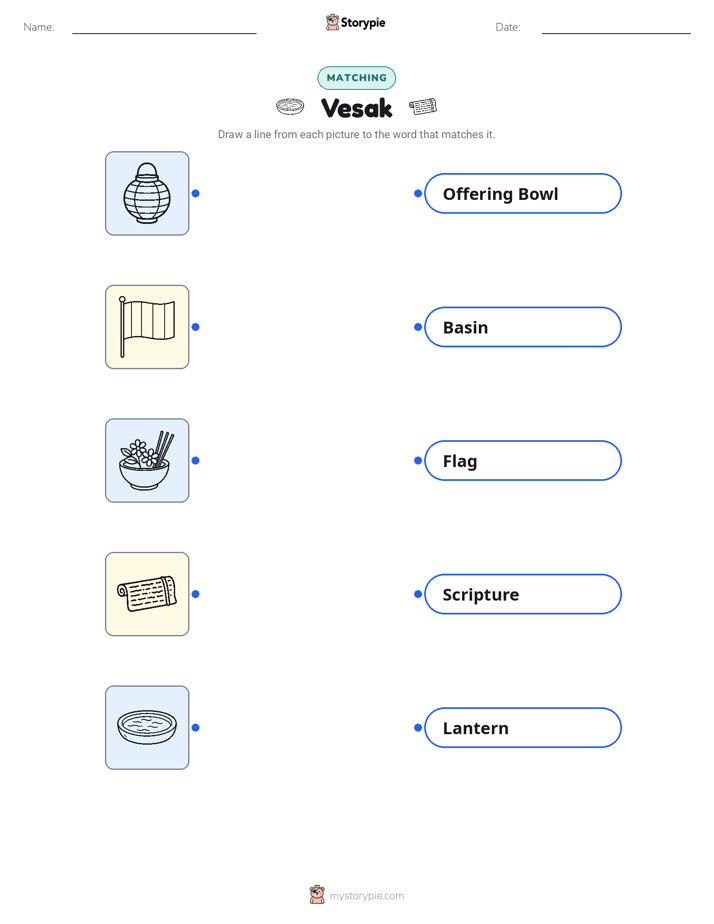
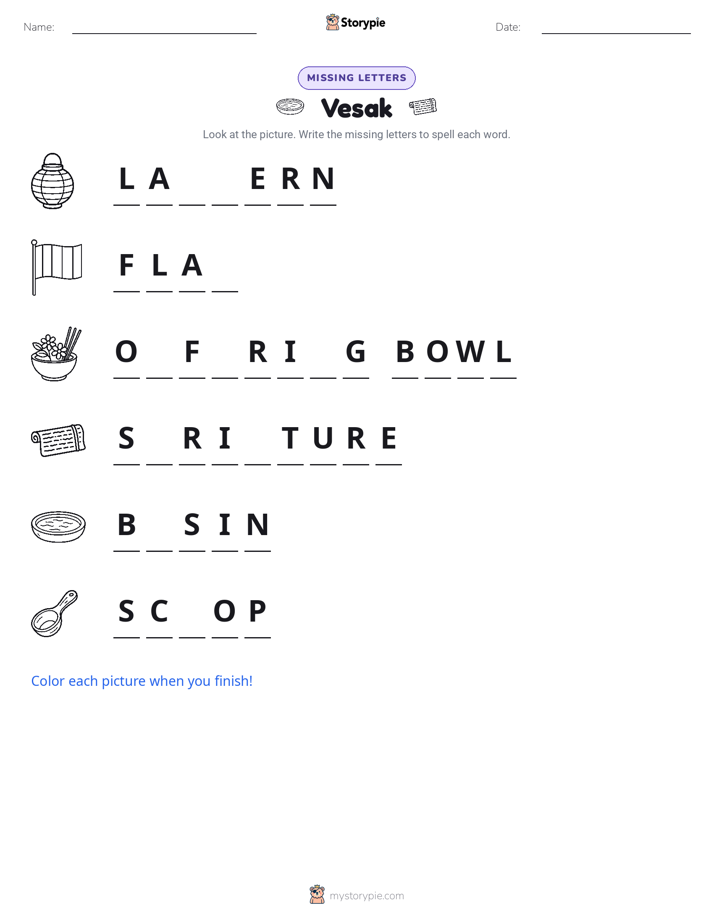
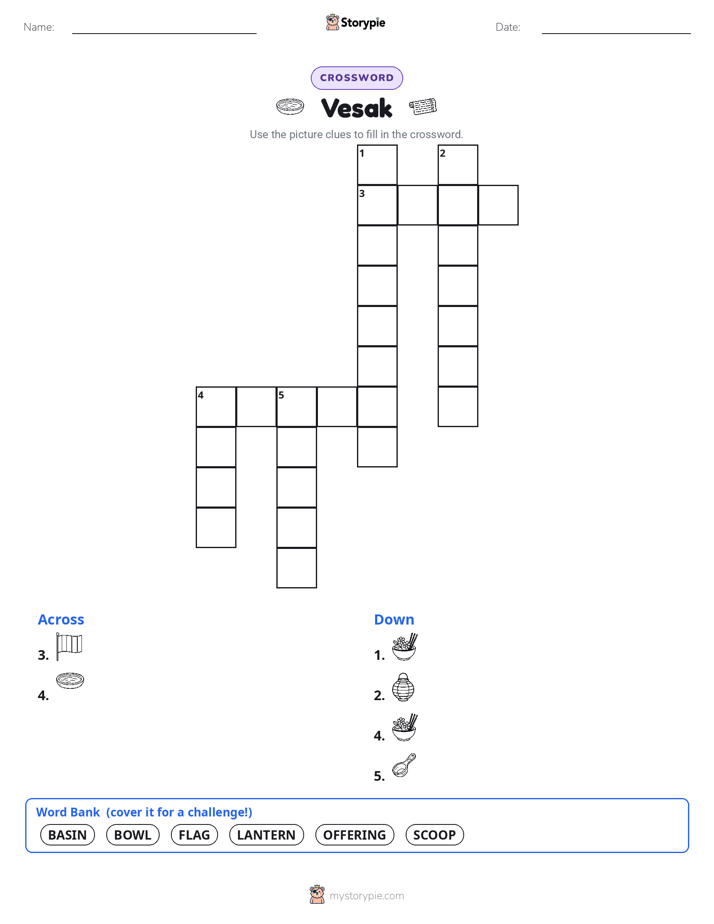
- Printable worksheets & coloring pages

Why Storypie for Schools
Students engaged. Prep in seconds. Evenings back to you.
- Worksheets & Quizzes
- Classroom Management
- Formative Assessment
- Custom Curriculum & Lesson Plans
- 27 Languages

Why Storypie for Homeschool
Curriculum done. They'll ask for more. Hours back in your day.
- Worksheet Generator
- First-Person Audio Stories
- Built-in Comprehension Quizzes
- Custom Curriculum & Lesson Plans
- Print & Go Activities