English

Cuneiform
Cuneiform is one of the earliest known systems of writing, developed around 3000 B.C.
Reads at Grades 6–8 Listens at Grades 4–8
Print & create
Answer keys·No prep·Free with an account
28 worksheets · answer keys · full story · quiz · Ages 10-12 · CEFR B2
Plus adds 102,000+ more stories in 27 languages, audio for every one, and printables for all of them.
Just want Cuneiform?
My Clay Beginnings
Before you had books or computers, before even paper and ink, there was me. I am Cuneiform, one of the very first ways humans learned to write down their thoughts. My name might sound complicated, but my form is simple. I am a collection of small, wedge-shaped marks pressed carefully into soft, damp clay. Imagine a world without a single written word. In the land of Mesopotamia, nestled between the Tigris and Euphrates rivers, great cities were rising. The clever people there, the Sumerians, were building, farming, and trading. Their lives were becoming so busy and complex that their memories couldn't keep up. How much grain was stored in the temple. Who owed what to whom. What promises a king had made. Without a way to record these things, confusion and disagreement could easily sprout. The Sumerians knew they needed a tool not for building walls, but for building memory. That is where my story begins, in the warm Mesopotamian sun, around 3400 BCE. I wasn't born from a flash of genius, but from a simple, practical need to remember. I was the solution to a world overflowing with information, a way to hold onto a thought long after it was spoken.
From Pictures to Power
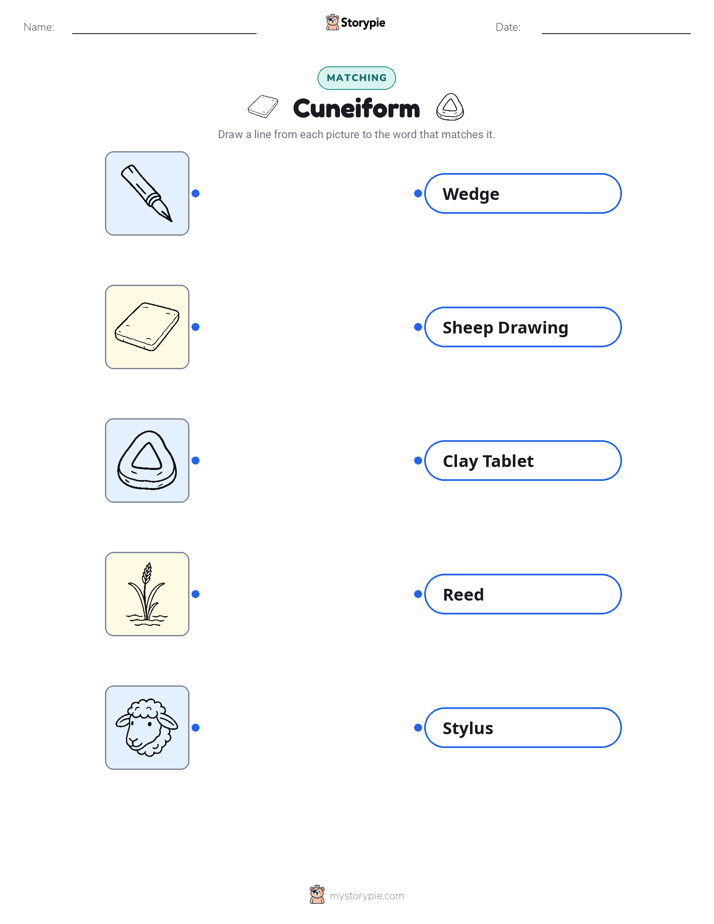
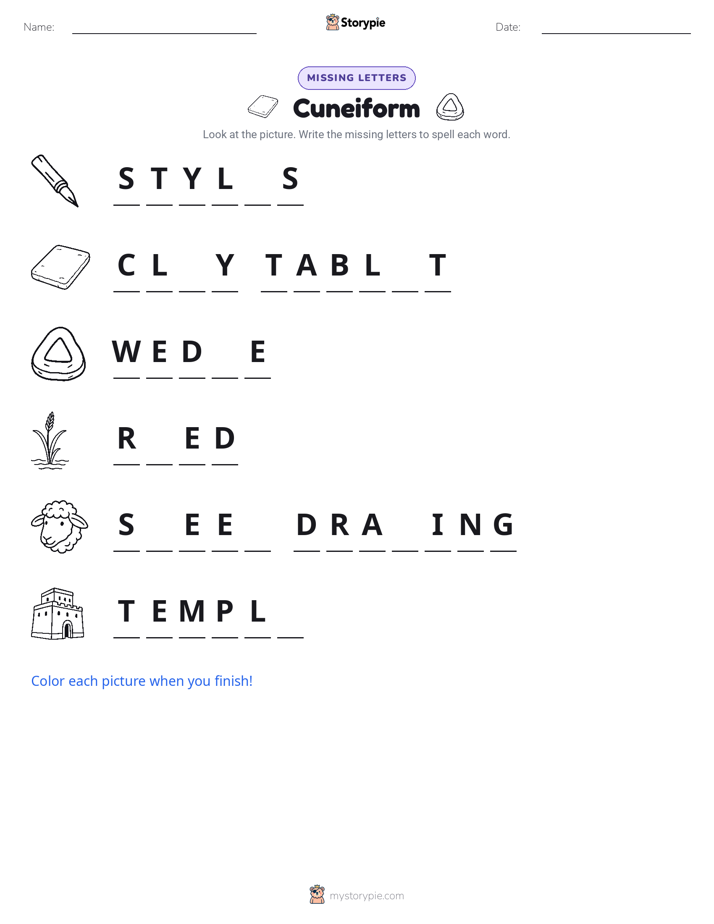
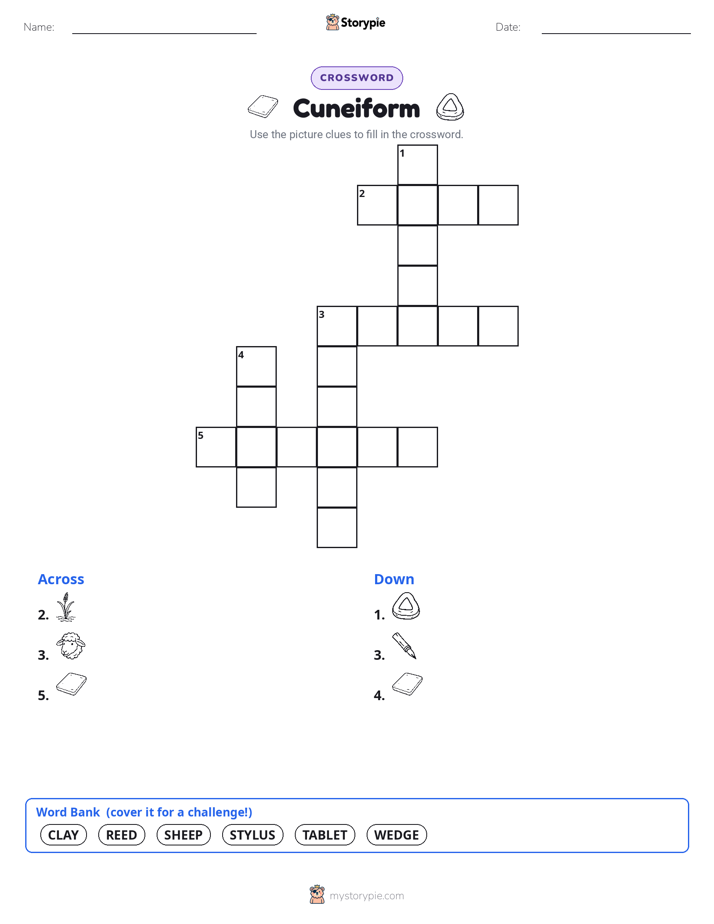
I did not spring into existence as the elegant script I would become. My earliest form, which scholars call proto-cuneiform, was little more than pictures. If a scribe wanted to record two sheep, he would draw a simple image of a sheep's head and make two marks. It was a good start, but drawing detailed pictures was slow and clumsy. Around 2900 BCE, the scribes had a brilliant idea. Instead of drawing, they began using a stylus, a tool usually made from a reed, to press shapes into the clay. The sharp, triangular tip of the stylus made a perfect wedge, and by combining these wedges in different ways, they could create symbols much faster than drawing. This was my true birth. I was no longer just a collection of pictures; I was a true system of writing. My transformation didn't stop there. An even bigger change came when the scribes realized my wedge-shaped symbols could represent not just things, but sounds. Now, I could spell out names, record conversations, and capture the nuances of spoken language. I had found my voice. With this new power, I was given the most important jobs in the kingdom. I kept the accounts for temples and merchants, ensuring trade was fair. I recorded the laws of the land, most famously in 1754 BCE when I was used to inscribe the Code of Hammurabi on a great stone pillar for all to see. I even told stories, preserving the grand adventures of heroes in the Epic of Gilgamesh, one of the first great works of literature. To make sure my words would last, the scribes would bake my clay tablets in a hot kiln. The fire hardened the clay into stone, making me a permanent record, a voice that could not be silenced by time.
A Voice from the Clay
My Clay Beginnings
Before you had books or computers, before even paper and ink, there was me. I am Cuneiform, one of the very first ways humans learned to write down their thoughts. My name might sound complicated, but my form is simple. I am a collection of small, wedge-shaped marks pressed carefully into soft, damp clay. Imagine a world without a single written word. In the land of Mesopotamia, nestled between the Tigris and Euphrates rivers, great cities were rising. The clever people there, the Sumerians, were building, farming, and trading. Their lives were becoming so busy and complex that their memories couldn't keep up. How much grain was stored in the temple. Who owed what to whom. What promises a king had made. Without a way to record these things, confusion and disagreement could easily sprout. The Sumerians knew they needed a tool not for building walls, but for building memory. That is where my story begins, in the warm Mesopotamian sun, around 3400 BCE. I wasn't born from a flash of genius, but from a simple, practical need to remember. I was the solution to a world overflowing with information, a way to hold onto a thought long after it was spoken.
From Pictures to Power
I did not spring into existence as the elegant script I would become. My earliest form, which scholars call proto-cuneiform, was little more than pictures. If a scribe wanted to record two sheep, he would draw a simple image of a sheep's head and make two marks. It was a good start, but drawing detailed pictures was slow and clumsy. Around 2900 BCE, the scribes had a brilliant idea. Instead of drawing, they began using a stylus, a tool usually made from a reed, to press shapes into the clay. The sharp, triangular tip of the stylus made a perfect wedge, and by combining these wedges in different ways, they could create symbols much faster than drawing. This was my true birth. I was no longer just a collection of pictures; I was a true system of writing. My transformation didn't stop there. An even bigger change came when the scribes realized my wedge-shaped symbols could represent not just things, but sounds. Now, I could spell out names, record conversations, and capture the nuances of spoken language. I had found my voice. With this new power, I was given the most important jobs in the kingdom. I kept the accounts for temples and merchants, ensuring trade was fair. I recorded the laws of the land, most famously in 1754 BCE when I was used to inscribe the Code of Hammurabi on a great stone pillar for all to see. I even told stories, preserving the grand adventures of heroes in the Epic of Gilgamesh, one of the first great works of literature. To make sure my words would last, the scribes would bake my clay tablets in a hot kiln. The fire hardened the clay into stone, making me a permanent record, a voice that could not be silenced by time.
A Voice Through Time
My usefulness was so great that I began to travel. My system of wedges was adopted by neighboring civilizations. The Akkadians, the Babylonians, and the powerful Assyrians all learned to use me to write their own languages. For over three thousand years, I was the language of power, religion, and daily life across the ancient Middle East. I was etched onto monuments, sealed into the foundations of buildings, and sent as letters between kings. But time brings change. New, simpler ways of writing were invented, alphabets with fewer symbols that were easier to learn. By the 1st century CE, my wedges were used less and less, until finally, the last scribe who knew my secrets was gone. I fell silent. For nearly two thousand years, I slept, buried beneath the dust of forgotten cities. My tablets were just mysterious, marked stones to those who found them. Then, in the 1800s CE, a new kind of explorer came to Mesopotamia: the archaeologist. They unearthed my tablets by the thousands and were determined to understand me. Scholars worked for decades, painstakingly comparing inscriptions, until they cracked my code. My voice was heard again. The secrets of the Sumerians, the laws of the Babylonians, the stories of ancient heroes all came rushing back into the world. Though no one writes with a stylus on clay anymore, my spirit lives on. I was the first great effort to capture human thought and give it permanence. Every time you write a sentence or read a book, you are continuing the journey I began, proving that an idea, once written down, can truly live forever.
Wow facts
About
Cuneiform is one of the earliest known systems of writing, developed around 3000 B.C. It is special because it has wedge-shaped marks on clay tablets. These marks were made using a reed stylus with a wedge-shaped tip. It was created by the ancient Sumerians of Mesopotamia.
Take a Quiz
Question 1 of 5
According to the story, what was the main problem in Mesopotamia that led to the invention of Cuneiform?
Explore next

Want to do even more?
Go beyond exploring. Unlock tools that turn every story into real learning.

Storypie Plus for families
Full stories, quizzes, and printables. Nights and car rides, sorted.
- Unlimited audio stories
- Create Mode: your child stars in the story
- Offline downloads
- Printable worksheets & coloring pages

Why Storypie for Schools
Students engaged. Prep in seconds. Evenings back to you.
- Worksheets & Quizzes
- Classroom Management
- Formative Assessment
- Custom Curriculum & Lesson Plans
- 27 Languages

Why Storypie for Homeschool
Curriculum done. They'll ask for more. Hours back in your day.
- Worksheet Generator
- First-Person Audio Stories
- Built-in Comprehension Quizzes
- Custom Curriculum & Lesson Plans
- Print & Go Activities