

 English

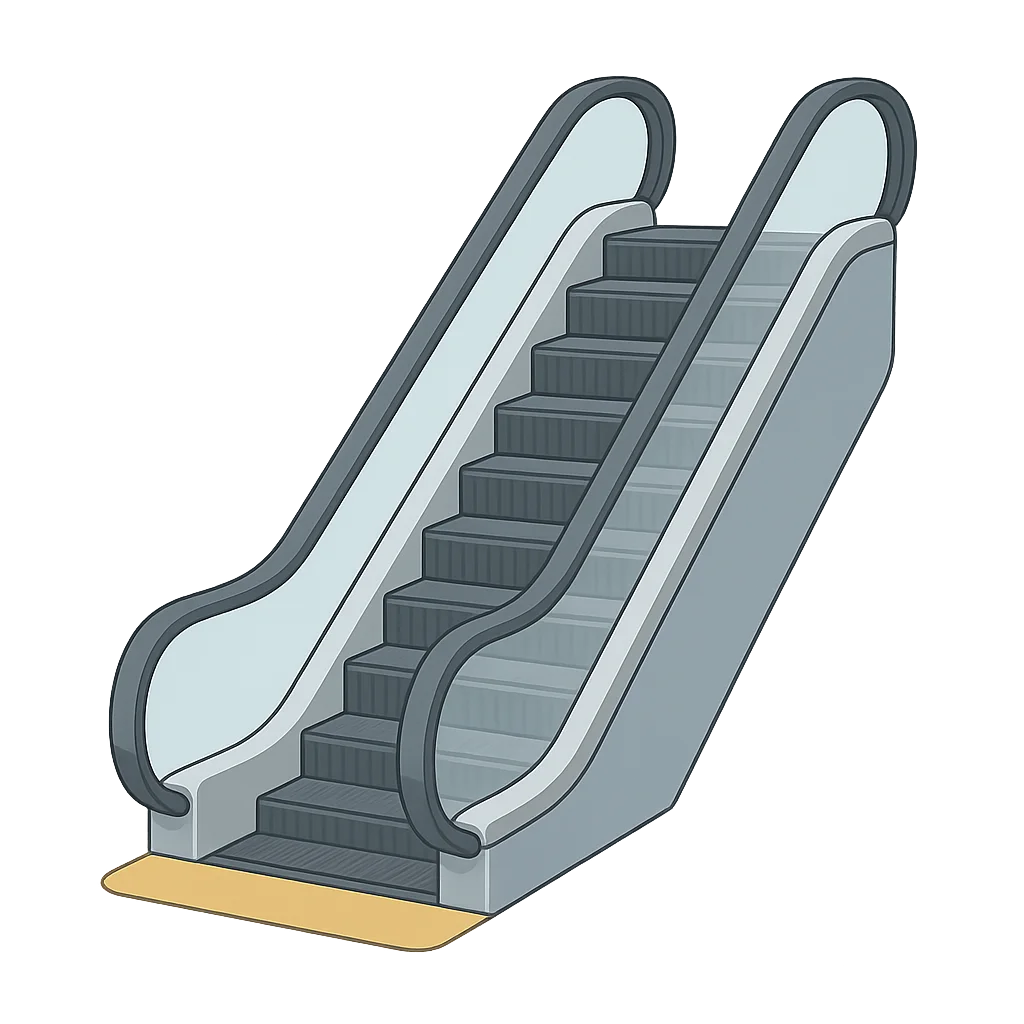
A Step in the Right Direction: My Story as the Escalator
Hello there. You might not notice me most days, but I am the Escalator, the moving staircase that helps you glide from one floor to the next. Before I came along, the world was full of huffing and puffing. Imagine giant new department stores with wonderful things to see on every level, or busy train stations with platforms high and low. To get anywhere, you had to climb, climb, climb. Your legs would get tired, and carrying heavy bags was a real workout. The world needed a new way to go up and down, a way that felt like floating. The first person to dream of me was a man named Nathan Ames. On March 9th, 1859, he drew up plans for what he called 'revolving stairs.' It was a wonderful idea, a staircase that moved all by itself! But for a long time, that’s all I was: an idea on a piece of paper. I was a dream, waiting patiently for someone to build me and let me take my first steps.
My real journey began with a clever inventor named Jesse W. Reno. He didn't just dream; he built! In 1896, he created the very first working version of me. He called me an 'inclined elevator,' which means a ramp that moves on a slant. My big debut was at a very exciting place: an amusement park on Coney Island in New York! I wasn't quite the same as I am today. I was more like a moving belt with little ridges, called cleats, for people to stand on. People would line up and ride me just for the fun of it, laughing as they were carried up a seven-foot incline. It was a thrilling start, but my story was about to get even better. Another brilliant man, Charles Seeberger, saw what Jesse Reno had done and thought he could make me even more perfect. He designed me with the flat, wide steps you use today, which made me much safer and easier for everyone to ride. He also gave me my grand name: the Escalator. He thought it sounded elegant and important. Charles Seeberger then joined forces with the famous Otis Elevator Company, and together, they decided to show me to the entire world. In the year 1900, they took me to a massive world's fair in Paris, France, called the Exposition Universelle. I was a superstar! People from every corner of the globe stood in long lines, their eyes wide with wonder, just to take a ride on my moving steps. They had never seen anything like me. I felt so proud as I carried them smoothly up and down. I even won the first prize at the fair for my design. I knew then that I wasn't just an amusement park ride anymore; I was going to change the world.
After my success in Paris, I began my true life's work. I moved out of the fairgrounds and into the places where people needed me most. I appeared in beautiful department stores, making it simple for shoppers to carry their bags from the shoe department to the toy section without getting tired. Soon, I was installed in busy airports, helping travelers rush to catch their flights, and in deep underground subway stations, lifting crowds of people back up to the city streets. I help everyone. I give a gentle lift to grandparents who find stairs a bit tricky, and I offer a fun ride for children who are excited to get to the movie theater on the top floor of the mall. My purpose is to make big buildings open and accessible to all people, no matter how young or old. I may not be as flashy as a rocket or as famous as the telephone, but I am always here. Looking back, I see I did more than just move people between floors; I gave them a little lift in their day. And I’m still working hard, quietly gliding along, always ready to help you on your way up.
Activities
Take a Quiz
Test what you learned with a fun quiz!
Get creative with colors!
Print a coloring book page of this topic.













 Free for Educators