

 English

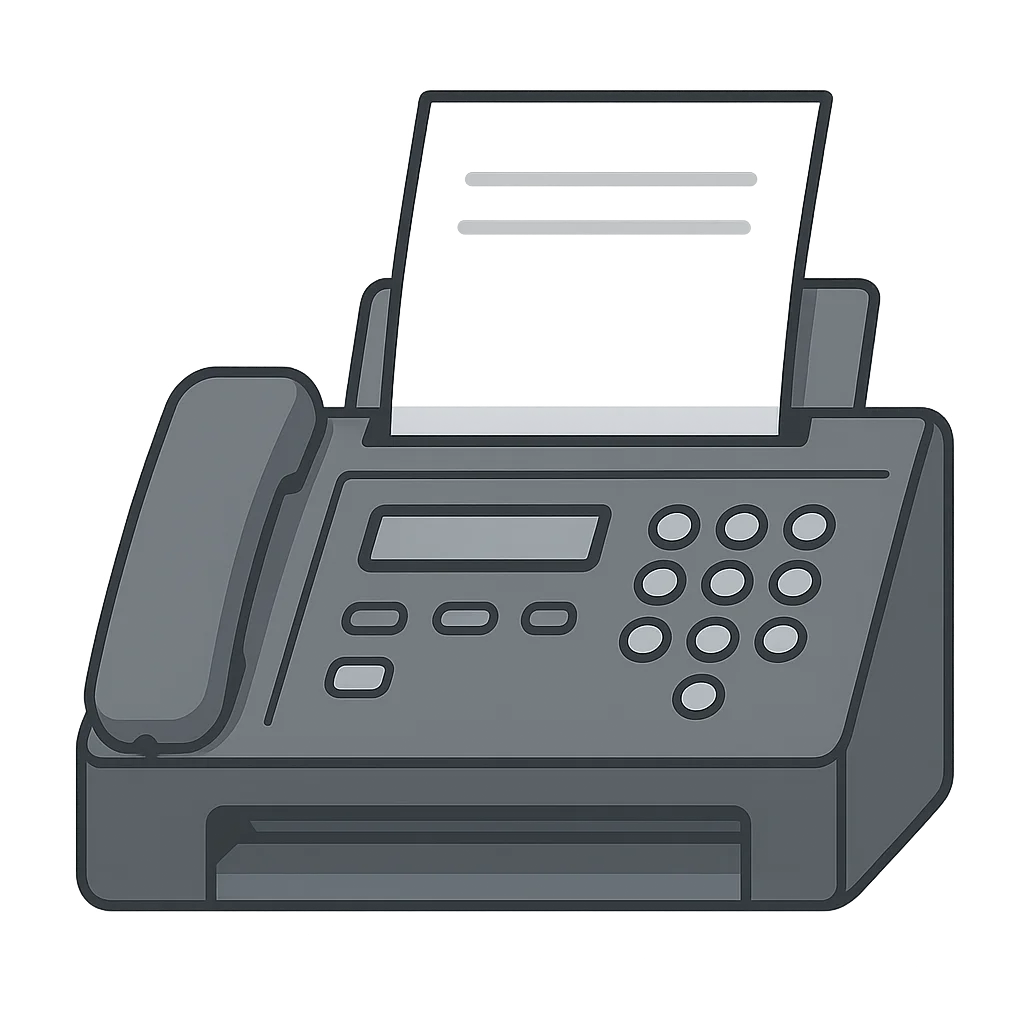
The Fax Machine's Tale
Hello there. You might not recognize me at first glance. I’m not as sleek as a smartphone or as common as a laptop, but I am a traveler of time and space. I am the Fax Machine, and for over a century, I was the closest thing the world had to a teleporter for paper. Before the instant click of an email, sending a signed contract or a hand-drawn picture across the country took days, carried by train or truck. The world of business, news, and even personal messages moved at the speed of a postage stamp. I was born from a desire for something faster, a way to send an exact copy of a document through a wire in mere minutes. My story began long before the hum of computers filled every office, back in an age of steam engines and flickering gaslights, when a new invention called the telegraph was already shrinking the world.
My story truly begins with a brilliant Scottish clockmaker and inventor named Alexander Bain. In the early 1840s, he was captivated by the telegraph, which sent messages as a series of clicks, dots, and dashes. But Alexander Bain had a more ambitious dream. He thought, if a wire can carry a code for letters, why can't it carry a picture? On May 27th, 1843, he patented the first design for me. It was an incredible piece of clockwork ingenuity. Imagine two heavy brass pendulums, swinging in perfect time with each other in two different places, connected by a telegraph wire. The sending pendulum would swing over a set of metal letters, creating electrical pulses. Miles away, the receiving pendulum swung over a sheet of special, chemically treated paper. As the electrical pulses arrived, they caused a stylus to touch the paper, creating a chemical reaction that left a dark blue mark. It was a slow and delicate dance of electricity and chemistry, but it worked. An image was being sent through a wire, letter by letter, line by line. It was a complex and fragile process, and many thought it was impossible, but Alexander’s belief in connecting people through images set me on my long journey.
Like any new idea, I needed time to grow and improve. Other inventors saw the magic in what Alexander Bain had started and began to build upon it. An English inventor named Frederick Bakewell improved my design around 1848 by replacing the swinging pendulums with synchronized rotating cylinders. This made my scanning process much more stable and the copies I produced far clearer. My big break into the working world, however, came from an Italian physicist named Giovanni Caselli. In the 1860s, he perfected my design and created the 'Pantelegraph.' He established the first-ever commercial fax service between the cities of Paris and Lyon. For the first time, banks could send a copy of a signature to verify a check, and people could send sketches or even short, handwritten notes across the country. I was no longer just an experiment; I was a service. As the world moved into the 20th century, I took another giant leap. Inventors discovered how to use photoelectric cells—tiny devices that turn light into electricity. Instead of tracing metal letters, I could now scan a photograph with a beam of light. I converted the bright and dark spots of the photo into strong and weak electrical signals. This changed everything, especially for newspapers. An important photograph of a world event could be sent across oceans in minutes, appearing in the morning paper for everyone to see.
My true golden age arrived in the 1970s and 1980s. By then, I had become smaller, faster, and more affordable. I was a fixture in almost every office around the globe, a symbol of modern efficiency. I had a voice all my own—a series of high-pitched beeps and squawks as I connected with another machine over the phone line, a sound that meant business was about to happen. Then came the steady, rhythmic whirring of my scanner pulling in a document, followed by the gentle hum as a warm, slightly curled copy emerged from a machine hundreds or thousands of miles away. I was the trusty workhorse of communication. But technology, as it always does, continued to march forward. The rise of the internet brought email and digital scanners, which could do my job instantly and without a dedicated phone line. My time as the star of the office began to fade. But I don't see it as an ending. I see it as a graduation. I had served my purpose, and I was proud to pass the torch to my digital descendants who could carry my mission forward in new and exciting ways.
Though you may not see me in many offices today, my spirit is everywhere. The core idea that gave me life—the concept of converting a physical image into a digital signal, sending it across a distance, and perfectly recreating it—is the foundation of so much of your modern world. Every time you scan a document to your computer, take a digital photograph with your phone, or stream a video from across the world, you are using the very principle I pioneered. I was the bridge between the physical page and the digital signal. I am a reminder that even the most complex technology of today began as a simple, powerful idea in the mind of someone who dared to dream. My lasting message is one of connection and innovation, and I am proud that my legacy lives on in every pixel and byte that connects your world today.
Activities
Take a Quiz
Test what you learned with a fun quiz!
Get creative with colors!
Print a coloring book page of this topic.









 Free for Educators