English

Julian Calendar
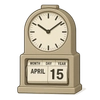
A solar calendar introduced by Julius Caesar in 45 BCE that standardized timekeeping with a 365-day year and…
Reads at Grades 3–5 Listens at Grades 1–5
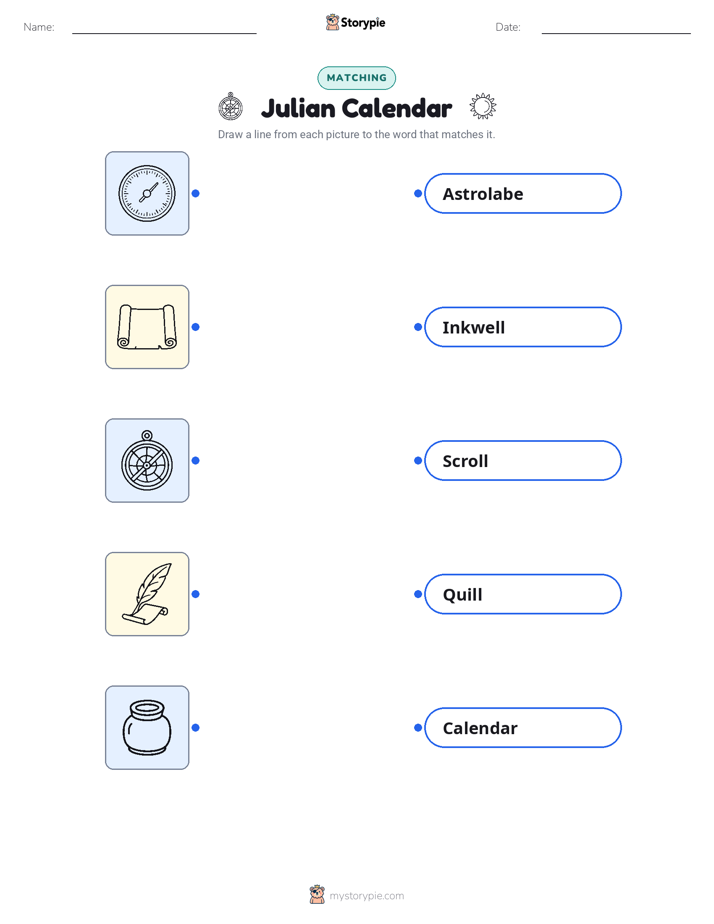
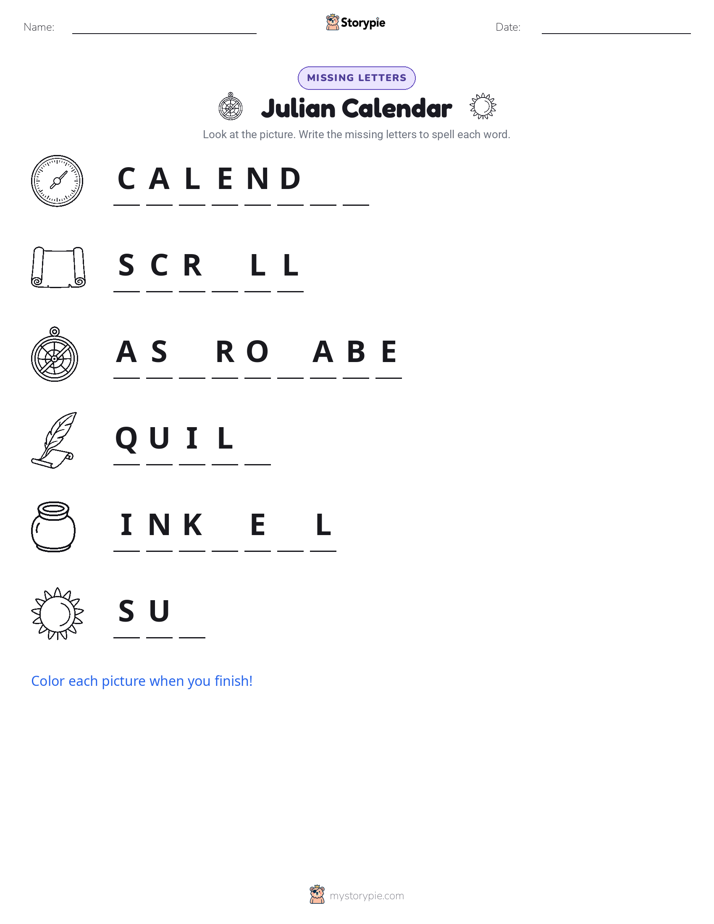
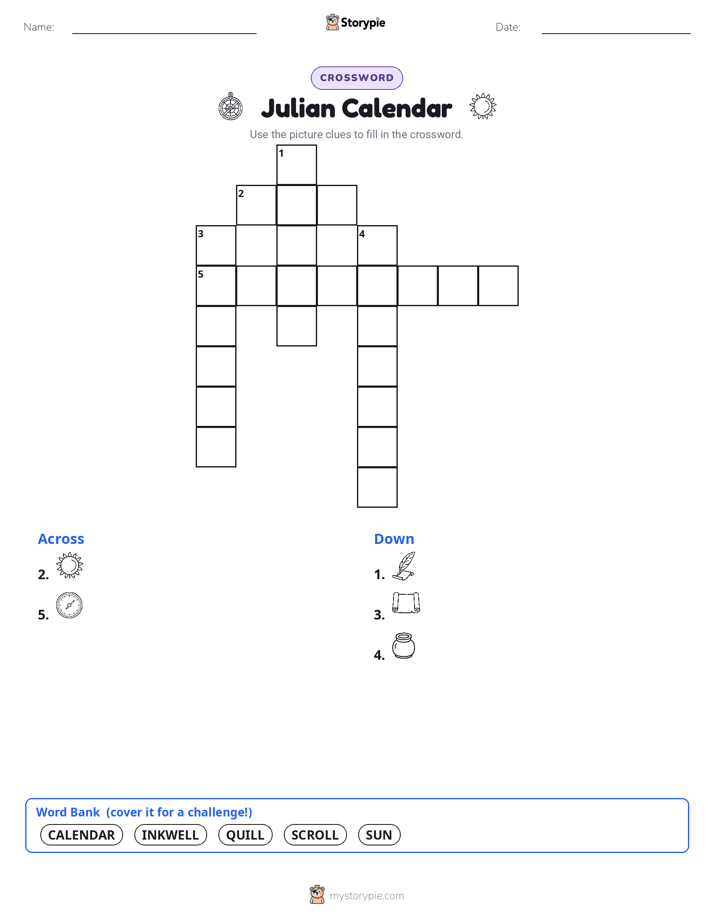
Print & create
Answer keys·No prep·Free with an account
28 worksheets · answer keys · full story · quiz · Ages 8-10 · CEFR B1
Plus adds 208,000+ more stories in 27 languages, audio for every one, and printables for all of them.
Just want Julian Calendar?
Hello there. You might not know my name, but my work helps organize your entire life. I am the Julian Calendar. Before I was born, time was a terrible jumble. Imagine trying to plan a birthday party, but you were never quite sure when the day would arrive. That's what life was like in the Roman Republic around 46 BCE. The calendar they used was a mess. It was too short and didn't match the seasons at all. Farmers didn't know the best time to plant their crops, and religious festivals would drift into the wrong time of year. It was like trying to read a book with all the pages mixed up. A powerful Roman leader named Julius Caesar saw this chaos. He was a great general and statesman, and he knew that a great republic needed order. He looked at the tangled mess of the old calendar and declared that it was time for a change. He wanted a system that was reliable, predictable, and based on the science of the sun and stars, a calendar that everyone could count on.
To fix such a big problem, Julius Caesar needed help from one of the cleverest minds he could find. He looked to Alexandria, a city in Egypt famous for its brilliant thinkers, and found an astronomer named Sosigenes. Together, they studied the sky. Sosigenes knew that the Earth takes a little more than 365 days to travel all the way around the sun. To be precise, it takes about 365 and a quarter days. That little quarter of a day was what had caused all the trouble with the old calendar. So, Sosigenes came up with a brilliant plan for me. I would have 365 days in a normal year. But to take care of that extra quarter, we would add one extra day every four years. You call this a 'leap day.' It was the perfect solution to keep me in sync with the seasons. But before I could begin my work, we had to fix the old mess. The year 46 BCE became known as the 'year of confusion' because Caesar had to add 90 extra days to it just to get the seasons back where they belonged. It was the longest year in history. Finally, on January 1st, 45 BCE, everything was ready. I officially began, bringing a new, steady rhythm to the world.
I Am the Julian Calendar
Hello there. You might not know my name, but my work helps organize your entire life. I am the Julian Calendar. Before I was born, time was a terrible jumble. Imagine trying to plan a birthday party, but you were never quite sure when the day would arrive. That's what life was like in the Roman Republic around 46 BCE. The calendar they used was a mess. It was too short and didn't match the seasons at all. Farmers didn't know the best time to plant their crops, and religious festivals would drift into the wrong time of year. It was like trying to read a book with all the pages mixed up. A powerful Roman leader named Julius Caesar saw this chaos. He was a great general and statesman, and he knew that a great republic needed order. He looked at the tangled mess of the old calendar and declared that it was time for a change. He wanted a system that was reliable, predictable, and based on the science of the sun and stars, a calendar that everyone could count on.
To fix such a big problem, Julius Caesar needed help from one of the cleverest minds he could find. He looked to Alexandria, a city in Egypt famous for its brilliant thinkers, and found an astronomer named Sosigenes. Together, they studied the sky. Sosigenes knew that the Earth takes a little more than 365 days to travel all the way around the sun. To be precise, it takes about 365 and a quarter days. That little quarter of a day was what had caused all the trouble with the old calendar. So, Sosigenes came up with a brilliant plan for me. I would have 365 days in a normal year. But to take care of that extra quarter, we would add one extra day every four years. You call this a 'leap day.' It was the perfect solution to keep me in sync with the seasons. But before I could begin my work, we had to fix the old mess. The year 46 BCE became known as the 'year of confusion' because Caesar had to add 90 extra days to it just to get the seasons back where they belonged. It was the longest year in history. Finally, on January 1st, 45 BCE, everything was ready. I officially began, bringing a new, steady rhythm to the world.
I was very proud of my work. For more than 1,600 years, I was the calendar used by most of the Western world. I helped empires schedule their plans, historians record important events, and families celebrate holidays year after year. I watched as generations of people used me to mark the moments of their lives. I wasn't absolutely perfect, though. Sosigenes's calculation was amazing for his time, but it was off by just a tiny bit—about 11 minutes each year. You might think 11 minutes is nothing, but over hundreds of years, it added up. By the 1500s, I was about 10 days ahead of the seasons. So, in 1582, my younger cousin, the Gregorian calendar, was born. It made a small adjustment to my leap year rule to fix that tiny error, and it's the calendar most of the world uses today. I'm not sad about it. Looking back, I see that I brought order out of chaos. I was the foundation for the very way you measure your days, and I am happy that my idea helped organize human history for so long.
Wow facts
About
A solar calendar introduced by Julius Caesar in 45 BCE that standardized timekeeping with a 365-day year and a leap year every four years, serving as the predominant calendar in the Western world for over 1,600 years.
Take a Quiz
Question 1 of 5
Who was the astronomer that helped Julius Caesar create the new calendar?
Explore next






Want to do even more?
Go beyond exploring. Unlock tools that turn every story into real learning.

Storypie Plus for families
Full stories, quizzes, and printables. Nights and car rides, sorted.
- Unlimited audio stories
- Create Mode: your child stars in the story
- Offline downloads
- Printable worksheets & coloring pages

Why Storypie for Schools
Students engaged. Prep in seconds. Evenings back to you.
- Worksheets & Quizzes
- Classroom Management
- Formative Assessment
- Custom Curriculum & Lesson Plans
- 27 Languages

Why Storypie for Homeschool
Curriculum done. They'll ask for more. Hours back in your day.
- Worksheet Generator
- First-Person Audio Stories
- Built-in Comprehension Quizzes
- Custom Curriculum & Lesson Plans
- Print & Go Activities