English

Papyrus
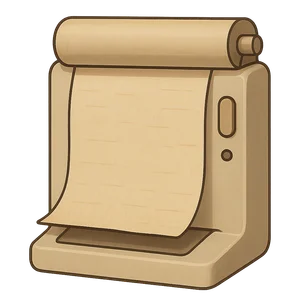
An early form of paper made from the pith of the papyrus plant…
Reads at Grades 6–8 Listens at Grades 4–8
I Am Papyrus, the Voice of the Nile
My story begins not in a workshop or a laboratory, but in the sun-drenched marshes along the great Nile River in ancient Egypt. I am Papyrus, and before I existed to carry words, I was a plant, the Cyperus papyrus, growing tall and proud with a feathery crown that danced in the warm breeze. For thousands of years, I watched civilizations rise, their ideas as heavy as the stones on which they were carved. Imagine a world where a story could not travel, where a law was fixed to a single temple wall, and where knowledge was trapped in cumbersome clay tablets. This was the world before me. Around 2500 BCE, the brilliant people of Egypt realized they needed something new. They needed a way for their thoughts, their histories, and their sacred beliefs to become light, portable, and shareable. They looked to the river, to the endless green reeds, and saw a possibility. They saw me, not just as a plant, but as a future filled with stories waiting to be told. My birth was not of metal or fire, but of water, sunlight, and human ingenuity, a response to a deep need to connect and to remember.
My transformation from a humble river reed into a royal scroll was a marvel of patience and skill. It began when Egyptian artisans waded into the marshes to harvest my long, triangular stalks. They would carry my green body back to their workshops, where my journey truly began. First, they carefully peeled away my tough outer skin, revealing the soft, white pith within. This tender heart of mine was the key to everything. With steady hands, they sliced the pith into the thinnest possible strips, delicate as ribbons. These strips were then soaked in the life-giving water of the Nile, which made them pliable and soft. The true magic happened next. The artisans laid my strips side-by-side, one layer vertically and a second layer horizontally on top, creating a woven mat. This crisscross pattern gave me strength. A linen cloth was placed over me, and then I was pressed under heavy stones for days. During this time, I released my own natural, sugary sap, a sticky juice that acted as the perfect glue, bonding my layers together into a single, unified sheet. I felt the immense pressure fusing my parts, transforming me from separate strands into a cohesive whole. Once I was dry, my surface was polished with a smooth stone or a piece of ivory until I was pale, smooth, and ready. I was no longer a plant; I was a canvas. Often, many of these individual sheets were carefully joined together, end to end, creating long, magnificent scrolls that could hold entire books.
Once I was prepared, I became the lifeblood of Egyptian civilization. My smooth surface eagerly accepted the ink from the scribe's reed pen, and I began to carry the words that shaped an empire. I held the grand histories of the pharaohs, detailing their divine lineage and their monumental achievements for all time. I carried the sacred spells and prayers of the Book of the Dead, a guide for souls journeying into the afterlife, tucked safely within sarcophagi. But my purpose was not only for the grand and the divine. I also carried the mundane, essential details of daily life. I held tax records for the kingdom, medical texts that detailed surgical procedures and remedies for illnesses, and architectural plans for pyramids and temples. I was used for personal letters between family members, for shopping lists carried through bustling markets, and for legal contracts that bound agreements. I filled the shelves of the world's first great libraries, most famously the legendary Library of Alexandria, where scholars from across the known world came to study the knowledge I held. My usefulness was so profound that my use spread far beyond the borders of Egypt. Phoenician traders carried my scrolls across the Mediterranean Sea, introducing me to the Greeks and later the Romans. I carried the philosophies of Plato and the epic poems of Homer, allowing ideas to travel and build upon one another, connecting distant minds and cultures in a way the world had never seen before.
My reign as the world's primary writing material lasted for thousands of years, but like all things, my time eventually came to an end. New materials, like the more durable parchment made from animal skin, and eventually the less expensive paper you know today, took my place. Yet, I was not forgotten. My legacy is woven into the very fabric of your modern world. Look at the word 'paper' itself. It is an echo of my ancient name, 'papyrus.' I represent the world's first great leap toward making knowledge accessible. I was the innovation that untethered ideas from stone and allowed them to fly across deserts and seas. I proved that the greatest thoughts are not heavy and immovable, but light and meant to be shared. Every book you read, every notebook you write in, and every document you print is a distant grandchild of mine. They continue the mission I began on the banks of the Nile so long ago: to ensure that human knowledge, creativity, and connection can travel through time and unite us all.
Wow facts
About
An early form of paper made from the pith of the papyrus plant, invented in ancient Egypt and used for writing throughout the ancient Mediterranean world.
Take a Quiz
Question 1 of 5
In your own words, retell the main events of how Papyrus was created from a plant into a writing material.
Explore next

Want to do even more?
Go beyond exploring. Unlock tools that turn every story into real learning.

Storypie Plus for families
Full stories, quizzes, and printables. Nights and car rides, sorted.
- Unlimited audio stories
- Create Mode: your child stars in the story
- Offline downloads
- Printable worksheets & coloring pages

Why Storypie for Schools
Students engaged. Prep in seconds. Evenings back to you.
- Worksheets & Quizzes
- Classroom Management
- Formative Assessment
- Custom Curriculum & Lesson Plans
- 27 Languages

Why Storypie for Homeschool
Curriculum done. They'll ask for more. Hours back in your day.
- Worksheet Generator
- First-Person Audio Stories
- Built-in Comprehension Quizzes
- Custom Curriculum & Lesson Plans
- Print & Go Activities