English

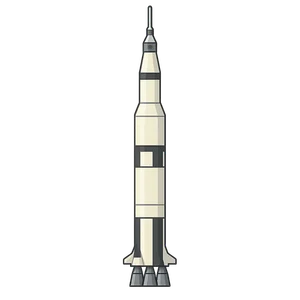
Saturn V
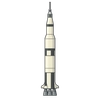
The Saturn V was an American super heavy-lift launch vehicle used by NASA between 1967 and 1973.
Reads at Grades 6–8 Listens at Grades 4–8
Print & create
Answer keys·No prep·Free with an account
28 worksheets · answer keys · full story · quiz · Ages 10-12 · CEFR B2
Plus adds 164,000+ more stories in 27 languages, audio for every one, and printables for all of them.
Just want Saturn V?
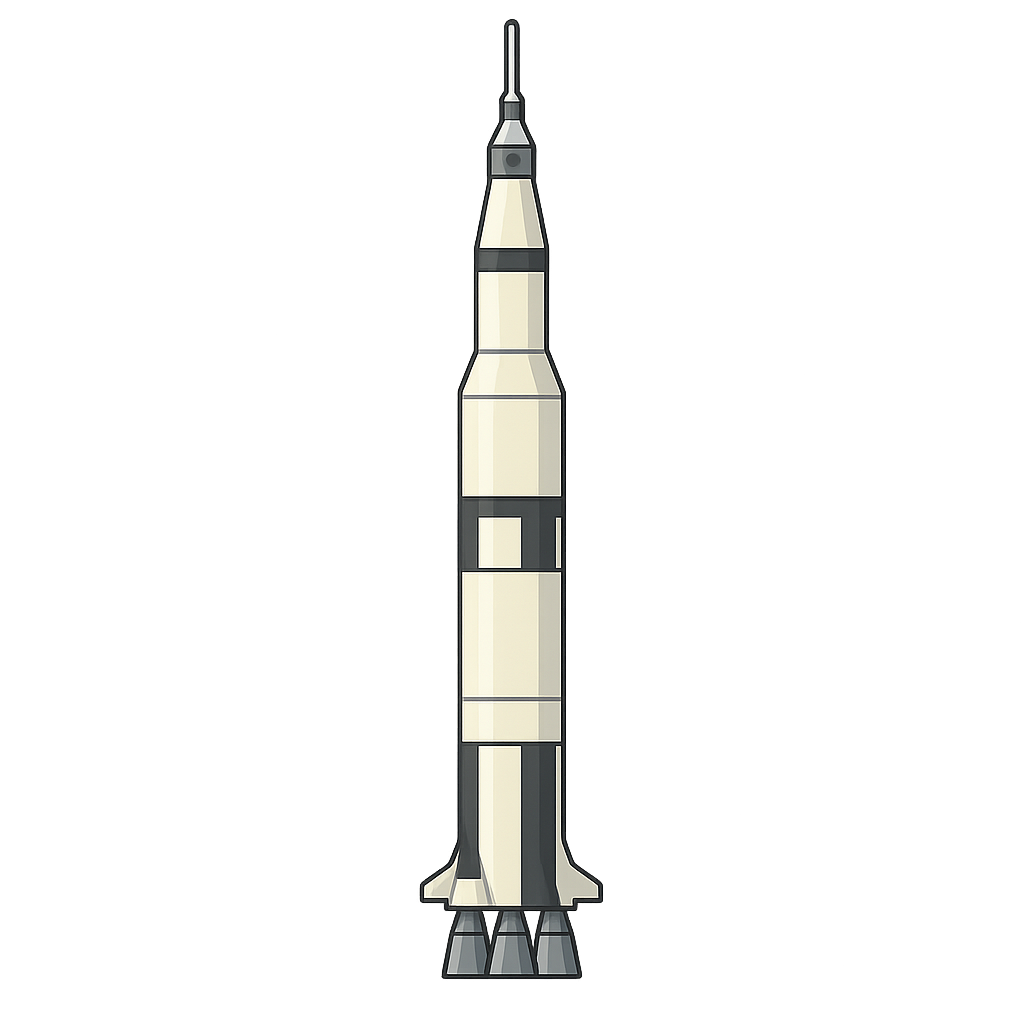
I am Saturn V. To this day, I remain the tallest, heaviest, and most powerful rocket ever brought to operational life. Imagine a skyscraper, 363 feet tall, standing not in a bustling city but on a launchpad in Florida, pointing directly at the stars. That was me. I wasn't built just to be tall; I was born from a colossal dream that captured the imagination of the entire world. It was the dream of sending human beings to leave their home planet and walk upon the surface of another world—the Moon. I came to be during the 1960s, a time of incredible change and ambition. Two great nations, the United States and the Soviet Union, were locked in a competition known as the 'Space Race.' It was a peaceful but intense rivalry to see who could achieve supremacy in space exploration. The world watched, breathless, as each side reached new milestones. Then, in 1961, a young president named John F. Kennedy issued a challenge. He promised that America would land a man on the Moon and return him safely to the Earth before the decade was out. It was a bold, almost impossible promise. To fulfill that promise, they needed a vehicle with power and reliability beyond anything ever conceived. They needed me.
My creation was not the work of one person, but of a vast team of brilliant minds at NASA's Marshall Space Flight Center, led by an engineering visionary named Wernher von Braun. They designed me with a clever strategy to defy Earth's immense gravity. I am not one single rocket but three rockets, called 'stages,' stacked one on top of the other. My first and largest stage held five of the most powerful engines ever built, the F-1s. Each one was a masterpiece of engineering. When they ignited, all five together generated over 7.6 million pounds of thrust. The sound was not just a roar; it was a physical force, a cataclysmic thunder that shook the very ground for miles and sent shockwaves rippling through the air. Once this first stage used up its fuel, it would fall away, making me much lighter. Then, my second stage, with its five J-2 engines, would ignite to push me even higher and faster. Finally, that too would fall away, and my third stage, with its single J-2 engine, would give the final push to break free from Earth's orbit. Building me took years of painstaking work, calculation, and endless testing. Thousands of components had to work in perfect harmony. My first true test came on November 9th, 1967. I was designated Apollo 4, an unmanned flight to prove I could do my job. As the liquid oxygen and kerosene fuel, colder than ice, began to rush through my pipes and tanks—my veins—I felt my systems awaken. The test was a complete success. I flew perfectly, proving to my creators and to the world that I was ready. The anticipation was electric; I knew my ultimate purpose was not just to fly, but to carry humanity's greatest explorers on the journey of a lifetime.
The Story of the Saturn V Rocket
I am Saturn V. To this day, I remain the tallest, heaviest, and most powerful rocket ever brought to operational life. Imagine a skyscraper, 363 feet tall, standing not in a bustling city but on a launchpad in Florida, pointing directly at the stars. That was me. I wasn't built just to be tall; I was born from a colossal dream that captured the imagination of the entire world. It was the dream of sending human beings to leave their home planet and walk upon the surface of another world—the Moon. I came to be during the 1960s, a time of incredible change and ambition. Two great nations, the United States and the Soviet Union, were locked in a competition known as the 'Space Race.' It was a peaceful but intense rivalry to see who could achieve supremacy in space exploration. The world watched, breathless, as each side reached new milestones. Then, in 1961, a young president named John F. Kennedy issued a challenge. He promised that America would land a man on the Moon and return him safely to the Earth before the decade was out. It was a bold, almost impossible promise. To fulfill that promise, they needed a vehicle with power and reliability beyond anything ever conceived. They needed me.
My creation was not the work of one person, but of a vast team of brilliant minds at NASA's Marshall Space Flight Center, led by an engineering visionary named Wernher von Braun. They designed me with a clever strategy to defy Earth's immense gravity. I am not one single rocket but three rockets, called 'stages,' stacked one on top of the other. My first and largest stage held five of the most powerful engines ever built, the F-1s. Each one was a masterpiece of engineering. When they ignited, all five together generated over 7.6 million pounds of thrust. The sound was not just a roar; it was a physical force, a cataclysmic thunder that shook the very ground for miles and sent shockwaves rippling through the air. Once this first stage used up its fuel, it would fall away, making me much lighter. Then, my second stage, with its five J-2 engines, would ignite to push me even higher and faster. Finally, that too would fall away, and my third stage, with its single J-2 engine, would give the final push to break free from Earth's orbit. Building me took years of painstaking work, calculation, and endless testing. Thousands of components had to work in perfect harmony. My first true test came on November 9th, 1967. I was designated Apollo 4, an unmanned flight to prove I could do my job. As the liquid oxygen and kerosene fuel, colder than ice, began to rush through my pipes and tanks—my veins—I felt my systems awaken. The test was a complete success. I flew perfectly, proving to my creators and to the world that I was ready. The anticipation was electric; I knew my ultimate purpose was not just to fly, but to carry humanity's greatest explorers on the journey of a lifetime.
Of all my journeys, none is more famous than the one that began on the morning of July 16th, 1969. This was my mission, Apollo 11. Tucked safely inside the command module at my very tip were three brave astronauts: Neil Armstrong, Buzz Aldrin, and Michael Collins. They placed their trust in me, and I felt the weight of that responsibility in every bolt and wire of my being. The world held its breath as the final countdown echoed across the launch complex. 'Five... four... three... two... one... ignition.' In that moment, a controlled explosion of unimaginable force erupted from my base. My five F-1 engines roared to life, and for a few seconds, I was held down by giant arms as my thrust built to full power. Then, the arms released me, and I began to rise. It was a slow, majestic ascent at first, as if I were carefully pushing the entire sky upward. I was fighting against the relentless pull of Earth's gravity with every ounce of my strength. For twelve minutes, I was their whole world. My first stage burned for about two and a half minutes before separating and falling back to the ocean. Then, my second stage fired, pushing the astronauts to the very edge of space. Finally, my third stage ignited, first to place them in a stable orbit around the Earth, and then, after a final check, it fired one last time for over six minutes. This was the Trans-Lunar Injection burn, the critical push that sent them hurtling out of Earth's orbit and on a precise path toward the Moon. My job was done. My final stage separated, and I watched silently as the tiny Apollo spacecraft drifted away, a small beacon of humanity on its way to make history. A profound sense of pride filled my silent, metallic heart. I had given them the start they needed.
My career was short but monumental. I flew thirteen times in total, from my first test flight in 1967 to my final mission in 1973. On every one of my manned missions, I performed flawlessly, and I am most proud that I never lost a single astronaut entrusted to my care. After the Apollo program concluded, I had one last important job to do. On May 14th, 1973, I used my immense power to launch Skylab, America's very first space station, into Earth's orbit. It was a different kind of mission, not a sprint to the Moon, but the start of a long-term human presence in space. Though my flying days are over, with my remaining parts now resting in museums for all to see, my legacy lives on. The engineering breakthroughs and the powerful engine technologies developed for me became the foundation for future spacecraft, including the Space Shuttle and the powerful rockets that explore our solar system today. I hope that when people look at me, they see more than just a massive machine of metal and wires. I am a symbol of what is possible when people dare to dream on a grand scale and work together with courage and ingenuity. I am proof that the biggest challenges can be overcome and that the desire to explore is one of humanity’s greatest strengths. I am a reminder to always reach for the stars.
Wow facts
About
The Saturn V was an American super heavy-lift launch vehicle used by NASA between 1967 and 1973. It was the tallest, heaviest, and most powerful rocket ever brought to operational status and was used to send astronauts to the Moon during the Apollo program.
Take a Quiz
Question 1 of 5
Retell the main steps of Saturn V's job during the Apollo 11 launch, from ignition to sending the astronauts toward the Moon.
Explore next


Want to do even more?
Go beyond exploring. Unlock tools that turn every story into real learning.

Storypie Plus for families
Full stories, quizzes, and printables. Nights and car rides, sorted.
- Unlimited audio stories
- Create Mode: your child stars in the story
- Offline downloads
- Printable worksheets & coloring pages

Why Storypie for Schools
Students engaged. Prep in seconds. Evenings back to you.
- Worksheets & Quizzes
- Classroom Management
- Formative Assessment
- Custom Curriculum & Lesson Plans
- 27 Languages

Why Storypie for Homeschool
Curriculum done. They'll ask for more. Hours back in your day.
- Worksheet Generator
- First-Person Audio Stories
- Built-in Comprehension Quizzes
- Custom Curriculum & Lesson Plans
- Print & Go Activities