English

Ultrasound Imaging
A medical imaging technique that uses high-frequency sound waves and their echoes to create images of the…
Reads at Grades 6–8 Listens at Grades 4–8
Print & create
Answer keys·No prep·Free with an account
28 worksheets · answer keys · full story · quiz · Ages 10-12 · CEFR B2
Plus adds 280,000+ more stories in 27 languages, audio for every one, and printables for all of them.
Just want Ultrasound Imaging?
Have you ever heard a secret? I am one of the world's best-kept secrets, a sound so high-pitched that your ears can't detect me at all. Hello, I am Ultrasound. I am not like the sounds you hear every day—a laugh, a song, or a clap of thunder. I am a vibration, a pulse of energy that travels through the world on a frequency far beyond human hearing. Think of me as a secret language, one that nature has been speaking for millions of years. Dolphins and whales use my cousins to navigate the vast, dark oceans, sending out clicks and whistles and listening for the echoes that bounce back. Bats use a similar trick, painting a picture of the night with sound alone. This is called echolocation, and it is the very heart of who I am. I send out a tiny, silent 'shout' and then I listen, very carefully, for the echo. By measuring how long it takes for that echo to return and how strong it is, I can build a picture of things that are hidden from sight. I can map the unseen world, turning silent echoes into a visible story, a power that would one day allow me to show humanity things they had only dreamed of seeing.
My story, however, doesn't begin in a quiet forest or a deep ocean, but with a great tragedy at sea. On the frigid night of April 15th, 1912, the magnificent ship RMS Titanic struck an iceberg and sank, a disaster that shocked the world. In the wake of this loss, people became desperate for a way to 'see' underwater, to detect dangers lurking in the dark. This need gave birth to my ancestor, SONAR. During the chaos of World War I, a French physicist named Paul Langevin harnessed the power of sound waves to hunt for enemy submarines, sending my pings into the depths to find hidden metal giants. For decades, my purpose was tied to the sea and to industry. It wasn't until the 1940s that someone wondered if I could explore a different kind of unknown territory: the human body. In Austria, a neurologist named Dr. Karl Dussik first attempted to use my waves to look for tumors inside the human brain. His early attempts were rough, but the idea was revolutionary. The real turning point, my true beginning as a medical marvel, happened in Glasgow, Scotland, during the 1950s. A compassionate and curious obstetrician, Dr. Ian Donald, was troubled by the difficulty of examining his patients and their unborn babies. He knew there had to be a better, safer way. By a stroke of fate, he met Tom Brown, a brilliant and practical engineer. Tom worked for a company that built machines using my sound waves to find tiny, dangerous cracks in the metal of ships. Together, they had a groundbreaking idea: what if a machine designed to find flaws in steel could be adapted to see inside the soft, delicate tissues of the human body? They took an industrial flaw detector, a clunky metal box, and began their experiments. It was not easy. They practiced on pieces of raw steak and liver from a butcher shop, trying to see the different textures. They faced skepticism and technical challenges, but their shared vision of a non-invasive window into the body drove them forward. They persevered, tinkering and refining their device until, in 1958, they published the first paper showing my ability to safely see cysts and tumors, and soon after, the first incredible images of a fetus inside the womb.
The Echo I Became: An Ultrasound's Story
Have you ever heard a secret? I am one of the world's best-kept secrets, a sound so high-pitched that your ears can't detect me at all. Hello, I am Ultrasound. I am not like the sounds you hear every day—a laugh, a song, or a clap of thunder. I am a vibration, a pulse of energy that travels through the world on a frequency far beyond human hearing. Think of me as a secret language, one that nature has been speaking for millions of years. Dolphins and whales use my cousins to navigate the vast, dark oceans, sending out clicks and whistles and listening for the echoes that bounce back. Bats use a similar trick, painting a picture of the night with sound alone. This is called echolocation, and it is the very heart of who I am. I send out a tiny, silent 'shout' and then I listen, very carefully, for the echo. By measuring how long it takes for that echo to return and how strong it is, I can build a picture of things that are hidden from sight. I can map the unseen world, turning silent echoes into a visible story, a power that would one day allow me to show humanity things they had only dreamed of seeing.
My story, however, doesn't begin in a quiet forest or a deep ocean, but with a great tragedy at sea. On the frigid night of April 15th, 1912, the magnificent ship RMS Titanic struck an iceberg and sank, a disaster that shocked the world. In the wake of this loss, people became desperate for a way to 'see' underwater, to detect dangers lurking in the dark. This need gave birth to my ancestor, SONAR. During the chaos of World War I, a French physicist named Paul Langevin harnessed the power of sound waves to hunt for enemy submarines, sending my pings into the depths to find hidden metal giants. For decades, my purpose was tied to the sea and to industry. It wasn't until the 1940s that someone wondered if I could explore a different kind of unknown territory: the human body. In Austria, a neurologist named Dr. Karl Dussik first attempted to use my waves to look for tumors inside the human brain. His early attempts were rough, but the idea was revolutionary. The real turning point, my true beginning as a medical marvel, happened in Glasgow, Scotland, during the 1950s. A compassionate and curious obstetrician, Dr. Ian Donald, was troubled by the difficulty of examining his patients and their unborn babies. He knew there had to be a better, safer way. By a stroke of fate, he met Tom Brown, a brilliant and practical engineer. Tom worked for a company that built machines using my sound waves to find tiny, dangerous cracks in the metal of ships. Together, they had a groundbreaking idea: what if a machine designed to find flaws in steel could be adapted to see inside the soft, delicate tissues of the human body? They took an industrial flaw detector, a clunky metal box, and began their experiments. It was not easy. They practiced on pieces of raw steak and liver from a butcher shop, trying to see the different textures. They faced skepticism and technical challenges, but their shared vision of a non-invasive window into the body drove them forward. They persevered, tinkering and refining their device until, in 1958, they published the first paper showing my ability to safely see cysts and tumors, and soon after, the first incredible images of a fetus inside the womb.
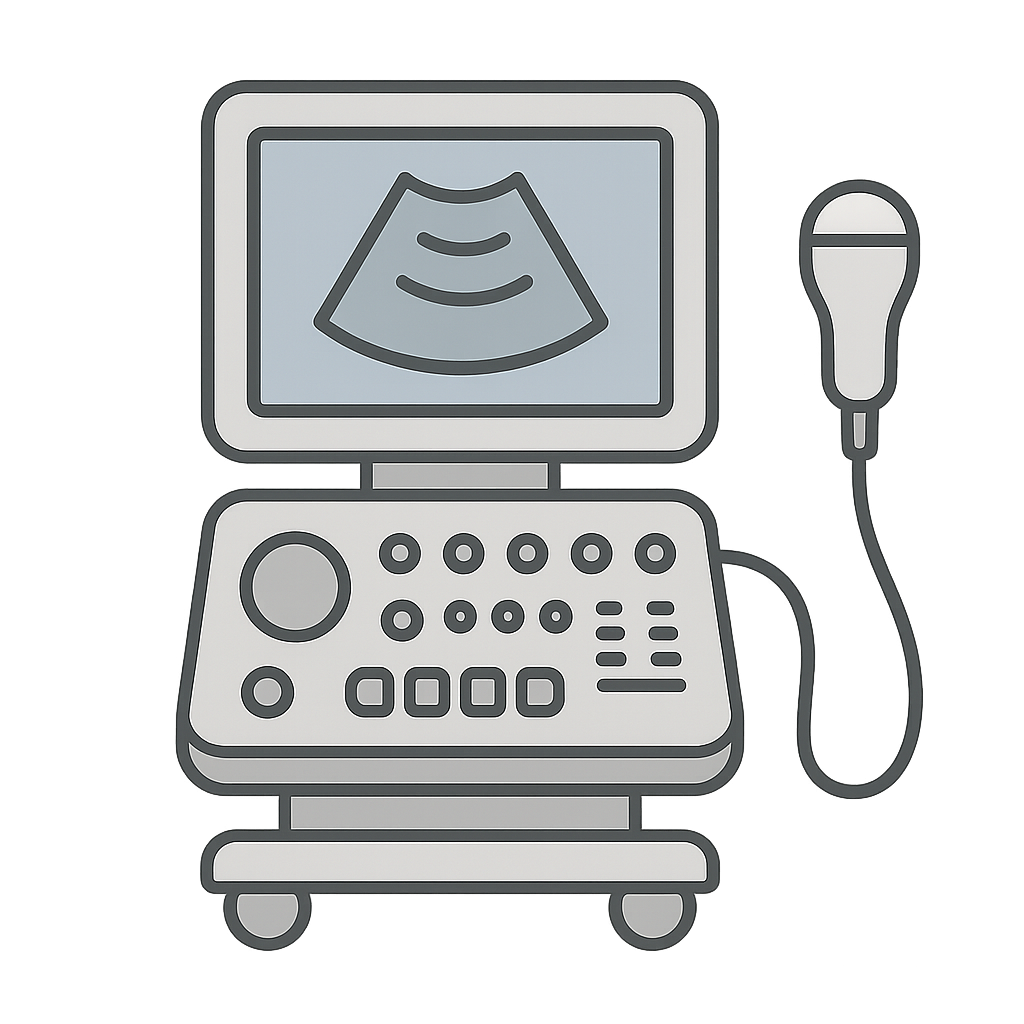
That is where my most famous story begins. I became a window to a new world, the hidden, watery universe where life begins. Imagine a nervous, excited parent in a dimly lit room. A doctor applies a cool, slippery gel, then glides a smooth wand, called a transducer, over the mother's belly. From that wand, I am sent out in silent pulses. I travel through skin and muscle, bouncing off the tiny structures within—a beating heart, a tiny hand, the curve of a spine. I return as a flurry of echoes, which a computer translates into a living, moving picture on a screen. For the first time, parents could see their child waving, kicking, or sucking its thumb long before birth. It was pure magic. This wasn't just about creating a memory; it was a revolution in medicine. With my help, doctors could check if a baby was growing properly, confirm how many babies were expected, and spot potential problems early on, making pregnancy and birth safer than ever before. But my work didn't stop there. I became an essential tool for all kinds of doctors. I could give them a real-time view of a patient’s heart, watching its valves open and close. I could examine kidneys, livers, and gallbladders, helping to diagnose diseases without a single cut. I even became a guide, allowing surgeons to perform delicate procedures like biopsies with incredible precision by showing them exactly where to place their needle. I offered a way to see inside the body that was safe, painless, and free of radiation, a gentle messenger of information and hope.
My journey has been one of constant transformation. I began as a colossal machine tethered to a hospital bed, but today I can be a device that fits in a doctor’s pocket, ready to be used in a remote village or a busy emergency room. The blurry, black-and-white shadows I once made have sharpened into stunningly clear 3D and even 4D images, showing a baby's face in breathtaking detail as they yawn or smile in the womb. From a response to a maritime disaster to a tool of war, and finally to a beacon of life and healing, my evolution has been remarkable. My story is a testament to human curiosity and our relentless desire to understand the world around us and within us. I was born from a simple idea found in nature—listening to echoes—and shaped by necessity and ingenuity. I continue to grow and change, finding new ways to help, to heal, and to reveal the beautiful complexity of life. I am a reminder that sometimes, the most powerful and profound things in this world are those we can neither see nor hear, but can only discover when we learn how to listen in a new way.
Wow facts
About
A medical imaging technique that uses high-frequency sound waves and their echoes to create images of the inside of the body. It is widely known for its use in obstetrics to view developing fetuses.
Take a Quiz
Question 1 of 5
In your own words, summarize the main events of Ultrasound's journey from an idea to a medical tool.
Explore next





Want to do even more?
Go beyond exploring. Unlock tools that turn every story into real learning.

Storypie Plus for families
Full stories, quizzes, and printables. Nights and car rides, sorted.
- Unlimited audio stories
- Create Mode: your child stars in the story
- Offline downloads
- Printable worksheets & coloring pages

Why Storypie for Schools
Students engaged. Prep in seconds. Evenings back to you.
- Worksheets & Quizzes
- Classroom Management
- Formative Assessment
- Custom Curriculum & Lesson Plans
- 27 Languages

Why Storypie for Homeschool
Curriculum done. They'll ask for more. Hours back in your day.
- Worksheet Generator
- First-Person Audio Stories
- Built-in Comprehension Quizzes
- Custom Curriculum & Lesson Plans
- Print & Go Activities