English

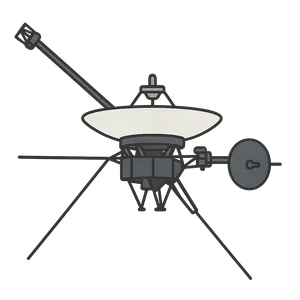
Voyager 1
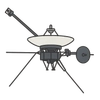
Voyager 1 is a space probe launched by NASA in 1977 to study the outer Solar System and interstellar space.
Reads at Grades 6–8 Listens at Grades 4–8
Print & create
Answer keys·No prep·Free with an account
28 worksheets · answer keys · full story · quiz · Ages 10-12 · CEFR B2
Plus adds 164,000+ more stories in 27 languages, audio for every one, and printables for all of them.
Just want Voyager 1?
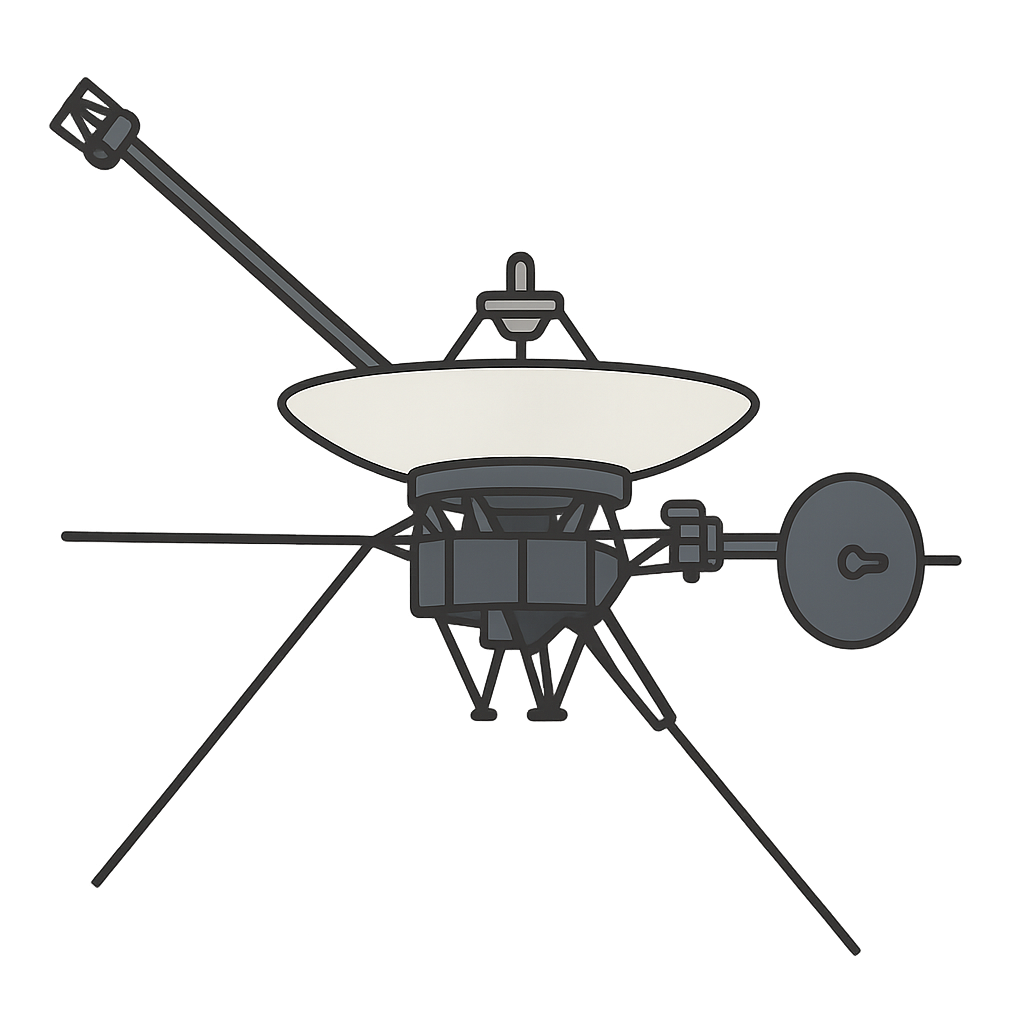
My existence began not with a single spark, but with a dream shared by countless brilliant minds. I am Voyager 1, a traveler, an explorer, a messenger sent from a small blue world. In the 1970s, my creators at NASA, the American space agency, saw a once-in-a-lifetime opportunity. The giant outer planets of our solar system—Jupiter, Saturn, Uranus, and Neptune—were aligning in such a way that a single craft could visit them all using gravity to hop from one to the next. They called it the 'Grand Tour.' It was an ambitious plan, a whisper of a possibility that required immense skill and perfect timing. I was designed for this grand purpose, built with cameras for eyes, sensors for fingers, and an antenna for a voice. My primary mission was to fly by the two largest giants, Jupiter and Saturn, and send back everything I learned. On September 5th, 1977, my moment arrived. I was perched atop a powerful Titan IIIE rocket at a place called Cape Canaveral in Florida. With a thunderous roar that shook the very ground, my journey began, climbing higher and higher until the blue sky turned to black. My twin, Voyager 2, had already left just a few weeks before me, on August 20th, 1977, on a slightly different, longer path. We were partners, two messengers setting off on the greatest journey ever undertaken.
For nearly two years, I sailed through the silent, cold emptiness of space. It was a quiet time, a long wait filled with anticipation as I flew toward my first destination. Then, in the early months of 1979, Jupiter began to grow in my view, from a bright star to a colossal, swirling world of color. As I drew closer in March of 1979, I was mesmerized. The planet was a masterpiece of orange, red, and white clouds, dominated by a furious, swirling storm larger than the entire Earth—the Great Red Spot. My mission was to observe and report, and what I found astonished my creators. I discovered that Jupiter’s moon, Io, was not a dead, icy rock but a world of fire, with active volcanoes spewing sulfur into space. I also spotted a faint, delicate ring of dust circling the planet, a feature no one had ever seen before. After my incredible encounter with Jupiter, I used its immense gravity to slingshot myself toward my next target: Saturn. I arrived in November of 1980, and the sight was more majestic than any drawing could have prepared me for. Its famous rings, which looked like a solid band from Earth, were revealed to be thousands of individual, shimmering ringlets of ice and rock, dancing in a complex cosmic ballet. As I explored these new worlds, I was always aware of the special passenger I carried. Bolted to my side is a golden phonograph record, a time capsule filled with the sights and sounds of my home. It holds greetings in 55 languages, music from different cultures, and 115 images of life on Earth. It is a message in a bottle, cast into the cosmic ocean, a greeting for any intelligent life that might one day find me.
A Messenger to the Stars
My existence began not with a single spark, but with a dream shared by countless brilliant minds. I am Voyager 1, a traveler, an explorer, a messenger sent from a small blue world. In the 1970s, my creators at NASA, the American space agency, saw a once-in-a-lifetime opportunity. The giant outer planets of our solar system—Jupiter, Saturn, Uranus, and Neptune—were aligning in such a way that a single craft could visit them all using gravity to hop from one to the next. They called it the 'Grand Tour.' It was an ambitious plan, a whisper of a possibility that required immense skill and perfect timing. I was designed for this grand purpose, built with cameras for eyes, sensors for fingers, and an antenna for a voice. My primary mission was to fly by the two largest giants, Jupiter and Saturn, and send back everything I learned. On September 5th, 1977, my moment arrived. I was perched atop a powerful Titan IIIE rocket at a place called Cape Canaveral in Florida. With a thunderous roar that shook the very ground, my journey began, climbing higher and higher until the blue sky turned to black. My twin, Voyager 2, had already left just a few weeks before me, on August 20th, 1977, on a slightly different, longer path. We were partners, two messengers setting off on the greatest journey ever undertaken.
For nearly two years, I sailed through the silent, cold emptiness of space. It was a quiet time, a long wait filled with anticipation as I flew toward my first destination. Then, in the early months of 1979, Jupiter began to grow in my view, from a bright star to a colossal, swirling world of color. As I drew closer in March of 1979, I was mesmerized. The planet was a masterpiece of orange, red, and white clouds, dominated by a furious, swirling storm larger than the entire Earth—the Great Red Spot. My mission was to observe and report, and what I found astonished my creators. I discovered that Jupiter’s moon, Io, was not a dead, icy rock but a world of fire, with active volcanoes spewing sulfur into space. I also spotted a faint, delicate ring of dust circling the planet, a feature no one had ever seen before. After my incredible encounter with Jupiter, I used its immense gravity to slingshot myself toward my next target: Saturn. I arrived in November of 1980, and the sight was more majestic than any drawing could have prepared me for. Its famous rings, which looked like a solid band from Earth, were revealed to be thousands of individual, shimmering ringlets of ice and rock, dancing in a complex cosmic ballet. As I explored these new worlds, I was always aware of the special passenger I carried. Bolted to my side is a golden phonograph record, a time capsule filled with the sights and sounds of my home. It holds greetings in 55 languages, music from different cultures, and 115 images of life on Earth. It is a message in a bottle, cast into the cosmic ocean, a greeting for any intelligent life that might one day find me.
My visit to Saturn was a spectacular finale to my planetary tour. With the data I collected, humans learned more about the gas giants in a few short months than they had in all of history. But my journey was far from over. My path was now set to take me away from the sun, on a course that would eventually lead me out of the solar system itself. My planetary mission was complete. Before I traveled too far into the darkness, a thoughtful astronomer named Carl Sagan, who had helped create my Golden Record, had a wonderful idea. He asked my controllers at NASA to turn my cameras around one last time and take a final look back at the worlds I had left behind. On February 14th, 1990, from a staggering distance of nearly 4 billion miles, I aimed my lens toward home. The resulting image was profound. In the vast, dark expense, scattered with light from the sun, my home planet appeared as nothing more than a tiny speck of light, a single, lonely pixel. Carl Sagan called it the 'Pale Blue Dot.' That picture showed humanity something incredibly important. It showed them that their world, with all its triumphs and troubles, its oceans and forests, its art and its love, existed together on that tiny, fragile dot suspended in a sunbeam. It was a humbling perspective, a reminder of how precious and unique our place in the universe truly is.
My journey since that last photograph has been one of increasing distance and solitude, but my work has never stopped. I continue to fly farther and farther into the vast, uncharted territory beyond the planets. On August 25th, 2012, I achieved a monumental milestone. I crossed an invisible boundary called the heliopause, the edge of our sun's influence. At that moment, I officially entered interstellar space—the mysterious expanse between the stars. I became the very first object built by human hands to ever reach this distant realm. Even now, decades after I left and light-hours away from Earth, my connection to my creators remains. My weak radio signal, traveling at the speed of light, still takes more than a day to reach the giant antennas on Earth that listen for my whispers. I send back data about the strange particles and magnetic fields I encounter in this new, unexplored region of the galaxy. I am an ambassador, a pioneer, and a testament to the boundless curiosity of the people who built me. My journey will continue long after my instruments fall silent, drifting through the Milky Way for millions of years. I will carry my Golden Record with me, a silent testament to a small world of thinkers and dreamers, forever representing the hope and wonder of humanity as I sail on into the great, beautiful unknown.
Wow facts
About
Voyager 1 is a space probe launched by NASA in 1977 to study the outer Solar System and interstellar space. It is the most distant human-made object from Earth.
Take a Quiz
Question 1 of 5
What is the main purpose of Voyager 1's journey as described in the story?
Explore next



Want to do even more?
Go beyond exploring. Unlock tools that turn every story into real learning.

Storypie Plus for families
Full stories, quizzes, and printables. Nights and car rides, sorted.
- Unlimited audio stories
- Create Mode: your child stars in the story
- Offline downloads
- Printable worksheets & coloring pages

Why Storypie for Schools
Students engaged. Prep in seconds. Evenings back to you.
- Worksheets & Quizzes
- Classroom Management
- Formative Assessment
- Custom Curriculum & Lesson Plans
- 27 Languages

Why Storypie for Homeschool
Curriculum done. They'll ask for more. Hours back in your day.
- Worksheet Generator
- First-Person Audio Stories
- Built-in Comprehension Quizzes
- Custom Curriculum & Lesson Plans
- Print & Go Activities