English


Dido
Dido was the legendary founder and first queen of the ancient city of Carthage.
Reads at Grades 6–8 Listens at Grades 4–8
Print & create
Answer keys·No prep·Free with an account
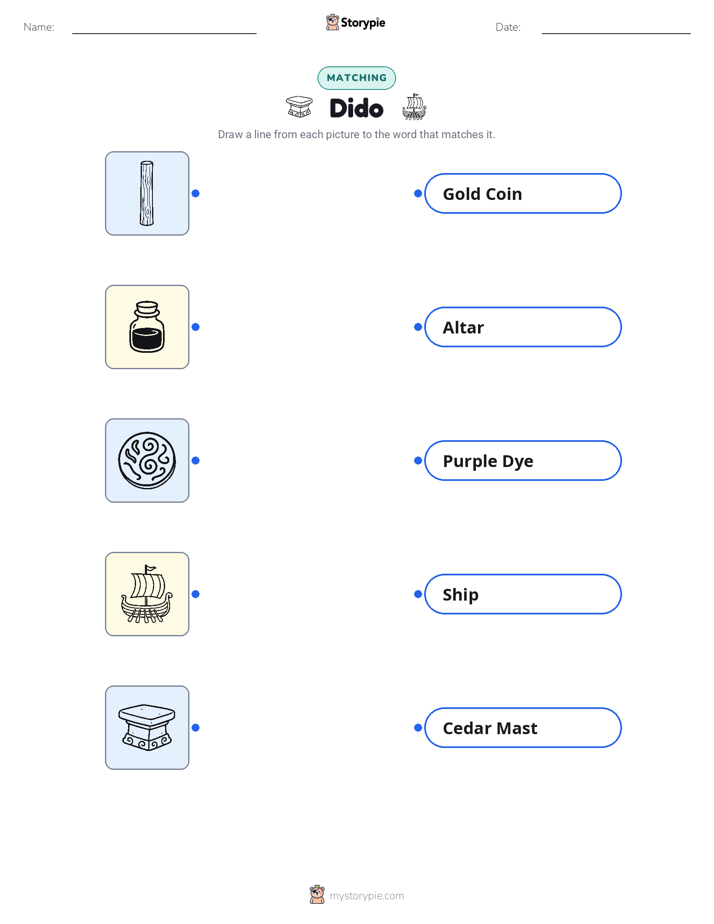
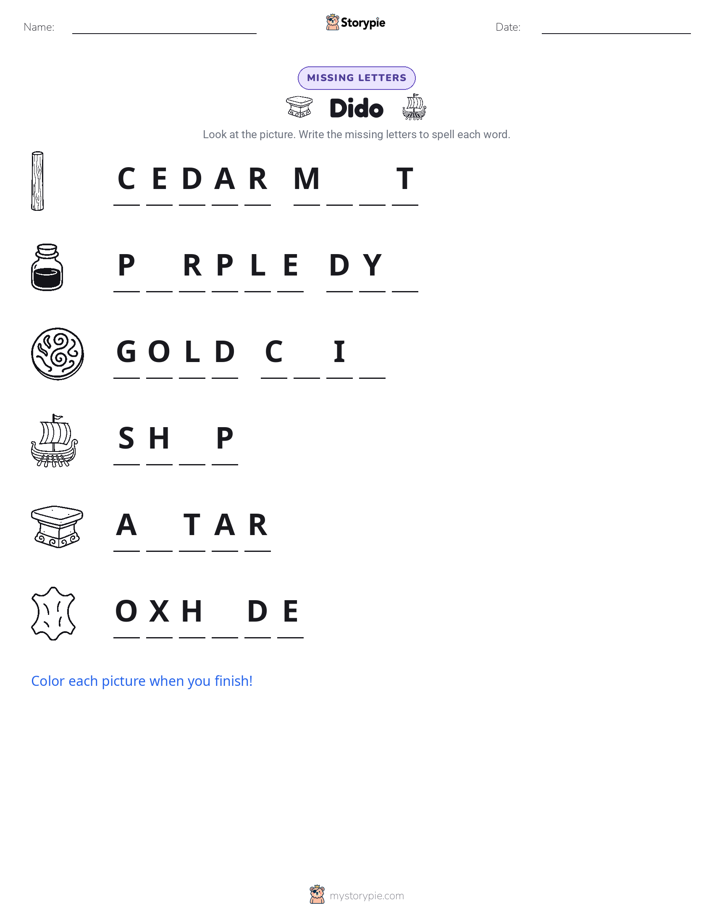
28 worksheets · answer keys · full story · quiz · Ages 10-12 · CEFR B2
Plus adds 208,000+ more stories in 27 languages, audio for every one, and printables for all of them.
Just want Dido?

My story begins not with a crown, but with a hurried escape in the dead of night. My name is Dido, and I was once a princess in the magnificent city of Tyre. Our home was a jewel of the Phoenician coast, a bustling port where towering ships with cedar masts carried our city’s treasures—including our famous Tyrian purple dye, a color so rich it was reserved for royalty—across the Great Sea. My life was filled with joy, shared with my beloved husband, Sychaeus, a man as wise as he was wealthy. But a shadow loomed in our palace, a shadow cast by my own brother, King Pygmalion. His greed was an insatiable hunger, as vast and as deep as the sea itself. One day, Sychaeus vanished. Pygmalion claimed ignorance, but my heart was filled with a cold dread. The truth came to me in a dream, a ghostly whisper in the dark. The spirit of Sychaeus appeared, his form pale and shimmering. He showed me the wound my brother had dealt him in secret, a cruel act driven by a lust for his legendary treasure. "Flee, my love," his voice echoed in my mind. "He will come for you next. Take the gold he so desperately seeks and build a new life far from his grasp." He revealed the hiding place of his immense fortune, buried beneath an old altar. When I woke, I knew what I had to do. I could not stay and be a pawn in my brother’s wicked games. I gathered those loyal to my husband, others who had grown weary of Pygmalion's tyranny, and we planned our exodus. Under the cloak of a moonless night, we unearthed the gold and loaded it onto our fastest ships. This is the beginning of my tale, the myth of Dido, the queen who would found Carthage.
The Founding of Carthage
My story begins not with a crown, but with a hurried escape in the dead of night. My name is Dido, and I was once a princess in the magnificent city of Tyre. Our home was a jewel of the Phoenician coast, a bustling port where towering ships with cedar masts carried our city’s treasures—including our famous Tyrian purple dye, a color so rich it was reserved for royalty—across the Great Sea. My life was filled with joy, shared with my beloved husband, Sychaeus, a man as wise as he was wealthy. But a shadow loomed in our palace, a shadow cast by my own brother, King Pygmalion. His greed was an insatiable hunger, as vast and as deep as the sea itself. One day, Sychaeus vanished. Pygmalion claimed ignorance, but my heart was filled with a cold dread. The truth came to me in a dream, a ghostly whisper in the dark. The spirit of Sychaeus appeared, his form pale and shimmering. He showed me the wound my brother had dealt him in secret, a cruel act driven by a lust for his legendary treasure. "Flee, my love," his voice echoed in my mind. "He will come for you next. Take the gold he so desperately seeks and build a new life far from his grasp." He revealed the hiding place of his immense fortune, buried beneath an old altar. When I woke, I knew what I had to do. I could not stay and be a pawn in my brother’s wicked games. I gathered those loyal to my husband, others who had grown weary of Pygmalion's tyranny, and we planned our exodus. Under the cloak of a moonless night, we unearthed the gold and loaded it onto our fastest ships. This is the beginning of my tale, the myth of Dido, the queen who would found Carthage.
Our voyage across the Mediterranean was a testament to our resolve. We were a small band of refugees, sailing toward an unknown horizon, our past a painful memory and our future a blank map. But with every league the waves carried us from Tyre, hope began to flicker and grow into a steady flame. We finally made landfall on the sun-drenched coast of North Africa, a land of rolling hills and warm breezes. But we were not alone. The local ruler, a powerful king named Iarbas, was wary of our arrival. He saw our ships and our foreign ways and did not trust us. I approached him not as a conqueror, but as a petitioner seeking a safe haven for my people. "We ask only for a small piece of land," I pleaded, "a place to build a home." Iarbas, thinking himself clever, laughed. "I will grant you as much land," he declared with a smirk, "as you can enclose with the hide of a single ox." His court roared with laughter at his cunning offer. They expected me to accept a tiny, useless patch of dust. But I saw an opportunity where they saw a joke. I accepted his terms. I took the oxhide he offered and instructed my most skilled followers to cut it into strips so fine they were like threads of leather. We worked through the night, meticulously slicing and then tying the thousands of thin strips end to end, creating one impossibly long cord. As the sun rose on the 2nd of March, 814 BCE, we took our cord and stretched it around the perimeter of a magnificent, strategic hill that overlooked the sparkling sea. We had enclosed a vast and defensible territory. King Iarbas was stunned into silence, outwitted by a princess he had underestimated. Upon that hill, we laid the first stones of our new home. We called it Carthage, the "New City," and I became its queen, dedicated to building a sanctuary of justice, prosperity, and hope for all who came to our shores.
For years, Carthage flourished under my rule. Our port bustled with trade, our streets were safe, and our people were content. We had transformed a barren hill into a beacon of civilization. Then one day, the sea brought another fleet of refugees to our shores. Their ships were splintered and their sails torn, casualties of a terrible storm. They were the last of the Trojans, led by the valiant hero Aeneas, a man whose shoulders carried the weight of his city’s ashes. He told me of Troy’s fall and his long, arduous journey to find a new homeland for his people, a destiny foretold by the gods. I saw in their weary faces the same desperation I had once felt. I opened my city to them without hesitation. "Carthage will be your home," I promised. "Here you will find safety and rest." As Aeneas and I spent time together, sharing stories of our pasts and dreams for our futures, a deep and powerful love grew between us. It seemed the gods had finally granted me peace. I imagined Aeneas ruling by my side, our two peoples uniting to build an empire of unparalleled greatness. But the gods are fickle. Jupiter, the king of the gods, had not forgotten Aeneas's true destiny. He sent Mercury, the winged messenger, to deliver a stark reminder. "You cannot linger here in comfort, Aeneas," Mercury commanded, his voice like thunder. "Your fate lies in Italy. You must sail on and found the city that will one day rule the world: Rome." Aeneas was shattered. He was caught in an impossible conflict between his love for me and his sacred duty to the gods and his people. Though his heart was breaking, he knew he could not defy a divine command. He began to prepare his ships for departure, trying to hide his intentions from me.
The discovery of his secret preparations felt like a betrayal colder than any winter sea. I confronted Aeneas, my voice choked with grief and anger. "Is this how you repay my kindness? By sneaking away like a thief in the night?" He could not meet my eyes, speaking of destiny and the will of the gods, words that sounded like hollow excuses for a broken promise. His departure left a void in my heart that nothing could fill. My story in the myth ends there, in overwhelming sorrow, a tragic choice born of a broken heart. But my story did not truly end. Nearly eight centuries later, a great Roman poet named Virgil decided to retell my tale. In his epic poem, 'The Aeneid,' written around the 28th of November, 19 BCE, he wove my love and loss into the founding story of Rome. He used our tragic romance to create a powerful, legendary explanation for the very real and bitter rivalry that later erupted between our two great cities, Carthage and Rome. So while the poem ends with my tragedy, my true legacy is not as a heartbroken victim. I am Dido, the refugee princess who outsmarted a king, the leader who built one of the most magnificent cities of the ancient world from nothing but courage and a clever idea. My story continues to inspire operas, art, and literature, a timeless reminder that even in loss, a legacy of strength and ingenuity can endure, and that the greatest empires can rise from a single, determined dream.
Wow facts
About
Dido was the legendary founder and first queen of the ancient city of Carthage. She is celebrated in Greco-Roman mythology for her cleverness in acquiring land and as a tragic heroine in Virgil's epic poem, the Aeneid.
Take a Quiz
Question 1 of 5
Describe Dido's character using evidence from the story. What traits made her a successful founder of Carthage?
Explore next





Want to do even more?
Go beyond exploring. Unlock tools that turn every story into real learning.

Storypie Plus for families
Full stories, quizzes, and printables. Nights and car rides, sorted.
- Unlimited audio stories
- Create Mode: your child stars in the story
- Offline downloads
- Printable worksheets & coloring pages

Why Storypie for Schools
Students engaged. Prep in seconds. Evenings back to you.
- Worksheets & Quizzes
- Classroom Management
- Formative Assessment
- Custom Curriculum & Lesson Plans
- 27 Languages

Why Storypie for Homeschool
Curriculum done. They'll ask for more. Hours back in your day.
- Worksheet Generator
- First-Person Audio Stories
- Built-in Comprehension Quizzes
- Custom Curriculum & Lesson Plans
- Print & Go Activities