English


Shamash
Shamash is the ancient Mesopotamian god of the sun, justice, truth, and morality.
Reads at Grades 6–8 Listens at Grades 4–8
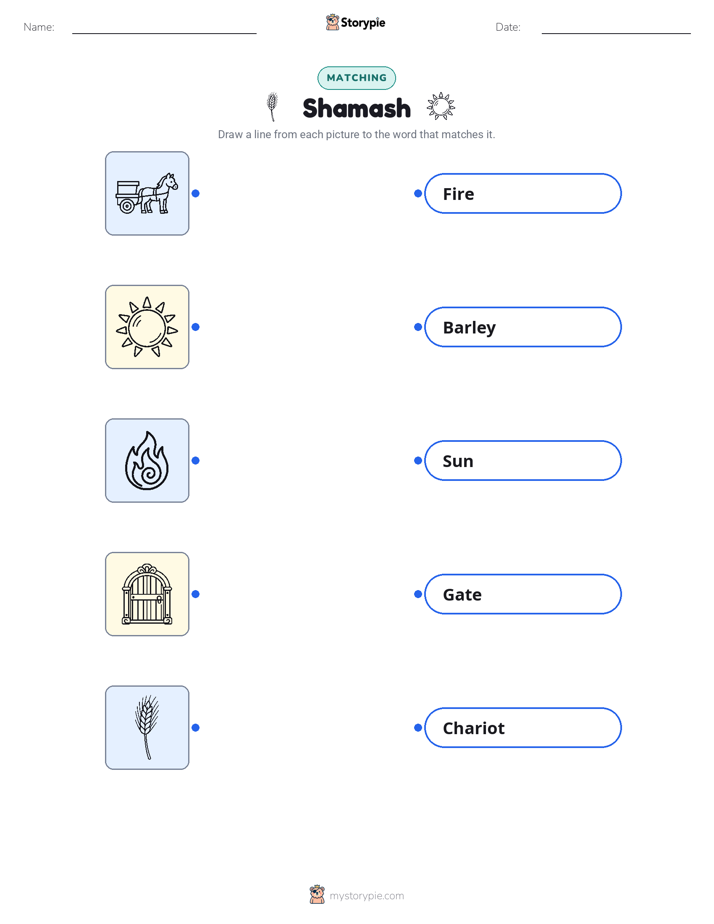
Print & create
Answer keys·No prep·Free with an account
28 worksheets · answer keys · full story · quiz · Ages 10-12 · CEFR B2
Plus adds 208,000+ more stories in 27 languages, audio for every one, and printables for all of them.
Just want Shamash?

My journey begins before the world awakens, in the profound, quiet darkness that blankets the land between two rivers. You can feel my approach in the cool air just before sunrise, a silent promise of warmth and clarity that stirs the sleeping world. I am the one who pushes back the velvet curtain of night, who unlocks the great gates of the east and rides a chariot of pure fire across the vastness of the sky. This is the story of Shamash, the God of Sun and Justice. For thousands of years, the people of Mesopotamia looked to me not just as the sun, but as the unwavering eye of justice itself. From my celestial path, I have watched civilizations sprout like the barley in their fields and, in time, return to the dust. I saw the first sun-baked bricks laid for the great ziggurats in my sacred cities of Sippar and Larsa, temples built like mountains of men, each step reaching toward my life-giving light. Below me, the rhythm of human life was a dance choreographed by my daily passage. Farmers, their faces turned to the east, would greet my first rays with hope, ready to tend the fields of wheat and date palms that flourished under my care. In the bustling marketplaces of Babylon and Ur, merchants would haggle and trade, their voices a vibrant chorus under my watchful gaze, trusting that my light revealed the true quality of their wares. Children’s laughter would echo through the dusty streets, their shadows stretching and shrinking in a playful dance as I journeyed from horizon to horizon. In the earliest days, the Sumerians called me Utu. As empires shifted and the Akkadian tongue spread like floodwater over the plains, I became known as Shamash. Though my name changed, my purpose remained as constant as my own rising. I was more than a celestial body; I was the divine judge who saw everything, the revealer of truths hidden in the deepest shadows. My light was not just for seeing, but for understanding.
The Myth of Shamash, the Sun God of Justice
My journey begins before the world awakens, in the profound, quiet darkness that blankets the land between two rivers. You can feel my approach in the cool air just before sunrise, a silent promise of warmth and clarity that stirs the sleeping world. I am the one who pushes back the velvet curtain of night, who unlocks the great gates of the east and rides a chariot of pure fire across the vastness of the sky. This is the story of Shamash, the God of Sun and Justice. For thousands of years, the people of Mesopotamia looked to me not just as the sun, but as the unwavering eye of justice itself. From my celestial path, I have watched civilizations sprout like the barley in their fields and, in time, return to the dust. I saw the first sun-baked bricks laid for the great ziggurats in my sacred cities of Sippar and Larsa, temples built like mountains of men, each step reaching toward my life-giving light. Below me, the rhythm of human life was a dance choreographed by my daily passage. Farmers, their faces turned to the east, would greet my first rays with hope, ready to tend the fields of wheat and date palms that flourished under my care. In the bustling marketplaces of Babylon and Ur, merchants would haggle and trade, their voices a vibrant chorus under my watchful gaze, trusting that my light revealed the true quality of their wares. Children’s laughter would echo through the dusty streets, their shadows stretching and shrinking in a playful dance as I journeyed from horizon to horizon. In the earliest days, the Sumerians called me Utu. As empires shifted and the Akkadian tongue spread like floodwater over the plains, I became known as Shamash. Though my name changed, my purpose remained as constant as my own rising. I was more than a celestial body; I was the divine judge who saw everything, the revealer of truths hidden in the deepest shadows. My light was not just for seeing, but for understanding.
As my chariot blazed across the heavens, I saw more than just the surface of the world. My light pierced the darkness of hidden places and the secrecy of human hearts. I saw acts of kindness and moments of courage, but I also saw dishonesty, cruelty, and unfairness. I heard the pleas of the wronged, the cries of the orphan, and the arrogant boasts of the deceitful. It was my sacred duty to ensure that truth prevailed, so I became the patron of justice. Kings and judges would call upon my name, praying for the wisdom to see a matter clearly, just as I illuminate the world. One of the greatest of these kings, Hammurabi of Babylon, understood my role more deeply than any other. He yearned to create a kingdom that was not ruled by the shifting whims of the powerful, but by principles as constant and reliable as my daily rising. 'Oh, Shamash,' he prayed, 'grant me the vision to establish a justice that endures.'. I heard his plea and was moved by his ambition. I inspired him to gather all the laws of his land—the ancient customs and the new decrees—and to carve them onto a great pillar of black diorite, a stele, for all his people to see. At the very top of this stone, his artist carved my image. There I sat, enthroned, handing him the rod and ring, symbols of divine authority and justice. This wasn't just a sculpture; it was a powerful statement that justice comes from a divine, unchanging source, not from the fleeting moods of a ruler. The Code of Hammurabi, created around the 18th century BCE, became a beacon in the ancient world. Its 282 laws covered everything from family matters to business disputes, ensuring that everyone, from the richest noble to the poorest farmer, knew their rights and responsibilities. My light represented the clarity of these laws—there were no secrets, no hidden rules that could be used to trick the unwary. 'An eye for an eye,' the code declared, a stark but clear principle of balanced retribution. But my role extended beyond human courts. I was also a key figure in the great tales of heroes. When the mighty Gilgamesh, the restless king of Uruk, and his wild-hearted friend Enkidu set out on their perilous quest to face the fearsome forest guardian, Humbaba, it was I they called upon for aid. Their quest was a just one—to rid the world of a great evil and bring back precious cedar wood for their city. I lent them my strength. 'I will send great winds to aid you!'. I promised, and my power buffeted Humbaba, blinding the monster and giving the heroes their chance. Through these acts, people understood that my light was not passive; it was an active force for good, a power that could be called upon in the fight for what is right.
A Light That Never Fades
Empires, no matter how great, eventually turn to dust. The ziggurats of Sippar and Larsa crumbled, their bricks dissolving back into the earth. The cuneiform tablets bearing my hymns were buried beneath layers of sand, and the mighty kingdom of Babylon, with its hanging gardens and towering walls, faded into history. But my light, and the ideal it stood for, could not be buried. The sun, of course, continued its journey across the sky each day, a constant, silent reminder of the eternal cycles of life, death, and rebirth. More importantly, the idea I championed—that justice should be clear, consistent, and available to all—traveled far beyond the banks of the Tigris and Euphrates. The concept of a written code of laws, a single standard of justice that holds everyone accountable, became one of Mesopotamia's greatest gifts to the world. It influenced the legal systems of countless cultures that followed, shaping how societies define fairness to this very day. When you see a symbol of justice today—perhaps the scales that carefully balance truth or the judge's gavel that calls for order and attention—you are seeing an echo of my ancient role. My story lives on not in stone temples or forgotten texts, but in the human heart's unending desire for fairness and truth. It continues in every person who stands up for what is right, in every law written to protect the vulnerable, and in every effort to bring clarity to a confusing world. So, the next time you feel the sun's warmth on your face, remember me. Remember Shamash, who taught the world that the greatest light is not the one that simply lets us see, but the one that helps us understand.
Wow facts
About
Shamash is the ancient Mesopotamian god of the sun, justice, truth, and morality. He was one of the most important deities in the Akkadian, Babylonian, and Assyrian pantheons.
Take a Quiz
Question 1 of 5
Based on the story, what two main roles did Shamash have in Mesopotamian culture?
Explore next





Want to do even more?
Go beyond exploring. Unlock tools that turn every story into real learning.

Storypie Plus for families
Full stories, quizzes, and printables. Nights and car rides, sorted.
- Unlimited audio stories
- Create Mode: your child stars in the story
- Offline downloads
- Printable worksheets & coloring pages

Why Storypie for Schools
Students engaged. Prep in seconds. Evenings back to you.
- Worksheets & Quizzes
- Classroom Management
- Formative Assessment
- Custom Curriculum & Lesson Plans
- 27 Languages

Why Storypie for Homeschool
Curriculum done. They'll ask for more. Hours back in your day.
- Worksheet Generator
- First-Person Audio Stories
- Built-in Comprehension Quizzes
- Custom Curriculum & Lesson Plans
- Print & Go Activities