English

The Fox and the Crow - French
A classic fable, famously retold by Jean de La Fontaine…
Reads at Grades 6–8 Listens at Grades 4–8
Print & create
Answer keys·No prep·Free with an account
28 worksheets · answer keys · full story · quiz · Ages 10-12 · CEFR B2
Plus adds 164,000+ more stories in 27 languages, audio for every one, and printables for all of them.
Just want The Fox and the Crow - French?
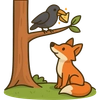
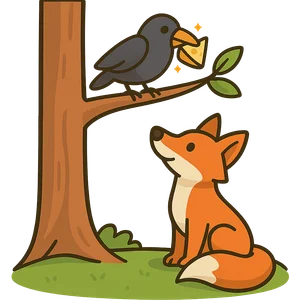
They call me Maître Renard, and in these woods, a reputation for cleverness is more valuable than sharp claws or a strong jaw. On a crisp autumn afternoon, when the leaves were a carpet of gold and crimson, I was trotting along, my mind on my rumbling stomach, when a magnificent scent stopped me in my tracks. It was pungent, creamy, and utterly irresistible. My nose led my eyes upward to the highest branch of a grand oak tree, and there he was: Maître Corbeau, the Crow, looking as proud and somber as a judge. And in his beak, he held the source of that glorious smell—a perfect, round wheel of cheese, stolen, no doubt, from a nearby farmhouse. I could almost taste its sharp, rich flavor from the forest floor. This was the famous fable of The Fox and the Crow, and I was about to play my part. The problem was clear: my prize was far beyond my physical reach, held by a bird too vain to simply be asked and too wary to be easily startled. My mind, therefore, began to churn. How could I convince him to give up his treasure without ever laying a paw on him.
Brute force was out of the question. A fox cannot fly, nor can he fell an oak with a glare. My only weapon was my wit, and my ammunition would be words, carefully chosen and aimed directly at my target's greatest weakness. I ambled to the base of the tree, sat back on my haunches, and looked up with an expression of pure admiration. “Good day, Maître Corbeau.” I called, my voice smooth as honey. “My, what a splendid sight you are today. In all my travels through these woods, I have never seen a bird with such lustrous, jet-black feathers. They shine like polished ebony in the sun.” The Crow, who had been ignoring me, shifted his weight and puffed out his chest. His little black eyes gleamed with self-satisfaction. He was listening. I continued, layering the praise on thickly. “Your form is so elegant, your posture so noble. You are without a doubt the king of all birds in this forest.” He ruffled his feathers, immensely pleased. Now, for the final, decisive strike. “I have been thinking,” I said thoughtfully, “that a creature so physically perfect must surely possess a voice to match. Your song must be more melodious than the nightingale's. Would you do me the great honor of letting me hear but a single note.” The internal conflict was visible on his face. He desperately wanted to keep his cheese, but the desire to prove his vocal magnificence was overwhelming. Vanity won. He tilted his head back, took a deep breath, and opened his great black beak to let out a tremendous “CAW.”. And just as I had calculated, the beautiful wheel of cheese tumbled down, end over end, landing softly in the leaves right at my paws.
The Fox and the Crow
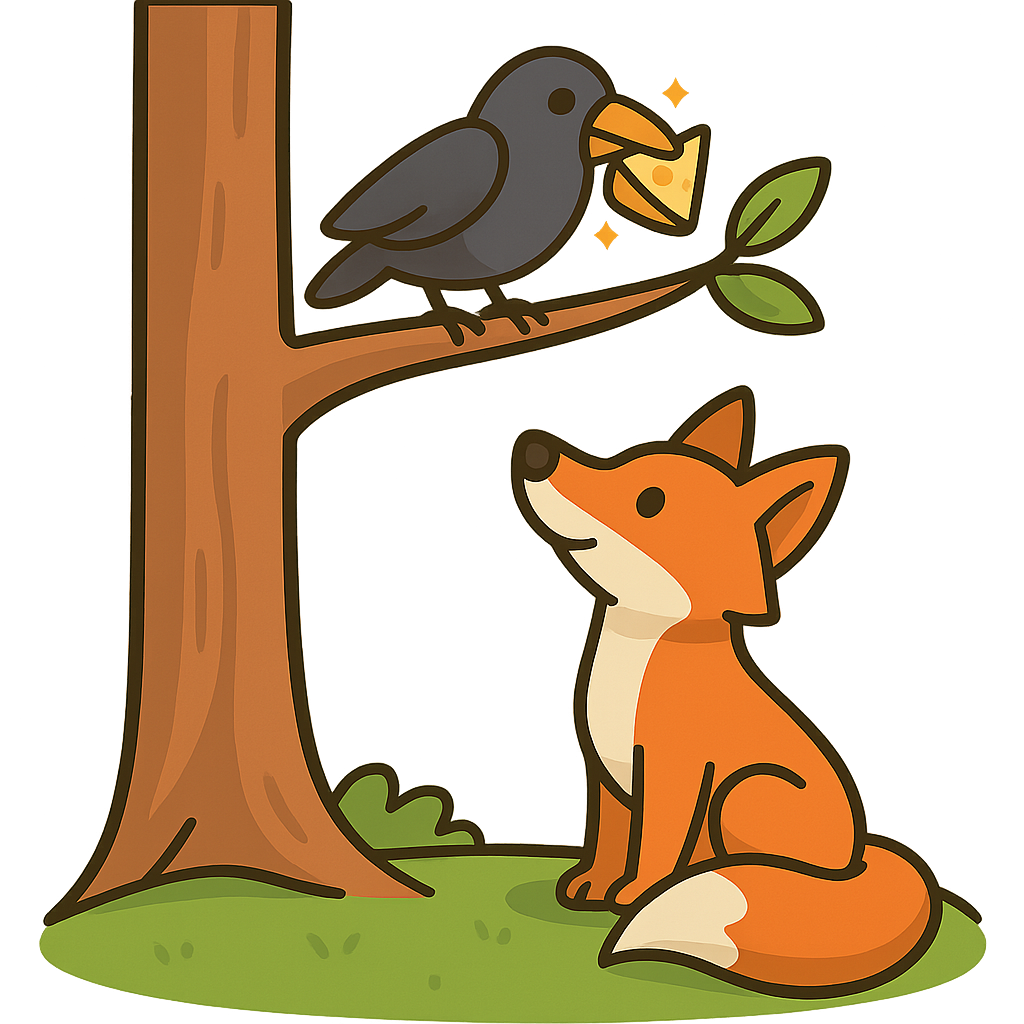
They call me Maître Renard, and in these woods, a reputation for cleverness is more valuable than sharp claws or a strong jaw. On a crisp autumn afternoon, when the leaves were a carpet of gold and crimson, I was trotting along, my mind on my rumbling stomach, when a magnificent scent stopped me in my tracks. It was pungent, creamy, and utterly irresistible. My nose led my eyes upward to the highest branch of a grand oak tree, and there he was: Maître Corbeau, the Crow, looking as proud and somber as a judge. And in his beak, he held the source of that glorious smell—a perfect, round wheel of cheese, stolen, no doubt, from a nearby farmhouse. I could almost taste its sharp, rich flavor from the forest floor. This was the famous fable of The Fox and the Crow, and I was about to play my part. The problem was clear: my prize was far beyond my physical reach, held by a bird too vain to simply be asked and too wary to be easily startled. My mind, therefore, began to churn. How could I convince him to give up his treasure without ever laying a paw on him.
Brute force was out of the question. A fox cannot fly, nor can he fell an oak with a glare. My only weapon was my wit, and my ammunition would be words, carefully chosen and aimed directly at my target's greatest weakness. I ambled to the base of the tree, sat back on my haunches, and looked up with an expression of pure admiration. “Good day, Maître Corbeau.” I called, my voice smooth as honey. “My, what a splendid sight you are today. In all my travels through these woods, I have never seen a bird with such lustrous, jet-black feathers. They shine like polished ebony in the sun.” The Crow, who had been ignoring me, shifted his weight and puffed out his chest. His little black eyes gleamed with self-satisfaction. He was listening. I continued, layering the praise on thickly. “Your form is so elegant, your posture so noble. You are without a doubt the king of all birds in this forest.” He ruffled his feathers, immensely pleased. Now, for the final, decisive strike. “I have been thinking,” I said thoughtfully, “that a creature so physically perfect must surely possess a voice to match. Your song must be more melodious than the nightingale's. Would you do me the great honor of letting me hear but a single note.” The internal conflict was visible on his face. He desperately wanted to keep his cheese, but the desire to prove his vocal magnificence was overwhelming. Vanity won. He tilted his head back, took a deep breath, and opened his great black beak to let out a tremendous “CAW.”. And just as I had calculated, the beautiful wheel of cheese tumbled down, end over end, landing softly in the leaves right at my paws.
I snatched the prize before it could roll away and took a triumphant bite. The flavor was even better than I had imagined. Looking up at the stunned and silent Crow, I delivered the lesson he had so painfully earned. “Maître Corbeau,” I said, my mouth full of cheese, “Learn that every flatterer lives at the expense of the one who listens.” He could only stare, a foolish figure of wounded pride. But you should know, this little drama was not my own invention. This story is ancient, first told by a wise Greek storyteller named Aesop thousands of years ago to teach a simple truth about human nature. My own version of this encounter became famous much later, thanks to a brilliant 17th-century French poet. On March 31st, 1668, Jean de La Fontaine published this tale in a collection of fables that became a treasure of French culture, read by schoolchildren for centuries to come. That simple fable, a brief moment between a hungry fox and a vain crow, became a timeless tool for teaching wisdom. It reminds us all to look past empty praise and to value genuine substance over superficial appearances. And so, a simple moment in a forest continues to teach a lesson that is as fresh today as it was in ancient Greece: be careful whose words you believe, especially when they are telling you exactly what you want to hear.
Wow facts
About
A classic fable, famously retold by Jean de La Fontaine, in which a cunning fox uses flattery to trick a vain crow into dropping its piece of cheese.
Take a Quiz
Question 1 of 5
What was the Crow's biggest weakness that the Fox exploited?
Explore next




Want to do even more?
Go beyond exploring. Unlock tools that turn every story into real learning.

Storypie Plus for families
Full stories, quizzes, and printables. Nights and car rides, sorted.
- Unlimited audio stories
- Create Mode: your child stars in the story
- Offline downloads
- Printable worksheets & coloring pages

Why Storypie for Schools
Students engaged. Prep in seconds. Evenings back to you.
- Worksheets & Quizzes
- Classroom Management
- Formative Assessment
- Custom Curriculum & Lesson Plans
- 27 Languages

Why Storypie for Homeschool
Curriculum done. They'll ask for more. Hours back in your day.
- Worksheet Generator
- First-Person Audio Stories
- Built-in Comprehension Quizzes
- Custom Curriculum & Lesson Plans
- Print & Go Activities