English

International Red Cross and Red Crescent Movement
A global humanitarian network that provides protection and assistance to people affected by armed conflict…
Reads at Grades 3–5 Listens at Grades 1–5
Print & create
Answer keys·No prep·Free with an account
28 worksheets · answer keys · full story · quiz · Ages 8-10 · CEFR B1
Plus adds 116,000+ more stories in 27 languages, audio for every one, and printables for all of them.
Just want International Red Cross and Red Crescent Movement?
Hello. We are the International Red Cross and Red Crescent Movement. Our story is one of helping people, and it begins not in a peaceful meeting room, but on a field of battle. In 1859, a Swiss man named Henry Dunant was traveling in Italy when he came upon the aftermath of a terrible fight called the Battle of Solferino. He saw thousands of soldiers who were wounded and suffering, with no one to care for them. What he witnessed that day gave him a powerful idea: what if there were groups of trained volunteers in every country, ready to help the wounded during a war, no matter which side they were on? This idea was the seed that grew into our movement. A few years later, in 1863, a group of people met in Geneva, Switzerland, and founded an organization called the International Committee for the Relief of the Wounded. That was the very beginning of who we are today.
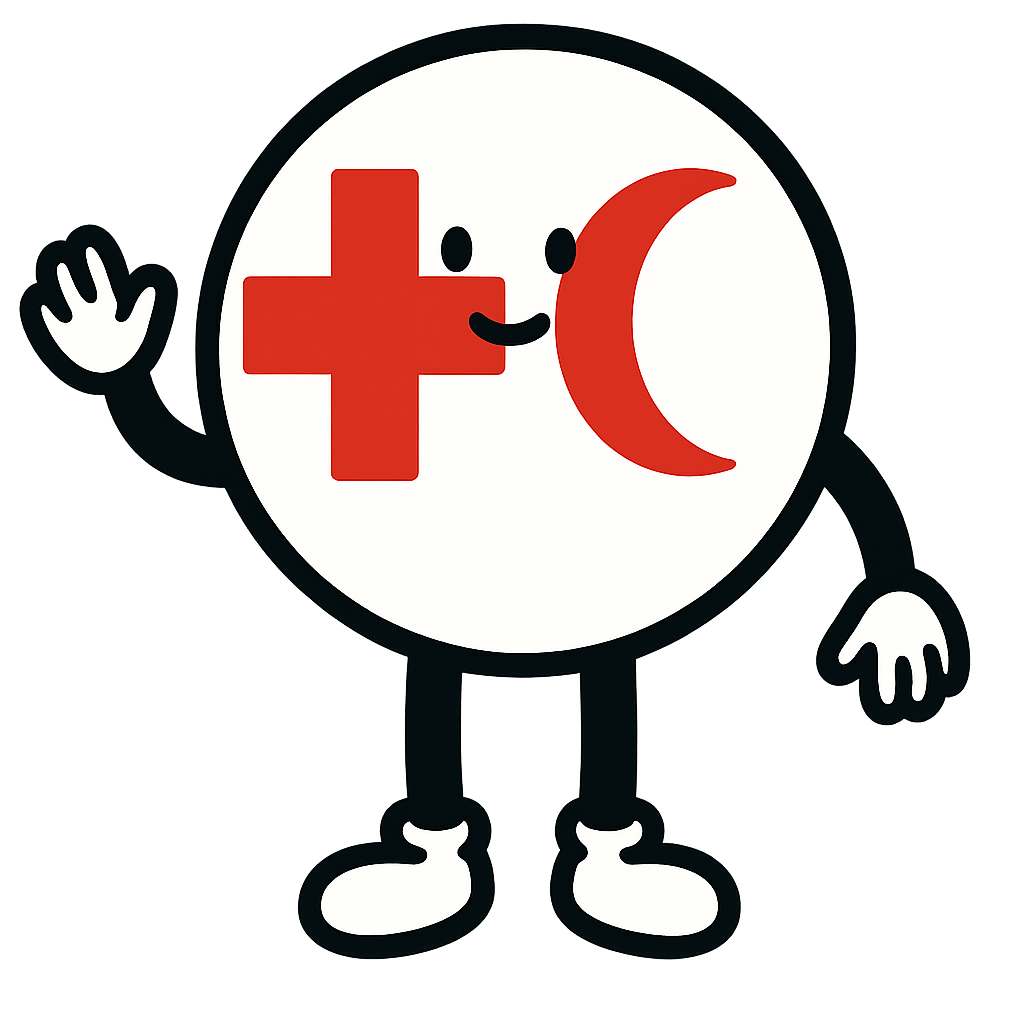
From the start, we knew our volunteers needed a way to show that they were not there to fight, but only to help. They needed a special symbol that everyone would recognize and respect. We chose a simple, powerful emblem: a red cross on a pure white background. This design was chosen because it is the reverse of the flag of Switzerland, the country where our movement was born. Later, another symbol was added to be used in many Muslim-majority countries: a red crescent, also on a white background. When you see these symbols, you know that the people wearing them are guided by very important rules, which we call our Fundamental Principles. Three of our most important principles are Humanity, which means we must care for all people; Impartiality, which means we help anyone who is suffering, no matter their nationality, race, or beliefs; and Neutrality, which means we do not take sides in any conflict. These symbols and principles are our guiding stars.
A Story of Help: The International Red Cross and Red Crescent Movement
Hello. We are the International Red Cross and Red Crescent Movement. Our story is one of helping people, and it begins not in a peaceful meeting room, but on a field of battle. In 1859, a Swiss man named Henry Dunant was traveling in Italy when he came upon the aftermath of a terrible fight called the Battle of Solferino. He saw thousands of soldiers who were wounded and suffering, with no one to care for them. What he witnessed that day gave him a powerful idea: what if there were groups of trained volunteers in every country, ready to help the wounded during a war, no matter which side they were on? This idea was the seed that grew into our movement. A few years later, in 1863, a group of people met in Geneva, Switzerland, and founded an organization called the International Committee for the Relief of the Wounded. That was the very beginning of who we are today.
From the start, we knew our volunteers needed a way to show that they were not there to fight, but only to help. They needed a special symbol that everyone would recognize and respect. We chose a simple, powerful emblem: a red cross on a pure white background. This design was chosen because it is the reverse of the flag of Switzerland, the country where our movement was born. Later, another symbol was added to be used in many Muslim-majority countries: a red crescent, also on a white background. When you see these symbols, you know that the people wearing them are guided by very important rules, which we call our Fundamental Principles. Three of our most important principles are Humanity, which means we must care for all people; Impartiality, which means we help anyone who is suffering, no matter their nationality, race, or beliefs; and Neutrality, which means we do not take sides in any conflict. These symbols and principles are our guiding stars.
Henry Dunant's idea was so inspiring that it quickly spread far beyond Switzerland. Soon, leaders and citizens in countries all over the world wanted to form their own volunteer aid groups. These groups are called National Societies, and they became the foundation of our work in local communities everywhere. Over time, we grew into a large, global family—a worldwide movement with three main parts that work together. The first part is the International Committee of the Red Cross, or ICRC. It continues our original mission of helping people affected by war and armed conflict. The second part is the International Federation of Red Cross and Red Crescent Societies, or IFRC. Its main job is to coordinate help when big natural disasters strike, like earthquakes, hurricanes, and floods. The third part is the many National Societies themselves. Today, there is a National Society in nearly every country, each one working to help people with their own specific community needs.
Throughout history, we have been present during some of the world's most difficult moments. During huge conflicts like World War I and World War II, our volunteers and staff worked tirelessly. They went onto the battlefields to provide critical medical care to wounded soldiers from all sides. But our work went beyond just medicine. We also took on the important job of visiting prisoners of war. Our teams would check on their living conditions and make sure they were being treated humanely. One of our most valued services was helping families stay in touch. In a time before email or instant messages, letters were everything. We delivered millions of letters and parcels between soldiers and their families back home, carrying messages of hope and love across enemy lines. This work helped keep families connected during the darkest of times.
Today, our world has changed, and so has our work. While we still provide aid in conflict zones, our mission has grown much wider. We are now among the first to respond when natural disasters happen anywhere in the world. We help people who have lost their homes and everything they own in devastating floods, powerful hurricanes, or destructive wildfires. At the same time, our National Societies are busy every single day in their local communities. They run vital services like blood donation centers, which save countless lives. They also teach valuable skills, such as first aid classes that empower ordinary people to help in an emergency. They organize programs to support the elderly and other vulnerable people who may need extra help. Our work may look different than it did in 1863, but our main goal has never changed: to prevent and relieve human suffering, wherever we may find it.
Wow facts
About
A global humanitarian network that provides protection and assistance to people affected by armed conflict, disasters, and other emergencies.
Take a Quiz
Question 1 of 5
What event inspired Henry Dunant to call for the creation of volunteer aid groups?
Explore next



Want to do even more?
Go beyond exploring. Unlock tools that turn every story into real learning.

Storypie Plus for families
Full stories, quizzes, and printables. Nights and car rides, sorted.
- Unlimited audio stories
- Create Mode: your child stars in the story
- Offline downloads
- Printable worksheets & coloring pages

Why Storypie for Schools
Students engaged. Prep in seconds. Evenings back to you.
- Worksheets & Quizzes
- Classroom Management
- Formative Assessment
- Custom Curriculum & Lesson Plans
- 27 Languages

Why Storypie for Homeschool
Curriculum done. They'll ask for more. Hours back in your day.
- Worksheet Generator
- First-Person Audio Stories
- Built-in Comprehension Quizzes
- Custom Curriculum & Lesson Plans
- Print & Go Activities