English

Indian Space Research Organisation
The national space agency of the Republic of India, responsible for space-based applications…
Reads at Grades 3–5 Listens at Grades 1–5
Print & create
Answer keys·No prep·Free with an account
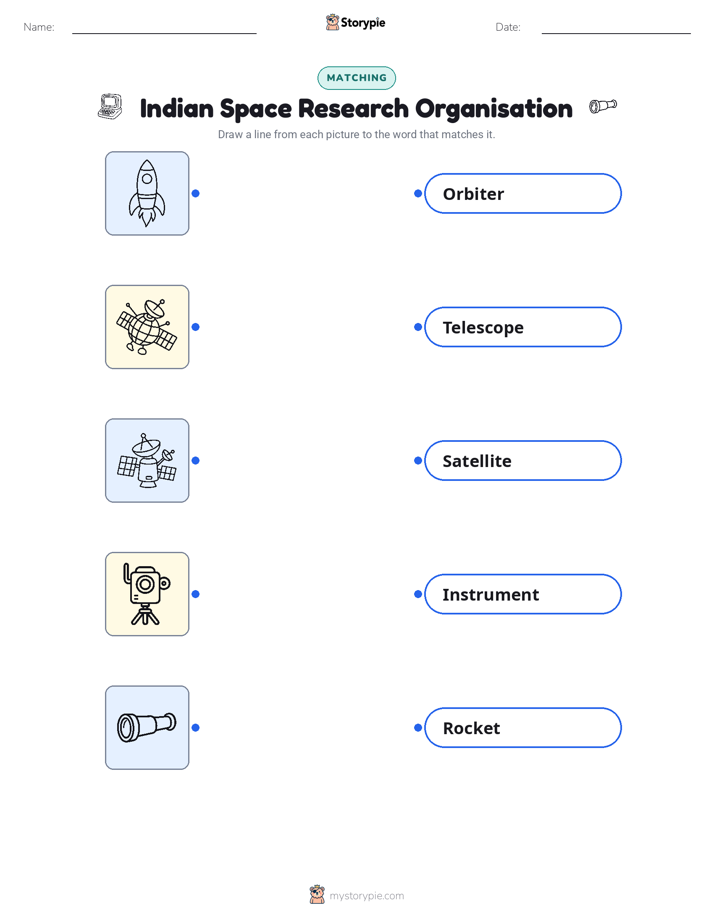
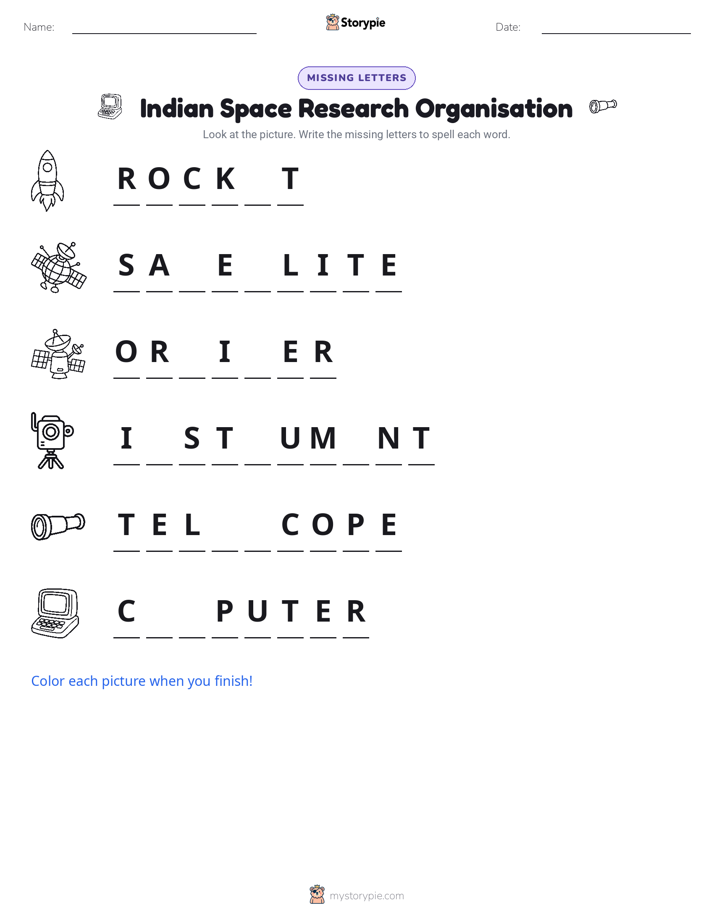
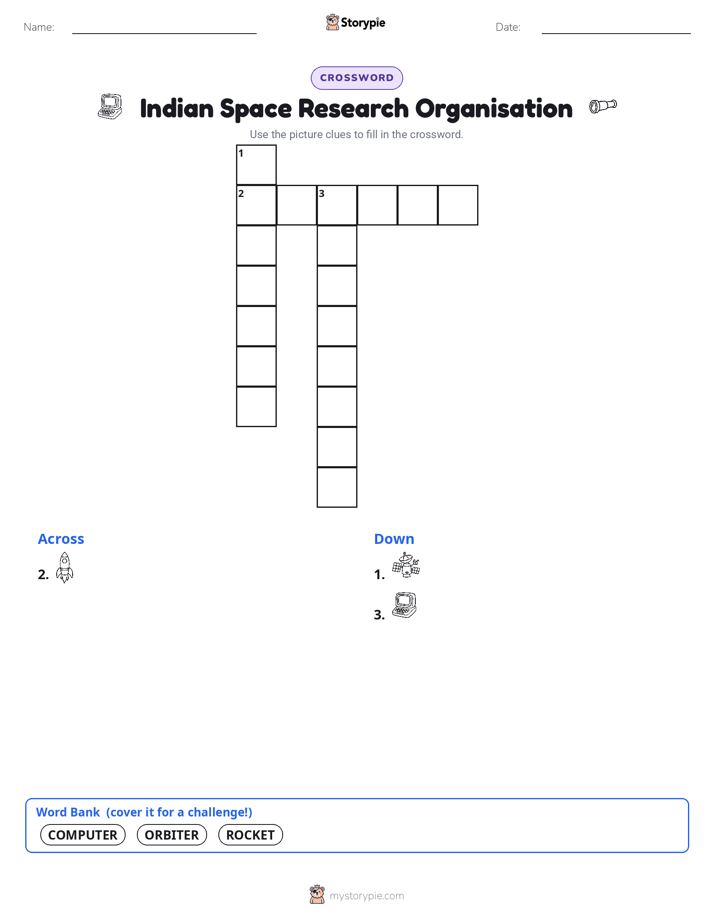
28 worksheets · answer keys · full story · quiz · Ages 8-10 · CEFR B1
Plus adds 164,000+ more stories in 27 languages, audio for every one, and printables for all of them.
Just want Indian Space Research Organisation?
Hello! We are the Indian Space Research Organisation, but most people know us by our initials, ISRO. As India’s national space agency, we have a very special job. Our main purpose isn’t just to explore the stars, but to use space technology to help people all across our country. Think about how important it is for a farmer to know when to plant their crops, or for a family to know if a big storm is coming. We launch and manage satellites that can look down at the Earth and provide that kind of vital information. From helping with weather forecasts to making sure people can communicate over long distances, our work in space has a real impact on daily life here on the ground.
Our story officially began on August 15th, 1969, the day we were formed. But the dream that created us started even earlier. Back in 1962, a group of scientists formed an organization called the Indian National Committee for Space Research, or INCOSPAR. It was led by a visionary scientist named Vikram Sarabhai. He believed that India could achieve great things in space. His dream was unique because he wasn't focused on competing with other nations. Instead, he wanted to use the power of space science to solve the problems that people faced right here on Earth. This guiding idea has been at the heart of our mission ever since.
In our early years, we had to learn how to take our first steps into space. Our first major project was launching a satellite. In 1975, we successfully sent our very first satellite, named Aryabhata, into orbit. For this launch, we worked with the Soviet Union, which provided the powerful rocket needed to carry Aryabhata into space. This was a huge moment for us, but our next goal was to become self-reliant. We wanted to be able to launch our own satellites on our own rockets. This dream required years of hard work, design, and testing.
A Story from the Indian Space Research Organisation
Hello! We are the Indian Space Research Organisation, but most people know us by our initials, ISRO. As India’s national space agency, we have a very special job. Our main purpose isn’t just to explore the stars, but to use space technology to help people all across our country. Think about how important it is for a farmer to know when to plant their crops, or for a family to know if a big storm is coming. We launch and manage satellites that can look down at the Earth and provide that kind of vital information. From helping with weather forecasts to making sure people can communicate over long distances, our work in space has a real impact on daily life here on the ground.
Our story officially began on August 15th, 1969, the day we were formed. But the dream that created us started even earlier. Back in 1962, a group of scientists formed an organization called the Indian National Committee for Space Research, or INCOSPAR. It was led by a visionary scientist named Vikram Sarabhai. He believed that India could achieve great things in space. His dream was unique because he wasn't focused on competing with other nations. Instead, he wanted to use the power of space science to solve the problems that people faced right here on Earth. This guiding idea has been at the heart of our mission ever since.
In our early years, we had to learn how to take our first steps into space. Our first major project was launching a satellite. In 1975, we successfully sent our very first satellite, named Aryabhata, into orbit. For this launch, we worked with the Soviet Union, which provided the powerful rocket needed to carry Aryabhata into space. This was a huge moment for us, but our next goal was to become self-reliant. We wanted to be able to launch our own satellites on our own rockets. This dream required years of hard work, design, and testing.
That hard work paid off just a few years later. In 1980, we reached a monumental milestone. We launched the Rohini satellite using a rocket that we built ourselves: the Satellite Launch Vehicle-3, or SLV-3. This was an incredible achievement because it proved we had the technology and skill to send objects into space without help from other nations. Launching our own satellites meant we could design missions specifically for India's needs and build a space program that was truly our own. The success of the SLV-3 and Rohini opened the door for all the amazing missions that would follow.
With the ability to launch our own rockets, we started to look further out into the solar system. We set our sights on the Moon and Mars. In 2008, we launched our first mission to the Moon, called Chandrayaan-1. This spacecraft didn't land, but it orbited the Moon and studied it closely with scientific instruments. During its mission, Chandrayaan-1 made an incredible and world-changing discovery: it found evidence of water molecules on the lunar surface. This finding excited scientists everywhere. A few years later, in 2013, we aimed for the Red Planet with our Mangalyaan orbiter. This mission was a stunning success. With it, we became the first country in Asia to reach Mars, and even more impressively, the first nation in the world to successfully reach Mars on its very first try.
Today, we continue to build on these successes. We use powerful and reliable rockets like the Polar Satellite Launch Vehicle (PSLV) and the Geosynchronous Satellite Launch Vehicle (GSLV) to carry our satellites into orbit. These satellites form a network that provides essential services for India, including television broadcasts, internet connectivity, and advanced weather monitoring. We also use our launch capabilities to help other countries by sending their satellites into space for them. In 2023, we celebrated one of our proudest moments when our Chandrayaan-3 mission made a soft landing near the Moon's south pole. This was a place no one had ever reached before, marking a historic achievement for us and for the world. We continue working to fulfill Vikram Sarabhai's dream, using our knowledge of space to build a better future on Earth.
Wow facts
About
The national space agency of the Republic of India, responsible for space-based applications, space exploration, and the development of related technologies.
Take a Quiz
Question 1 of 5
What was the name of the very first satellite ISRO launched in 1975?
Explore next






Want to do even more?
Go beyond exploring. Unlock tools that turn every story into real learning.

Storypie Plus for families
Full stories, quizzes, and printables. Nights and car rides, sorted.
- Unlimited audio stories
- Create Mode: your child stars in the story
- Offline downloads
- Printable worksheets & coloring pages

Why Storypie for Schools
Students engaged. Prep in seconds. Evenings back to you.
- Worksheets & Quizzes
- Classroom Management
- Formative Assessment
- Custom Curriculum & Lesson Plans
- 27 Languages

Why Storypie for Homeschool
Curriculum done. They'll ask for more. Hours back in your day.
- Worksheet Generator
- First-Person Audio Stories
- Built-in Comprehension Quizzes
- Custom Curriculum & Lesson Plans
- Print & Go Activities