English


SETI Institute
The SETI Institute is a non-profit research organization whose mission is to explore, understand…
Reads at Grades K-2 Listens at K–3
Print & create
Answer keys·No prep·Free with an account
28 worksheets · answer keys · full story · quiz · Ages 6-8 · CEFR A2
Plus adds 116,000+ more stories in 27 languages, audio for every one, and printables for all of them.
Just want SETI Institute?

Hello from Earth! We are the SETI Institute. That’s a shorter way of saying our full name, which is the Search for Extraterrestrial Intelligence. 'Extraterrestrial' is a big word that just means 'not from Earth.' Our job is to be cosmic detectives! We are scientists who search for any signs of life or technology on planets that are very, very far away from our home. We were created in 1984 by people like Thomas Pierson and Jill Tarter, who were inspired by the work of other scientists like Frank Drake. Together, they wanted to help answer one of the biggest and most exciting questions anyone can ask: are we alone in the universe? Ever since then, we have been looking to the stars for an answer.
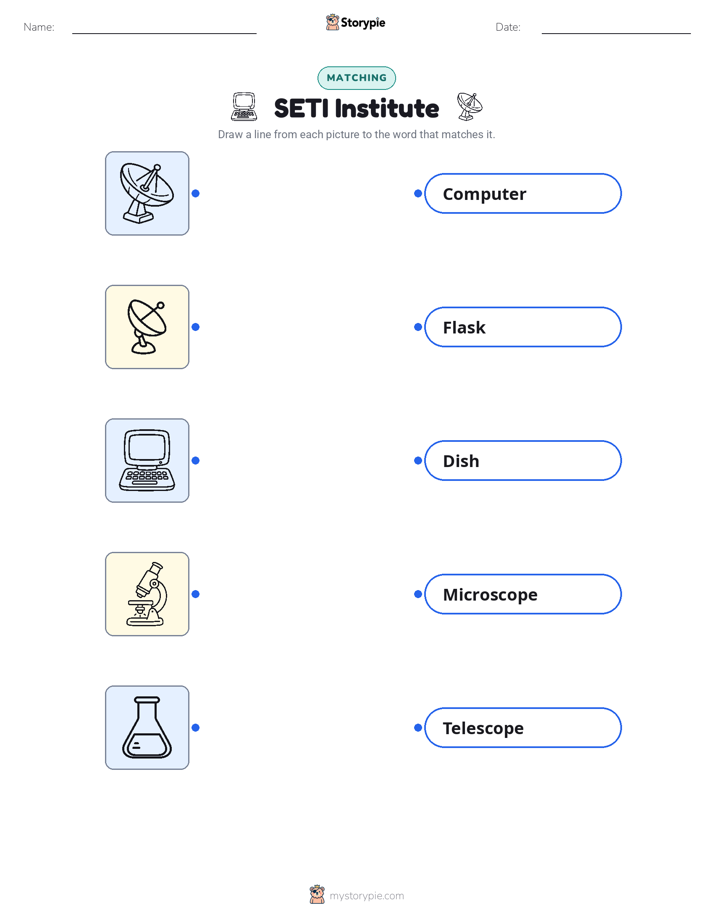
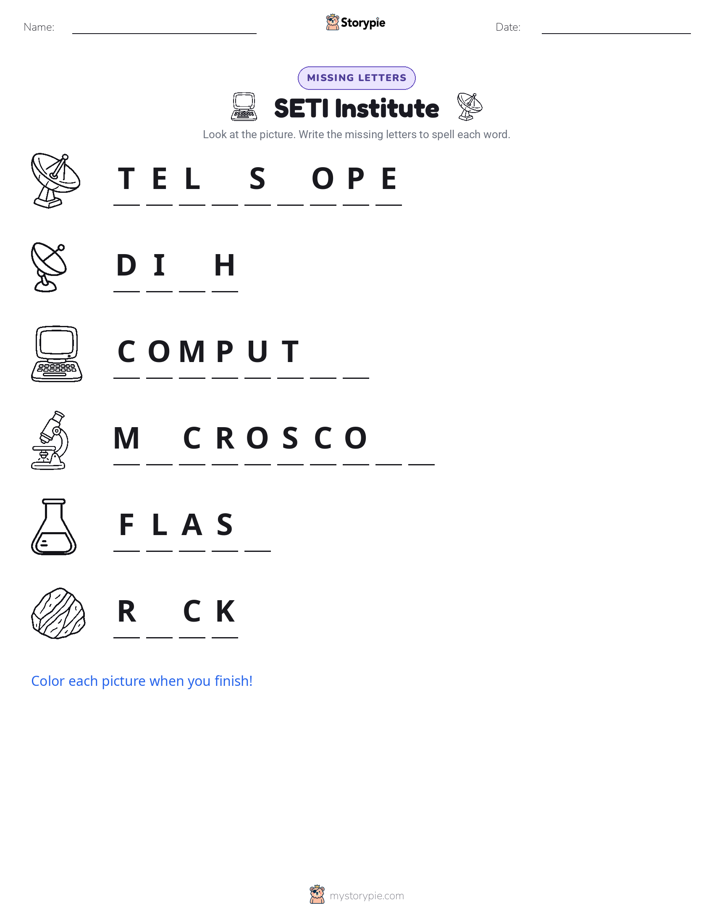
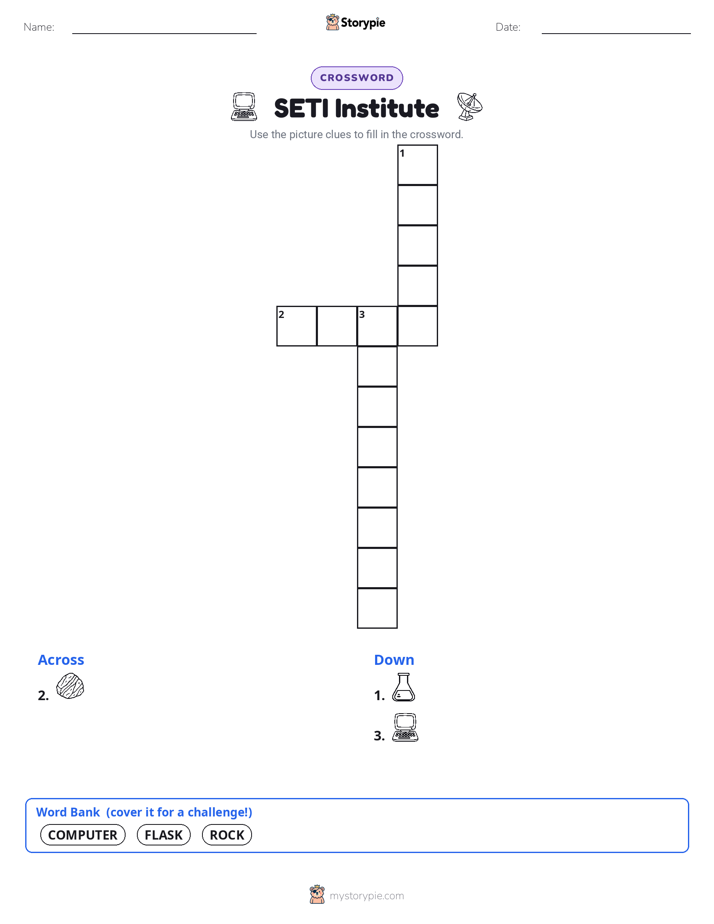
So, how do you search for life millions of miles away? Our main job is to listen very carefully for signals that might be traveling through space. To do this, we use special tools called radio telescopes. You can imagine them as our planet's giant ears, turned toward the stars. They look like enormous satellite dishes, and their job is to catch very quiet signals called radio waves that travel across space from far away. Most of what our telescopes hear is just random noise from stars and galaxies, like static on a radio. But we wonder if, hidden in all that noise, there might be a special pattern. A pattern could be a sign of technology, which might mean it’s a message from another civilization.
Our giant radio telescopes collect so much information every single day. It would be impossible for a person to listen to it all. That’s why we use powerful computers to help us with our search. These computers look through all the cosmic noise our telescopes pick up. They are programmed to search for any signal that doesn't seem natural. We tell the computers to look for special patterns that repeat or stand out from the background static. If the computers find something interesting, our scientists can take a closer look. It’s a very patient job, like looking for one special seashell on a beach covered in sand. We are always listening, hoping to find a signal that tells us someone else is out there.
A Message from the SETI Institute
Hello from Earth! We are the SETI Institute. That’s a shorter way of saying our full name, which is the Search for Extraterrestrial Intelligence. 'Extraterrestrial' is a big word that just means 'not from Earth.' Our job is to be cosmic detectives! We are scientists who search for any signs of life or technology on planets that are very, very far away from our home. We were created in 1984 by people like Thomas Pierson and Jill Tarter, who were inspired by the work of other scientists like Frank Drake. Together, they wanted to help answer one of the biggest and most exciting questions anyone can ask: are we alone in the universe? Ever since then, we have been looking to the stars for an answer.
So, how do you search for life millions of miles away? Our main job is to listen very carefully for signals that might be traveling through space. To do this, we use special tools called radio telescopes. You can imagine them as our planet's giant ears, turned toward the stars. They look like enormous satellite dishes, and their job is to catch very quiet signals called radio waves that travel across space from far away. Most of what our telescopes hear is just random noise from stars and galaxies, like static on a radio. But we wonder if, hidden in all that noise, there might be a special pattern. A pattern could be a sign of technology, which might mean it’s a message from another civilization.
Our giant radio telescopes collect so much information every single day. It would be impossible for a person to listen to it all. That’s why we use powerful computers to help us with our search. These computers look through all the cosmic noise our telescopes pick up. They are programmed to search for any signal that doesn't seem natural. We tell the computers to look for special patterns that repeat or stand out from the background static. If the computers find something interesting, our scientists can take a closer look. It’s a very patient job, like looking for one special seashell on a beach covered in sand. We are always listening, hoping to find a signal that tells us someone else is out there.
But we do more than just listen! We also want to understand what kind of life we might be looking for. Our scientists, called astrobiologists, study how life began right here on our own planet, Earth. They also look for tiny living things in some of the toughest places imaginable. They travel to icy deserts where it’s freezing cold and to the bottom of the ocean, next to deep-sea vents where hot water shoots up from under the ground. By learning how life can survive in these extreme places, we get a better idea of where life might exist on other worlds. This important work helps us know what to look for on planets like Mars or the faraway moons that circle Jupiter and Saturn.
Today, our mission to explore the universe continues. We use powerful tools like the Allen Telescope Array, which is a group of many radio telescopes working together to listen to the sky. After all these years of searching, we have to be honest: we haven’t found any aliens yet. But that doesn’t stop us, because the universe is a very, very big place. There are billions of planets out there, and we have only just started our search. Our work is to keep exploring, to keep asking big questions, and to share everything we learn with you and everyone else on Earth. The search for extraterrestrial intelligence is a great adventure, and we are excited to see what we discover next.
Wow facts
About
The SETI Institute is a non-profit research organization whose mission is to explore, understand, and explain the origin and nature of life and intelligence in the universe.
Take a Quiz
Question 1 of 4
What is the main job of the SETI Institute?
Explore next






Want to do even more?
Go beyond exploring. Unlock tools that turn every story into real learning.

Storypie Plus for families
Full stories, quizzes, and printables. Nights and car rides, sorted.
- Unlimited audio stories
- Create Mode: your child stars in the story
- Offline downloads
- Printable worksheets & coloring pages

Why Storypie for Schools
Students engaged. Prep in seconds. Evenings back to you.
- Worksheets & Quizzes
- Classroom Management
- Formative Assessment
- Custom Curriculum & Lesson Plans
- 27 Languages

Why Storypie for Homeschool
Curriculum done. They'll ask for more. Hours back in your day.
- Worksheet Generator
- First-Person Audio Stories
- Built-in Comprehension Quizzes
- Custom Curriculum & Lesson Plans
- Print & Go Activities